

Vector network analyzers (VNAs) are an integral part of the RF/microwave industry1,2 and continue to experience strong growth with a compound annual growth rate exceeding 6 percent across research and development, signal integrity, aerospace and defense and other applications.3 They are widely used for characterizing various passive, active or frequency translating devices such as mixers. Modern VNAs increasingly incorporate advanced technologies to enable faster, more accurate and more automated measurements with minimal user intervention. Anritsu’s Tensor™ VNA (Figure 1) represents a significant advancement in this field. It introduces AI capabilities, high speed measurement performance and enhanced architectural flexibility. Key features include:
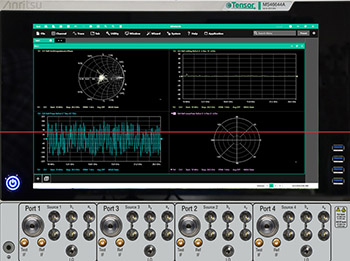
Fig. 1 Tensor™ vector network analyzer.
- World’s first AI-assisted measurement setup and optimization
- High speed data acquisition and transfer
- Dedicated source per port for improved flexibility
- Independent control of multiple sources and receivers
- True bi-static measurement capability.
APPLICATIONS
The Tensor checks all boxes for the definition of a modern, next-generation platform supporting a wide range of applications across multiple industries.
Signal Integrity. Signal integrity is one of the fastest growing market segments. The Tensor enables accurate multiport measurements for high speed digital systems and data server infrastructure. Testing more copper traces on a printed circuit board connecting modern high speed devices (such as CPU and GPU dedicated for data servers), electrical interconnects, backplanes, server cables are some examples where VNAs must be used to ensure that the signal integrity is maintained. Tensor’s scalable architecture (8 to 128 ports via switch matrices) combined with proprietary automation software enables highly accurate, repeatable and efficient measurements with excellent dynamic range.
Aerospace and Defense. As RF systems such as satellites, phased arrays and radar front-ends increase in complexity, precise characterization of individual components becomes critical. Even minor performance deviations can compromise system functionality. Active devices, mixers, high dynamic range filters and phase shifters are examples that need to be tested accurately in a speedy fashion. The Tensor VNA, with a dedicated source per port, enables simultaneous testing of multiple devices without external signal generators. Advanced features such as multiple source control allow flexible frequency configuration, significantly enhancing test efficiency and capability.
Research and Development. Research and development is always the prime market for VNAs that demands maximum flexibility. The Tensor VNA (like a Swiss knife) consists of not only pure VNA core but can be also used as a multi-output (with four independent sources) highly reconfigurable signal generator with excellent spectral purity and switching speed. This reduces the need for additional expensive instrumentation and simplifies complex test setups.
PERFORMANCE AND FUNCTIONALITY
Advances in vector network analysis fall into two categories: improvements in traditional performance metrics and the introduction of new functionality. The Tensor platform addresses both. One focus in the first group is RF power source and power handling. Both can be important for measuring power devices while the former can be relevant for even passive measurements when the test scenario (e.g., over-the-air testing, lossy fixtures, etc.) is signal-to-noise ratio (SNR) limited. In this SNR-limited case, higher source power allows one to have more headroom above the instrument noise floor when the device under test (DUT) or path losses are high. Available port powers in the Tensor instrument exceed 15 dBm at all frequencies with minimal hardware options and typically can be in that range with common hardware options selected. That source power is also of value when the VNA provides the LO for a frequency-converting DUT (the importance depends on the device technology). Source spectral purity has also been improved in terms of phase noise (by about 20 dB over a previous generation) and harmonic content. The spectral purity enhancements can be valuable when using a source as a mixer local oscillator (LO) for mmWave measurements (where the multiplication numbers can be high) and for improving general trace noise.
Power handling has increased through the use of new coupler designs (able to handle over 5 W), new receive-side step attenuators (with improved repeatability) and high linearity receivers. The receive-side step attenuators are not electromechanical, thus, they can be toggled after a calibration and the calibration will not need to be redone just because of repeatability errors, as may have happened on earlier generation instruments. For high power handling, another important aspect is the port match, which is linear for incident powers to over 20 dBm (and, again, internal or external attenuators can be used to push that level higher). Better receiver noise figures than in previous generations help to reduce the system noise floor in all configurations. Combined with higher source power, this often results in a 15 dB larger system dynamic range (depending on frequency range and configuration).
Speed is often a traditional metric of great importance and 1 MHz IF bandwidth measurement speeds (at high point count) are about a factor of five faster compared to a previous generation of instruments. Measurement speed is a multi-faceted quantity and there have also been significant improvements in CW and few-frequency-sweep measurements (10 to 20x). This latter speed aspect can be valuable for certain production and over-the-air measurements where frequency point counts per measurement may not be high, but the number of measurements required is large. Remote data transfer speed has also increased (~5x relative to a previous generation), which can be important in longer measurement campaigns and tests requiring high point counts.
Functional changes help in making measurement setup simpler, making the analysis or interpretation of data easier, or allowing different measurements or calibrations to be performed. The functional changes in this instrument family fall into several categories:
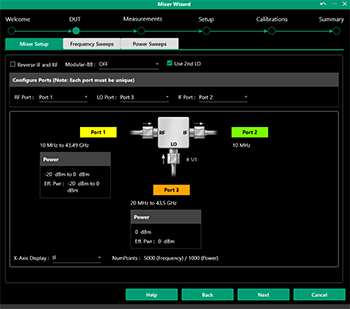
Fig. 2 Mixer configuration wizard.
- mmWave measurements (2- and 4-port) without ever needing a test set (option required, however). With this option, all of the RF and LO drive and control capabilities are added to the VNA chassis so banded mmWave measurements are possible with almost any available module (from Anritsu to 220 GHz and from other vendors up to over 1 THz). Greater source spectral purity helps to improve performance at the higher mmWave frequencies and more flexible power control simplifies setups.
- Wizards for simplifying setups and calibrations of specific DUT classes (e.g., amplifiers and mixers as shown in Figure 2). These tools walk the user through the required DUT parameter entry, measurement selection, and required calibration steps before setting up the needed channels and traces to get reasonable measurements in the most common scenarios. Of course, all of the measurements can also be manually orchestrated to get maximum flexibility and cover more complex testing scenarios.
- Amplifier measurements configurable by the wizard: small signal S-parameters, stability metrics, gain compression (including AM/AM and AM/PM), intermodulation distortion levels and intercept points as well as harmonics.
- Mixer measurements configurable by the wizard: S-parameters (match and isolation), conversion and conversion phase, conversion gain compression and LO sensitivity.
- A dynamic two-LO configuration option is available where internal LOs can be re-routed to different receivers to support more advanced mixer calibrations, multiple measurements on different frequency plans, and noise optimization in complex DUTs. Not only can either LO be used for all receivers, but each LO can also be redirected to different receivers as needed.
- A more flexible user interface where data can be organized in up to 4,096 traces using up to 512 measurement channels. The presentation can be managed through a system of display windows and tabs to allow rapid and comprehensive interpretation of results. This approach offers considerably more configurability than in earlier generations.
- A single channel can have up to 1,000,000 measurement points and the aggregate, in any one instrument setup, can have up to 3,000,000 measurement points. While this may seem like a large number, it does allow one large calibration to be used for many frequency range subsets without having to interpolate, but still maintaining frequency resolution, allows time domain and group delay analysis with simultaneously fine resolution and large alias-free range, and allows for very complex, multi-attribute measurements to be performed in one continuous sweep set.
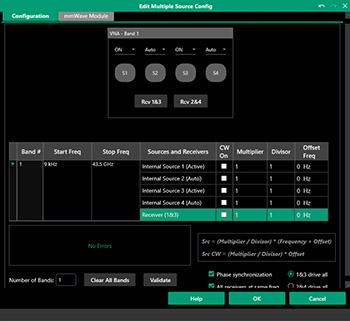
Fig. 3 Source configuration wizard.
The Tensor instrument is available in two- and four-port configurations with a variety of hardware options including direct access loops, receive-side and source-side step attenuators, a second internal LO (4-port instruments only), external ALC, external IF in and out, banded mmWave support. A diagram showing some of these configurations is shown in Figure 3. Software options include time domain processing, gain compression, several mixer measurement options, mmWave support and many others.