


ARTIFICIAL INTELLIGENCE
The Tensor VNA introduces AI-assisted measurement workflows enabling users to configure complex measurements through natural language interaction. “Hey, Tensor, can you help to set up a mixer measurement?” That’s the only thing you need to say to reveal all setup details, including a block diagram, recommended connections and settings. Once sufficient information is provided, the system automatically configures the measurement, performs required calibrations and executes the test. This significantly reduces setup time, minimizes user error and establishes a new standard for usability in advanced RF instrumentation. It is worth noting that the AI engine is inherent to Tensor, meaning it operates without any internet connection — an important advantage for certain applications.
BI-STATIC MEASUREMENTS
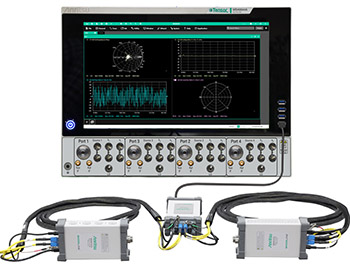
Fig. 4 Bi-static measurements setup.
The concept of bi-static measurement originates from radar systems. A traditional monostatic radar uses the same antenna to send and receive a signal, like shouting and hearing your own echo. In contrast, a bi-static radar employs two separate antennas; thus, one device transmits the signal and a different, separate device receives the reflected signal. This approach offers certain advantages, such as improved detection of stealth objects. Inspired by radar systems, the Tensor VNA adopts this approach by employing distributed transceiver modules synchronized via fiber-optic links.4 The remote transceiver modules are attached to the Tensor VNA, as depicted in Figure 4. This architecture enables large spatial separation between measurement reference planes with minimal degradation in dynamic range and phase stability. It is particularly valuable for emerging applications such as reconfigurable intelligent surfaces, where traditional monostatic or pseudo bi-static approaches are insufficient. By overcoming limitations associated with cable loss and phase instability, the Tensor platform enables new classes of measurements previously impractical with conventional VNAs.
The whole list of new features and capabilities is essentially endless. In short, the Tensor VNA combines high performance, exceptional flexibility and intelligent automation. Its advanced capabilities redefine measurement efficiency and expand the boundaries of RF and microwave testing. The integration of AI and true bi-static measurement capability represents a significant step forward in vector network analysis.
References
- R. A. Witte, “Spectrum and Network Measurements,” Noble Publishing, 2001.
- C. F. Coombs, “Electronic Instrument Handbook,” McGraw-Hill, Third Ed., 1999.
- Frost & Sullivan, www.frost.com.
- D. Bradley, A. Chenakin, J. Borrill and J. Martens, “Method for Improved True Bi-static Radar Cross Section Measurements,” patent pending.