


Modern wideband phased array systems require spectral agility, multi-function operation and stringent size, weight, power and cost (SWaP-C) performance across platforms, including airborne electronic warfare (EW) suites and satellite payloads. Direct RF sampling architectures meet these requirements by eliminating intermediate-frequency conversion stages. However, they also introduce challenges in interference rejection, anti-aliasing and channel-to-channel consistency. This article examines how silicon-on-insulator (SOI) tunable bandpass filters address these challenges. These filters are essential for multi-element digital beamforming arrays. The article also examines the integration of SOI filtering with III-V power amplifiers in heterogeneous multi-chip front-end modules. This integration enables compact, tileable transmit/receive modules that provide wideband agility and high EIRP while meeting strict size and power constraints. Together, these technologies are key to the next-generation of electronically scanned arrays operating from 2 to 18 GHz and beyond.
Modern Phased Array System Architecture
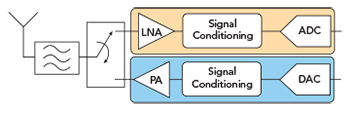
Fig 1. Direct sampling RF front-end architecture.
More vendors now offer multi-channel transceivers for direct RF sampling in phased array systems, see Figure 1. This simplifies the construction of scalable, multi-antenna setups for modern beamforming. Removing traditional mixing stages and components, such as local oscillators and mixers, streamlines the RF hardware. As a result, size, weight, power and cost decrease. The smaller footprint, lower power consumption, reduced heat and lower channel cost are particularly important for space- and power-constrained platforms, such as airborne EW suites, satellite payloads and mobile radar systems. Combining various RF front-end device types further enhances these benefits. Wideband systems require careful design because engineers must handle both a broad frequency range and very wide instantaneous bandwidths, often several gigahertz per channel. These large bandwidths present several challenges, such as:
- Managing high data rates from giga sample per second (GSPS) converters
- Mitigating aliasing and spurious signals across Nyquist zones
- Ensuring precise multi-channel phase-coherence and deterministic latency
- Implementing effective anti-aliasing preselection without compromising bandwidth.
Flexible RF System Design
For applications requiring real-time spectrum analysis, software-defined radios (SDRs) have become the preferred platform due to their exceptional flexibility. Unlike traditional fixed-architecture radios, SDRs execute core functions such as modulation, demodulation, filtering and frequency translation in the digital domain using programmable software and high speed hardware. SDRs support fast waveform updates, work with multiple standards and can run multiple channels simultaneously, from handheld devices to airborne or shipboard systems. Tunable filtering is essential in these systems to accommodate the varying operational environments.
In phased array systems, mismatched filter responses introduce amplitude and phase errors. This degrades beamforming accuracy, geolocation precision or multi-channel correlation. Repeatability and phase/amplitude consistency across channels are equally vital, as they directly minimize system calibration overhead and ensure reliable performance across multi-element arrays or coherent receiver chains. SOI tunable filters can achieve this through precise digital control, on-chip temperature compensation, pre-alignment during manufacturing and closed-loop calibration routines. These routines compensate for process variations or environmental drift. They often reduce calibration time from minutes to seconds or eliminate the need for frequent recalibration.
Interferers may be out-of-band, such as strong adjacent-channel or co-site signals that cause compression or intermodulation distortion, or in-band, including co-channel jammers or pulsed threats within the instantaneous bandwidth. The ability to dynamically reposition the passband or implement a notch filter is an important mitigation strategy. By shifting the filter center frequency, adjusting the bandwidth or switching to a band-reject mode via software control, the SDR can suppress threats in real time. This approach enables tracking of frequency-agile jammers or removal of narrowband interferers while preserving the integrity of the desired signal.
Electronic Warfare Wideband Systems
In the fast-evolving field of EW, systems operating across the 2 to 18 GHz frequency range have become foundational to modern wideband phased array hardware development. This broad octave-spanning band strikes an effective balance between favorable propagation traits (relatively low atmospheric attenuation and reasonable antenna sizes) and the capacity to support high-resolution sensing, high data-rate signal processing and powerful waveform generation. These capabilities enable a wide array of critical EW functions, including electronic attack (jamming and directed-energy disruption), electronic support (signal interception, direction finding and emitter geolocation) and electronic protection (countermeasures against threats while preserving friendly communications and radar performance).
- Finer angular resolution due to shorter wavelengths, which enable narrower beamwidths and more precise beam steering
- Reduced susceptibility to certain types of interference and jamming
- Enhanced support for ultra-high bandwidth applications such as synthetic aperture radar imaging, multi-beam communications and advanced electronic attack techniques.
Wideband systems are evolving and becoming more common. They now cover both the traditional 2 to 18 GHz range and extend into mmWave bands in modern phased arrays. This growth is driven by the need for more flexible frequency use and multi-function operation. Demand for smaller, lighter and more efficient systems to handle advanced threats also drives this growth. These systems represent a key transition toward more versatile, software-defined and digitally enabled EW capabilities. As the hardware matures, the difference between wideband and ultra-wideband will diminish. This allows platforms to adjust dynamically to contested environments.
SOI Tunable Filter Characteristics
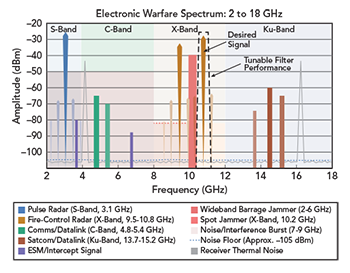
Fig 2. EW spectrum with wanted and unwanted signals.
In dense electronic environments, such as the contested electromagnetic spectrum in EW, high-selectivity filtering is essential for discriminating between closely spaced emitters that may differ by only a few MHz, see Figure 2. Traditional fixed or switched filter banks often lack the agility or resolution needed to isolate these signals without crosstalk or calibration complexity. This leads to degraded accuracy in emitter identification or direction finding. High-selectivity tunable filters address this by providing sharp skirts and narrow instantaneous bandwidths when needed, and rapid digital retuning to track frequency-agile or hopping threats in real time. This improves system performance in busy spectra. It enables reliable detection, classification and localization of multiple signals simultaneously while blocking strong interference that could overload the receiver.