


There are various physical, chemical and biochemical methods of solid or liquid food analysis that have evolved to identify the quality and quantity of contaminants or adulterants (i.e., impurities) in food. Most of those methods, however, are time-consuming, expensive, laborious and difficult to access. They also require expert food analysts. In water and liquid food products, adulterants or contaminants are dissolved and cannot be detected or isolated easily. The experimental procedure demonstrated here seeks to reduce these challenges. It detects food impurities in liquids using microwave radiation by observing changes in the transmission coefficient. In this work, pure double-toned milk is used as the liquid food product under test along with three different types of adulterants (detergent, starch and water). Adulterants blended in concentrations as low as 0.03 percent by weight of fresh milk are effectively measured. The method is low-cost, contactless and scalable.
According to a 2015 World Health Organization (WHO) report on the estimates of the global burden of foodborne diseases, an estimated 600 million, almost 1 in 10 people in the world, fall ill after eating contaminated food, and 420,000 die every year. Children under 5 years of age carry 40 percent of the foodborne disease burden, with 125,000 deaths every year. Therefore, food poisoning and foodborne diseases have a very adverse effect on the society and economy of a nation. The first step to improve this situation is to incorporate proper methods of detecting any impurities in food products before marketing them for sale.
Food products are contaminated voluntarily or involuntarily while undergoing industrial processing, preservation and packaging. To reduce food loss and improve food safety, the food business must detect various types of impurities.1
Prior to the marketing and sale of food products in India, samples are tested by food testing laboratories and quality control laboratories established by the Food Safety and Standards Authority of India (FSSAI), as well as by certain commercial food testing laboratories. To determine the kind and amount of impurity, a variety of physical, chemical and biological methods of analysis have been developed; however, these methods are time-consuming, costly, labor-intensive, difficult to obtain and require skilled food analysts.
Mass spectroscopy, gas chromatography, liquid chromatography, near-infrared (NIR) chromatography, hyper-spectral imaging and X-ray imaging are some of the currently used food testing techniques. These require sophisticated equipment and modern technology. In addition to these methods, several chemical tests on food components are employed to detect foreign substances. There are only a small number of food testing laboratories available in India with these capabilities, and they are limited to areas close to large cities.
This work focuses on the detection of impurities in liquid food products. It is generally easier to identify adulterants in solid food products. In water or liquid food products, impurities dissolve, making them more challenging to isolate and identify.
Measurements are performed using milk as the liquid food product. Milk is a balanced food containing most of the necessary nutrients; it is a staple for children, sick and elderly people. If milk and milk products are contaminated or adulterated, then a considerable percentage of the population is impacted.1
Milk is found to be adulterated with detergent, starch and other substances by merchants, wholesalers and retailers for monetary benefit. Additionally, water is intentionally added to increase volume without cost before sale. A national survey on milk adulteration conducted by the FSSAI in 2011 revealed that detergents, skimmed milk powder and impure water are found in about 70 percent of the milk consumed in India, which is similar to other developing nations as well.2
One such adulterant is starch, which is usually added to increase the solid non-fat milk content. Excessive amounts of starch in milk remain undigested and are reported to cause threatening diseases like diarrhea.3,4 Furthermore, high levels of starch accumulated in the body may be fatal for diabetic patients.
Adulterated milk does not provide necessary nutrients and might result in other health issues such as migraines, vision problems, hypertension, kidney stones and even death.5-7 After the Chinese milk crisis in 2008, in which infant milk products were adulterated with melamine to boost nitrogen content, milk adulteration has been highlighted as a global concern.8 Therefore, the rapid and accurate identification of adulterants in milk is essential for quality control and food safety assurance.
Generally, mixing impurities in a liquid modifies its dielectric properties. Microwave sensors using split ring resonators (SRRs) and complementary SSR technology have been proposed to measure the concentration of contaminants in fluids by sensing changes in their dielectric properties.9-14 These techniques, however, demand high-precision sensors and typically require contact with the liquid under test.
Other methods have been explored to determine the percentages of adulterants in milk. Sadat et al.15 used the electrical conductance of sampled milk, but controlling this condition in the market is difficult. Durante et al.16 proposed the measurement of the electrical impedance property of sampled milk for real-time detection of bovine milk adulteration. Here, as well, contactless measurement is not possible.
The experimental procedure described in this work overcomes the challenges of the previously mentioned techniques. It demonstrates the detection of impurities present in liquid food products using microwave radiation. Because the presence of impurities in a liquid food product changes its dielectric properties, the reflection and transmission of incident microwave radiation change as well. Measured data reveal characteristic changes in a liquid’s transmission coefficient magnitude (|S21|) for specific types of food products and impurities. Moreover, this provides the benefit of being a contactless measurement technique.
METHODOLOGY
This is based on the principle that variations in a material’s dielectric constant or relative permittivity measurably influence its transmission characteristics at microwave frequencies. When a microwave signal within a specific frequency band propagates through a material, its transmission depends on the material’s dielectric constant.17 The transmission coefficient (S21) of electromagnetic radiation passing through two materials (in this case, air and liquid) is governed by Equation 1:

where, η1 and η2 are the intrinsic impedances of the air and liquid media, respectively.
The intrinsic impedance of a medium is given by Equation 2:

where μ is the permeability and εr is the permittivity (ε=εo εr) of the medium.
As εr in the liquid increases, η2 decreases, which in turn reduces |S21|. According to Maxwell’s equations and Fresnel’s transmission theory, |S21| is inversely related to the dielectric constant of the medium. As permittivity increases, the intrinsic impedance (η2) of adulterated milk decreases, leading to a higher absorption of incident microwave radiation. Adulterants, such as water, starch or detergent added to pure milk alter its dielectric properties by increasing εr. The increase in each case is monotonic with the increased percentage of adulterant.18 Therefore, adulterants in milk result in decreased microwave signal transmission, which is measurable.
In this work, pure double-toned milk from Anand Milk Union Limited (AMUL) is the material under test and different types of adulterants are added in separate experiments. Each of the materials under test has a distinctly different dielectric constant. When compared to pure milk, the reflection and transmission characteristics of the adulterated milk are different as well. Based on this principle, pure double-toned milk is distinguished from the adulterated forms.
MEASUREMENT SETUP AND PROOF OF CONCEPT
The measurement setup is shown in Figure 1. A thin, flat plastic 25 cm × 16 cm × 3.3 cm3 container containing the liquid under test is suspended between two 8 to 12 GHz horn antennas. |S21| is measured with a Rohde and Schwarz ZNB 20 VNA. Note that these measurements are performed without the use of an anechoic chamber in an uncontrolled environment. The goal of this work is to demonstrate the ability to measure the percentage of adulterants or contaminants in a location outside of a laboratory where the surroundings are uncontrolled or natural. A handheld VNA and X-band horn antennas are portable. They can be easily carried and set up in any location. This may result in some variability in the data over frequency, which can be fit to a smooth curve, as shown in Figure 2.
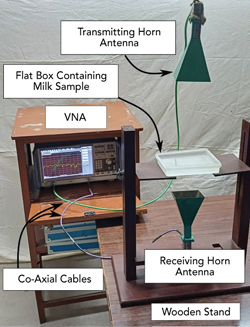
Figure 1 Test setup.
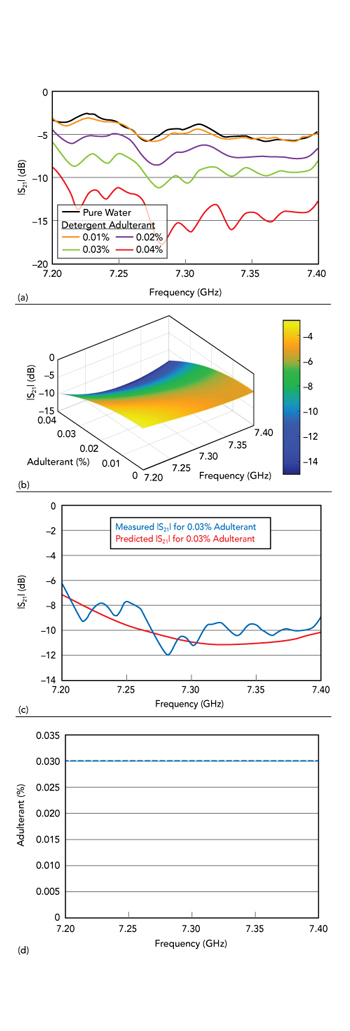
Figure 2 Measured |S21| of detergent in water (a), predicted |S21| (b), measured and predicted |S21| for 0.03 percent adulterant (c) and predicted concentration for a given |S21| (d).
Prior to the measurements of adulterants in milk, an experimental trial is carried out using distilled water as the solvent and detergent as the adulterant. Detergent powder having a weight/volume ratio (weight of detergent/volume of water) from 0.01 to 0.04 percent is added consecutively to the distilled water. |S21| is measured for the different detergent concentrations. For these measurements, the depth of the sample liquid is 1 cm.
Measured |S21| of detergent as an adulterant in pure water versus frequency is plotted in Figure 2a. Using the sample data points of transmission coefficients, |S21| as a function of frequency and adulterant percentage is derived (see Figure 2b). Figure 2c shows predicted transmission coefficients from the function compared with measured transmission coefficients for a 0.03 percent concentration of detergent in distilled water. By comparing the measured transmission characteristics with the pre-trained reference curves, the adulterant concentration in the test sample is quantitatively estimated and predicted based on the measurement of |S21| (see Figure 2d).
Because measurable decreases in |S21| versus frequency are observed with an increasing percentage of detergent in pure water, similar measurements are carried out with milk and different types of adulterants.