

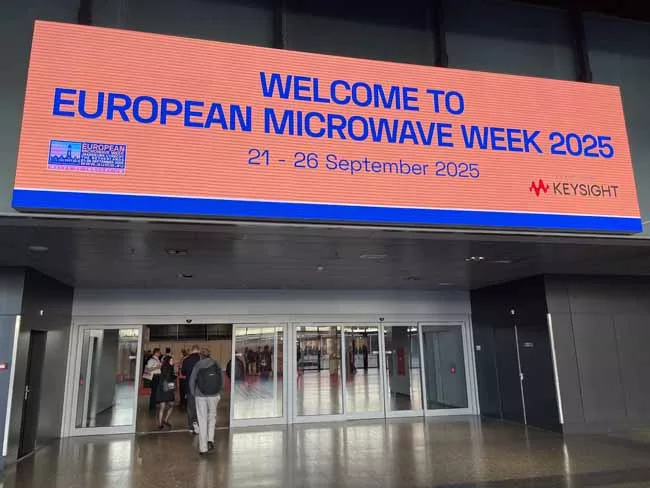
The 28th edition of the European Microwave Week took place in Utrecht, continuing the annual series of highly successful microwave events that started back in 1998. In 2020, the event was moved from Amsterdam to Utrecht for the first time, but was canceled due to the pandemic, so this will be the first year it takes place in Utrecht, which is conveniently located just outside of Amsterdam. As always, EuMW 2025 is made up of three co-located conferences: the European Microwave Conference, the European Microwave Integrated Circuits Conference and the European Radar Conference.
In addition, EuMW 2025 includes the Defence, Security and Space Forum; Automotive Forum; 6G Forum; and a large exhibition. EuMW 2025 provides the opportunity to participate in conferences, workshops, short courses and special events such as Women in Microwave Engineering. It is Europe’s version of IMS and the largest microwave event on that continent. The forums set this event apart from others enabling device/component companies to exchange technical information and network with systems companies unlike other events like IMS. The quality of the delegates is also very high and this year was a new record for exhibition space.
Here is a link to our Picture Gallery and Video Channel for EuMW 2025.
During the show, we found the following highlights from companies:
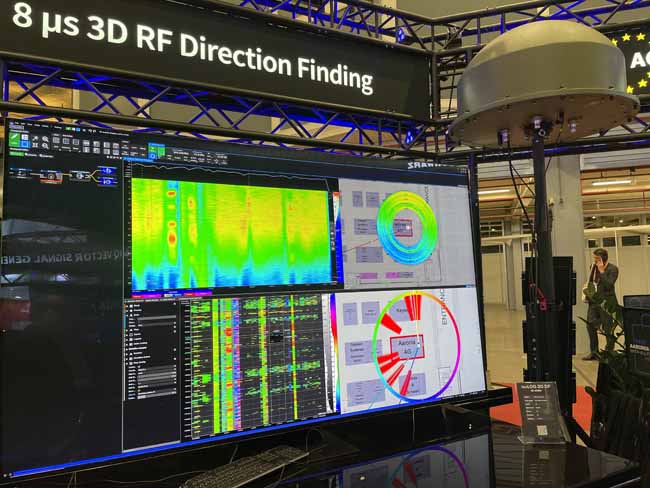 Aaronia showed the fast, USB-based SPECTRAN® V6 solutions at the largest booth, B026, directly at the main entrance of EuMW. With a real-time bandwidth of up to 490 MHz and a sweep speed of 3 THz/s, the SPECTRAN® V6 Xplorer is the new reference in terms of speed. Equipped with waveguide connections, the analyzer allows measurements in the millimeter wave range that are not possible with conventional cables. In order to fully exploit the performance of the SPECTRAN® V6 real-time spectrum analyzers, they also presented their broadband antenna range. Included are the brand new PowerLOG® horn antennas up to 70 GHz, as well as the real-time DF solutions based on the improved and further developed IsoLOG® DF DF and tracking antenna. Also on display were the new IsoLOG® DF 16-10180 with a frequency range of 1 to 18 GHz and the IsoLOG® DF 16-20400 with a frequency range of 2 to 40 GHz.
Altum RF showcased its featured products and technical expertise at the event. Company leaders were in the booth to answer questions about specific products, roadmaps and their decades of experience designing and delivering RF, microwave and mmWave semiconductors. With over 40 GaAs and GaN MMICs from X-Band to over 100 GHz, Altum RF featured several products, including new components for satcom, telecommunication (with E-Band), radar and test and measurement markets.
AMCAD showcased three live demonstrations focused on RF transistor modeling, test and measurement and high-voltage GaN characterization:
- RF Power Amplifier for Test and Measurement: A reliable solution for RF labs, presented in a live setup to highlight performance in real conditions.
- AM3200 Pulse IV System with Focus Tuners and MPI Probe Station: A complete workflow for RF transistor modeling, including pulsed IV and S-parameter measurements. The demo showed how the system improves measurement speed and modeling accuracy.
- High-Voltage GaN Pulsed IV with the AM3242 Probe: Dedicated to GaN power device characterization, with robust and precise pulsed IV measurements at high voltage.
Amphenol/MicroCoax has delivered high-reliability RF solutions trusted worldwide. ARACON® fiber provides strong, lightweight EMI shielding for demanding applications. UTiFLEX® assemblies deliver excellent phase stability, flexibility and low-loss performance in harsh environments. Semi-rigid coaxial cables offer precision, effective shielding and unmatched electrical performance for high-frequency needs. Together, these product families ensure signal integrity and reliability across aerospace, defense and airframe, where performance and durability are critical.
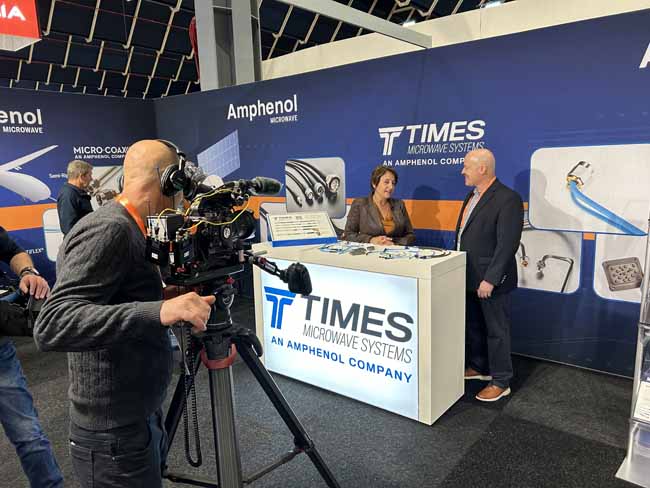 Amphenol/Times featured the M8 multi-port connector system, designed for high-performance environments and qualified to meet the demanding transmission line assembly specifications of MIL-T-81490 and MIL-C-87104, offering excellent shielding and phase stability with low VSWR and insertion loss up to 20 GHz. The M8 interconnection system easily survives harsh environments where high vibration, shock, temperature and humidity can cause cable and system performance degradation. The interconnect system is presently used on a number of airborne applications and has logged hundreds of thousands of flight hours. PhaseTrack cable assemblies are designed for applications demanding minimal phase change over temperature. All PhaseTrack cables use a proprietary TF4™ dielectric that does not have the abrupt shift in phase that occurs with solid- or tape-wrapped PTFE-based products under normal room ambient temperature conditions.
ANTENNEX team members gave multiple talks at EuMW and had two in-booth demos, demonstrating the technology driving their test chambers and the different use cases for their products. One of the ANTENNEX demos demonstrated the advantage of the ANTENNEX test chamber to measure mmWave spectrum, while the other demo showcased the chamber’s ability to measure noise figure. ANTENNEX also had a live demo during the 6G Forum on Monday. Members from ANTENNEX gave scientific talks titled “Mastering Accurate and Practical Over-the-Air Characterization Techniques from Passive to Active Antenna Systems” on Sunday and “Over-the-Air Testing of Front-End Losses in Active Array Antennas” on Thursday. Anouk Hubrechsen, CEO of ANTENNEX, attended and moderated the Entrepreneurship in RF event, emphasizing ANTENNEX’s success and continued growth in the industry.
Anyfields featured their EMBox Lab, a compact and modular hardware platform for RF education. The RF Source (2.3 to 2.6 GHz) is reliable and has a safe signal generation for real-world experimentation. The starter pack includes turnkey lab exercises and three antennas.
ATEK Midas showcased their high-performance analog, mixed-signal ASICs and RFICs at EuMW, along with their various MMICs and modules. ATEK Midas utilizes different semiconductor technologies, including SiGe, BiCMOS, RF CMOS, SOI, GaAs, GaN and InP, and had company leaders in the booth to discuss COTS and bespoke solutions with customers and prospects.
Blueshift introduced PhaseBlue® 1500, the first product in its Series Circuit Materials (SCM) line. These latest laminates are engineered with a proprietary nanoporous polyimide aerogel core composed of 85 percent air and 15 percent polyimide, enabling an unmatched combination of light weight, flexibility and high-frequency performance. As a U.S.-made and sustainably compliant material that meets modern environmental standards (formulated without intentionally added per- and polyfluoroalkyl substances), PhaseBlue® addresses growing regulatory and environmental concerns while delivering a next-generation alternative to PTFE-based substrates. PhaseBlue® SCM offers a dielectric constant (Dk) of 1.3 to 1.5 at 1 GHz and an ultra-low dissipation factor (Df) of <0.001 at 1 GHz. Unlike conventional perfluorinated substrates, PhaseBlue® maintains stable dielectric performance across a wide frequency range (1 to 10 GHz) without exhibiting the ‘dielectric knee’ that compromises signal reliability under high temperatures. PhaseBlue® is up to 80 percent lighter than conventional laminates with a density of 0.27 to 0.45 g/cm³. Its thin profile, available in dielectric thicknesses from 0.0065 to 0.030” (165 to 750 µm), provides engineers with flexible, formable solutions ideal for 3D structures, conformal antennas, phased arrays, radomes, CubeSats, UAV systems and high-speed aerospace communications. The material also integrates with existing FR-4 PCB processes (DES, drilling, etchback), allowing engineers to adopt it without special equipment or costly process changes.
Cadence displayed how next-generation wireless modules require optimal IC/package interconnect design, thermal/ electromagnetic (EM) analysis and seamless IC/package co-design. They showed how Cadence Virtuoso Studio RF platform accelerates RFIC/MMIC design, heterogeneous integration, and RF analysis of your Virtuoso design IP. In their latest white paper, see how they’ve redefined what’s possible in RF design with:
- Concurrent RF/physical design entry
- Spectre simulation/optimization
- In-design EM and thermal analyses
- Seamless co-design across silicon, laminate and system domains
CML Micro displayed high-performance RFICs, MMICs and advanced microwave technologies at the event. These included:
- MMA-495930-Q4 – High Linearity MMIC Power Amplifier: A high-performance GaAs HFET MMIC amplifier covering 4.9 to 5.9 GHz delivering robust output power and high linearity. It is ideally suited to radar, satellite and communications applications requiring reliable broadband amplification.
- MGA-445940-02 – Hybrid GaN Power Amplifier: A high-reliability GaN-PA optimized for 4.4 to 5.9 GHz, offering output power of 10 W, perfect for mission-critical radios and defence communication systems.
- CMX90A007/CMX90A009 – High-Efficiency Power Amplifiers: Compact, high-efficiency power amplifiers designed for mission-critical systems, with output power up to +40 dBm and efficiency exceeding 60 percent, suitable for tactical radios, UAV data links and secure communication networks.
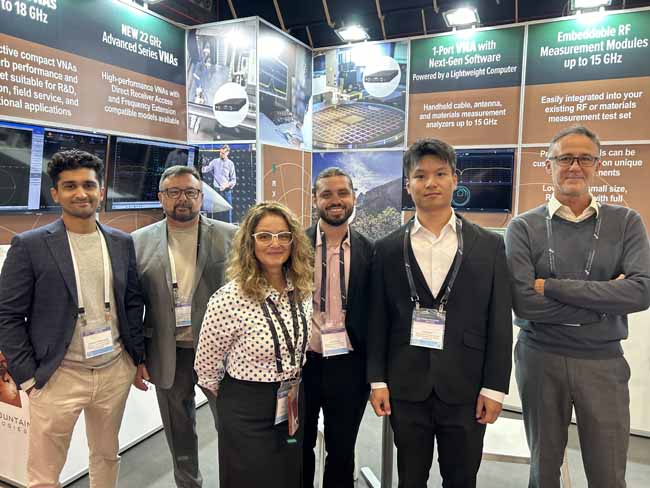 Copper Mountain has introduced the 1.5 GHz VTR0102 and 3.5 GHz VTR0302 VNAs that are value-priced 2-port 1-path vector network analyzers designed for common S11 and S21 measurements, making them ideal for testing antennas, filters, amplifiers, transmission lines and cables. In addition to running on Windows or Linux operating systems on a PC, laptop, tablet or x86 board single-board computer, the VNA software will execute on ARM processors, so a Raspberry Pi can be used to operate these VNAs. Advanced Series VNAs from Copper Mountain Technologies are available in four configurations: the A2202 base model, A2202-Fx frequency extension compatible model, A2202-D Direct Receiver Access (DRA) model and A2202-DFx model offering both DRA and frequency extension compatibility. For users requiring precision mmWave measurements, the A2202-Fx and A2202-DFx models from the new Advanced Series offer a cost-effective solution, delivering accurate S-parameter measurements and seamless compatibility with our frequency extenders for exceptional value. They deliver an impressive dynamic range of 130 dB and ultra-fast sweep speed as low as 12 µs/point, with all the advanced software features engineers have come to expect included standard in our software.
dSpace demonstrated a new radar solution for functional testing of radar sensors. The DARTS ARROW has been specially developed for use in end-of-line tests and periodic technical inspections (PTI) of radar-based driver assistance systems. The compact radar target simulator is efficient and easy to use, and simulates the range, speed and radar target cross-section of a radar target in dynamic scenarios.
The new solution covers a frequency range from 76 to 81 GHz and offers a customizable bandwidth of up to 5 GHz. It enables the simulation of distances up to 500 m in steps of less than 7 cm and at speeds of ±700 km/h. Depending on the application, the front-end can be configured as monostatic or bistatic. This makes the robust and cost-effective system ideal for validating safety-relevant driver assistance systems such as emergency braking, lane departure warning and distance control assistants. By realistically simulating traffic scenarios under controlled conditions, sensor errors can be detected, and the functionality of safety-critical assistance systems can be ensured over the entire lifecycle.
Emerson/NI announced the signing of an agreement with Vrije Universiteit Brussel (VUB) to advance wideband characterization methods for active electronically scanned array (AESA) systems. This joint effort aims to accelerate innovation, improve test coverage and reduce risks for industries adopting next-generation AESA technologies, including aerospace and telecommunications. AESA architectures are rapidly transforming radar, communications and navigation systems, driving the need for more sophisticated and real-world-relevant test methodologies. To address this demand, Emerson will work with VUB to develop innovative approaches for wideband characterization of RF and microwave components and subsystems used in AESA systems. As part of the collaboration, Emerson is providing NI PXI test hardware and vector signal transceivers (VST) instruments to VUB. These tools enable multichannel, high-fidelity signal generation and analysis, allowing researchers to validate component behavior under realistic wideband conditions. This joint effort aims to accelerate innovation, improve test coverage and reduce risks for industries adopting next-generation AESA technologies.
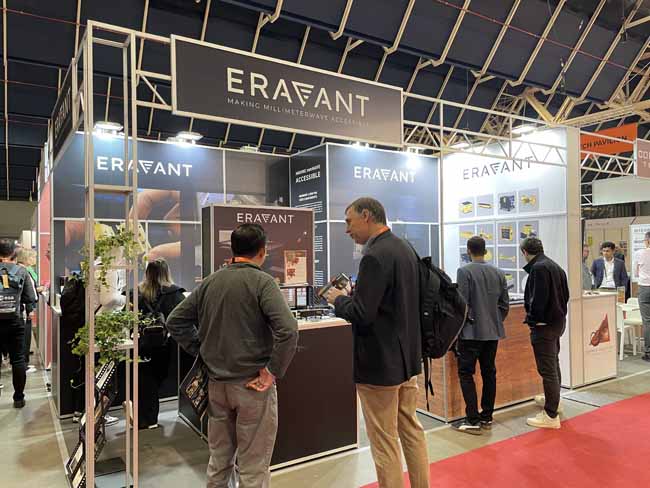 Eravant showcased its new ACCESS compact frequency extender alongside the new ACCESS synthesized signal generator paired with the Rohde & Schwarz VNA, demonstrating 120 dB dynamic range and extended coverage from 67 to 116 GHz. The demo also featured Eravant’s hybrid dual-function attenuator, combining manual and programmable control in a single compact unit. Despite its compact size, the attenuator offers fine manual adjustment via a precision knob, motorized operation through a standard USB interface and the convenience of a rechargeable internal battery. Eravant’s booth also demonstrated its ACCESS portfolio, custom and specialty assemblies, advanced antenna solutions and an extensive range of COTS products designed for fast turnaround and dependable performance.
ERZIA announced the launch of a new line of COTS RF microwave amplifiers engineered specifically for new space missions, addressing the industry’s demand for faster delivery and cost efficiency without compromising performance. The current lineup includes 13 new COTS RF amplifiers designed for satellite and payload manufacturers, SmallSat developers and commercial space integrators operating in LEO, MEO and CIS-Lunar orbits. Each amplifier delivers best-in-class RF performance while incorporating enhancements that make it flight-ready for next-generation missions. ERZIA’s New Space COTS line has been engineered to meet the toughest mission demands, featuring radiation-tolerant circuitry valid up to 30 Krad and 32 MeV for proven resilience in space environments. Each unit is built with vacuum-compatible housings and integrated depressurization structures to withstand rapid decompression, while outgassing-compliant materials ensure compliance with mission standards. Leveraging automotive-grade components, the products are prepared for rigorous thermal, vibration and acceleration environments. Every delivery includes, by default, a complete acceptance test report at three temperatures with the option for additional screening upon request.