

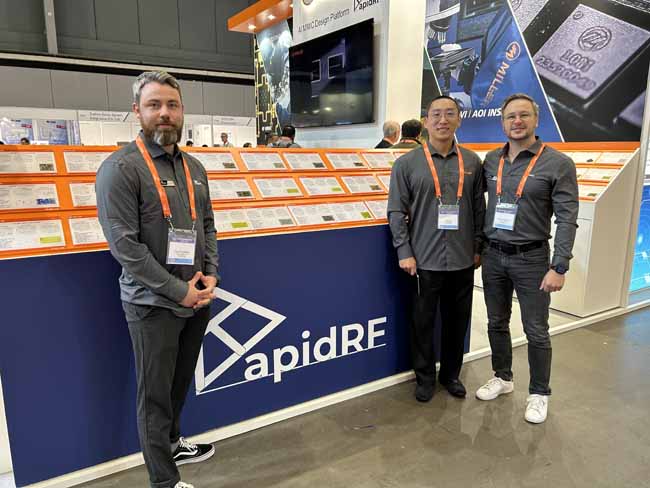
 RapidRF AI showcased its groundbreaking platform for AI-driven RFIC design generation. Visitors experienced how they could enter their requirements at the booth touchscreen and receive comprehensive design reports for tapeout-ready RFICs within less than an hour. RapidRF’s online platform enables customers to generate custom RFICs tailored to their unique specifications, powered by the first-of-its-kind AI-driven design generation technology. As a leader in this field, RapidRF is redefining the speed and accessibility of RFIC design. The company also introduced a new service for end-application customers who typically do not design MMICs themselves. This service covers the entire process—from tapeout to fabrication, dicing and testing—delivering custom ICs at highly competitive costs while ensuring customers retain full IP ownership for greater independence and faster development. In addition, RapidRF teased upcoming AI-driven tools and future capabilities, signaling even more disruptive innovations ahead.
Reactel featured its full line of filters, multiplexers and multifunction assemblies covering up to 67 GHz. Reactel attended the event alongside its BeNeLux partner, Semi Dice International. Their booth showcased Reactel’s miniature line of high-performance filters for SWaP-sensitive applications. Supporting military, aerospace, commercial, Future-G and research needs, Reactel can design a unit that is right for you. From small, lightweight units suitable for flight or portable systems to high power units up to 25 kW, connectorized or surface-mount, large or small quantities – Reactel’s talented engineers can design a unit specifically for your application.
RFHIC featured the RRT951005K0-570 transmitter that is designed for the high-power radar application at 9500 to 10000 MHz. The RRT951005K0-570 is designed for use in maritime, surveillance and weather radar transmitters. The RRT951005K0-570 transmitter replaces industrial magnetrons and other vacuum tubes, which are currently used in high-power applications. RRT951005K0-570 transmitter is designed with a forced air cooling system. Also, the RRK20405K0-680 uses GaN transistors and is designed for high-power radar applications at 2000 to 4000 MHz. This solid-state transmitter allows users to upgrade the existing VED (vacuum electronic device, such as klystron, magnetron, travelling wave tube and cross-field amplifier) based transmitter for radar platforms.
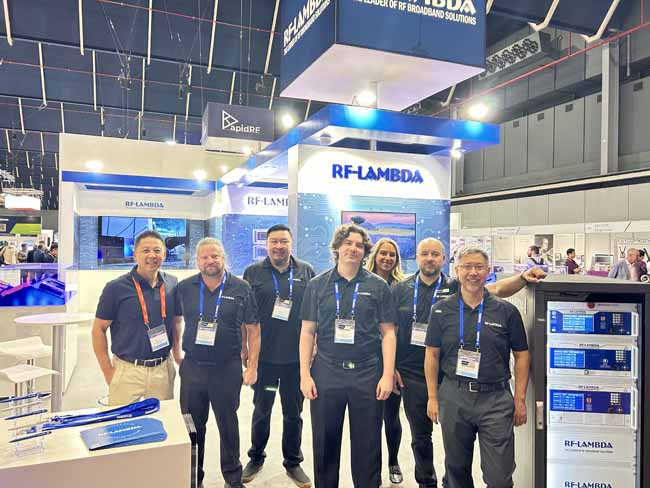 RF-Lambda designs and manufactures high-power, solid-state, broadband AC-powered EMC power amplifiers. As an AS9100 and ITAR registered company, they deliver the highest-power EMC solutions available globally, with frequency and power ranges of:
- 2 to 6 GHz up to 1000 W CW
- 6 to 18 GHz up to 800 W CW
- 18 to 40 GHz up to 400 W CW
Their amplifiers incorporate state-of-the-art features, including built-in protection, automatic calibration, over-temperature protection, antenna VSWR detection and remote operation with integrated signal generators. These solutions are widely deployed across defense, aerospace, satellite communications (Starcom and Starlink), 5G/6G infrastructure and the automotive industry—underscoring RF Lambda’s commitment to advancing technology for the most demanding environments.
RFMW featured a wide range of solutions from their various partners, including high-power amplifiers, advanced RF switches, beamformers, filters, attenuators, timing solutions and broadband connectivity components for radar, SATCOM, test, communications and defense applications. RFMW had members from Qorvo, Smiths Interconnect, Marki Microwave, CML Micro, Menlo Micro, Nuvotronics, Guerrilla RF, Micross Hi-Rel RF Solutions, TTM Technologies, Quarterwave, Pasternack, dB Control, ED2 Corporation, Spectrum Control, Finwave Semiconductor, Inc., Knowles Corporation, Ampleon, pSemi, Empower RF Systems, Axiro Semiconductor and SiTime.
In the RFMW booth, various companies highlighted products. Axiro Semiconductor highlighted the F6413 and F6415, part of the company’s TRx beamformer family. SiTime showcased the SiT7910, part of SiTime’s Endura™ line of ruggedized timing solutions. Ampleon shared the ART4K0FX, a compact, high-power RF module designed for CW operation at 13.56 MHz. Empower RF Systems showcased the Model 1212, a rugged solid-state broadband power amplifier operating from 2 to 6 GHz. Spectrum Control highlighted their ultra-miniature, high-Q lumped element filters. Finwave shared the FW2001, a broadband, high-power SPDT switch covering 30 MHz to 12 GHz. Knowles Corporation highlighted the B100RH4S, a compact, high-performance bandpass filter covering 2 to 18 GHz. Guerilla RF presented the GRF6402, a versatile 7-bit digital step attenuator operating from 50 MHz to 6 GHz. ED2 Corporation highlighted the ED2-0023 StingArray™, a compact surface-mount phased array module operating from 26.5 to 29.5 GHz. Marki Microwave showcased the new MPD4-0218CSP3, a 2 to 18 GHz MMIC 4-way power divider housed in the company’s ultra-compact CSP3 package. Menlo Micro highlighted several high-performance switch solutions, including the new MM5625 differential loopback switch, which is a derivative of the popular MM5620. The MM5625 increases supported data rates to over 80 Gbps and offers a flexible configuration for asymmetric bus testing. CML Micro showcased its expanding portfolio of GaN and GaAs RFICs and MMICs for secure, satellite and defense-grade communications, including the CMX90A009, a high-efficiency, 10 W power amplifier operating across 136 to 1000 MHz. Qorvo shared X-Band radar products, including the QPF5001 and beamformer ICs, such as AWMF-0221. Quarterwave highlighted the UWB Aora, a high-precision omnidirectional antenna designed for angle-of-arrival (AoA) localization in ultra-wideband applications. dB Control/Charter Engineering displayed the dB-9006, a high-performance microwave synthesizer that covers 100 MHz to 27 GHz with a 1 Hz resolution. Nuvotronics showcased a selection of PolyStrata® components, including the μMUX Suboctave Multiplexers, which are designed for compact EW and SIGINT platforms and available in 3-, 4- and 5-channel versions covering 2 to 40 GHz. TTM Technologies presented the XMB0465Z1-50100G, a compact 50 to 100 Ω transformer designed to meet the tight electrical and mechanical requirements of modern broadband RF systems. Smiths Interconnect featured their TSX series chip attenuators, thin film attenuators with outstanding RF performance from DC to 50 GHz and available in compact 0604 and 0404 packages. pSemi showcased the PE42447, a high-performance UltraCMOS® SP4T switch that covers 10 MHz to 8 GHz. Micross highlighted the KS03R2-22, a rugged SPDT PIN diode switch capable of handling up to 200 W from 20 MHz to 3 GHz. Finally, RFMW announced a new partnership with Pasternack and featured their high-performance RF cable assemblies designed for test and measurement, wireless infrastructure and military and aerospace applications.
RIGOL introduced the RSA6000 Series Real Time Spectrum Analyzer with real-time analysis bandwidth of up to 200 MHz, sweep speed up to 4 THz/s, phase noise as low as -108 dBc/Hz at 1 GHz and DANL as low as -163 dBm. It operates from 5 kHz to 26.5 GHz. It has five modes in one instrument: RTSA, GPSA, VSA, EMI and ADM.
Rogers featured their RO4830 Plus laminates that are woven-glass-free thermoset dielectric materials with a stable dielectric constant and low insertion loss, as required by RF designers for mmWave automotive radar sensors. The design dielectric constant of RO4830 Plus laminates is approximately 3.03 at 77 GHz (microstrip differential phase length method). The combination of Rogers’ low-loss thermoset resin system and very low profile electrodeposited copper foil translates to a very low insertion loss of 1.5 dB/inch for 5 mil laminates, as measured by the microstrip differential phase length method. They also featured RT/duroid® 5280LZ filled PTFE composites, reinforced with woven fiberglass, and engineered for precise stripline and microstrip circuit applications that demand dimensional stability throughout PWB processing. The unique filler results in a low-density, lightweight material for high-performance, weight-sensitive applications. The very low dielectric constant of RT/duroid® 5280LZ laminates is uniform from panel to panel and is constant over a wide frequency range. Its low dissipation factor extends the usefulness of RT/duroid® 5280LZ laminates to Ku-Band and above. It has a Dk of 2.06 or 2.10, depending on the glass and a dissipation factor of 0.0028 at 10 GHz.
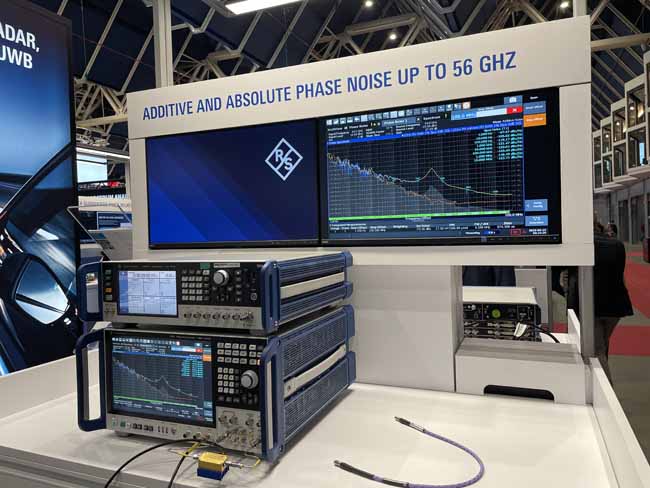 Rohde & Schwarz held a European debut in their booth during the EuMW, with the newly introduced FSWX signal and spectrum analyzer. The FSWX took center stage, featured in a variety of demo setups. This game-changing analyzer overcomes the limitations of today’s measurement methods with its novel architecture that combines multiple input ports with cross-correlation techniques.
Additional demonstrations at the booth included a novel approach for wideband modulated load pull, addressing the growing need to verify wideband RF frontends across varying impedances as seen when connected to multi-band antennas. This solution, based on the R&S RTP oscilloscope and the R&S SMW200A vector signal generator, enables rapid wideband signal capture, essential for such applications.
Rohde & Schwarz also presented the R&S ZNB3000, its latest vector network analyzer, optimized for high-volume production and short ramp-up times. Offering industry-leading measurement speed and reliability, the R&S ZNB3000 is designed for rapid upscaling and easy adaptation to application-specific requirements. With the highest dynamic range and output power in its class, as well as future-ready performance, it supports next-generation technologies.
Rohde & Schwarz also presented wideband measurements in the sub-THz range, featuring the new FSWX signal and spectrum analyzer and the R&S SFI100A wideband IF vector signal generator combined with the new R&S FC330ST/SR frequency converters. The signal generator generates signals with up to 10 GHz RF modulation bandwidth, while the frequency converters up- and down-convert intermediate frequency (IF) signals to and from the RF frequency range of 220 to 330 GHz, known as the H-Band. The FSWX supports an IF range of up to 35 GHz, enabling the analysis of ultra-wideband signals. The cross-correlation mode improves the EVM performance of the FSWX significantly by removing the instrument-inherent internal noise.
An eye-catcher at the booth was a THz measurement system using photonic techniques for ultra-wideband high-frequency characterization. A photodiode converts an optical beat signal – generated by lasers at slightly different optical frequencies – into an electrical signal through photomixing. Both lasers are locked to a frequency comb, enabling the generation of ultra-stable, narrow-line THz signals. This approach, explored in projects like 6G-ADLANTIK, not only supports 6G data transmission but also facilitates the development of test and measurement systems for phase-sensitive characterization across a wide frequency range, which is essential for THz metrology, next-generation communications, material analysis and non-destructive testing.
Rohde & Schwarz is at the forefront of supporting the automotive industry’s transition to autonomous, connected and electrified vehicles. The AREG800A target generator, together with the R&S ATS800R CATR chamber, which now covers automotive radar frequency bands from 76 to 81 GHz, is used for validating automotive radar sensors in a cost-effective way. The solution enables chipset developers, Tier 1 automotive radar manufacturers and OEMs to electronically create complex traffic scenarios and ensure advanced driver assistance system (ADAS) functionality.
Rosenberger had experts at EuMW showcasing their solutions in test and measurement technology. They showcased calibration standards for lab use and field use, showing versatility. Rosenberger also had a large display on quantum control and readout technology, showcasing SMPS connectors in their high-density wiring scheme.
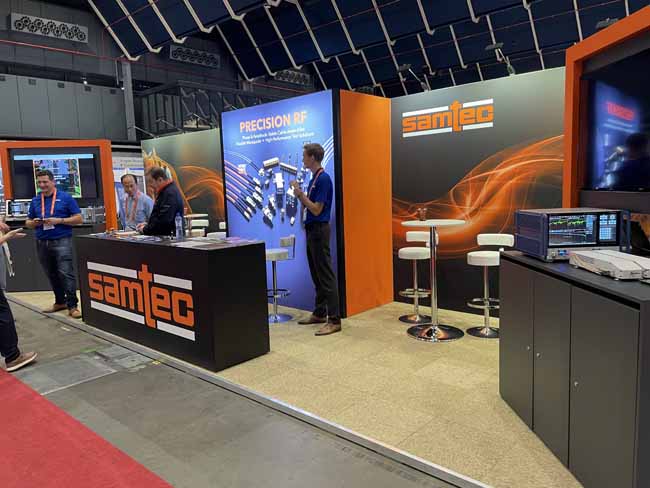 Samtec had experts onsite and displayed their cable and connectorized solutions, including Nitrowave phase and amplitude stable cable assemblies, Bulls Eye® high-performance test systems, ganged multi-port RF blocks and cable assemblies and glass core technology.
Smiths Interconnect, a leading provider of technically differentiated electronic components, microwave, optical and radio frequency products, and a business of Smiths Group plc, featured demonstrations that consisted of:
- Thermopad® temperature variable attenuators with patented technology replacing costly, complex active temperature compensation alternatives
- Mini-Lock ultra-high-reliability RF cable assembly with patent-pending technology operating up to 110 GHz
- LightABLE-RF™ and SpaceABLE-RF™ RF-over-Fiber (RFoF) capability utilizing an 850 nm VCSEL over multimode fiber, enabling new lows in SWaP-C.
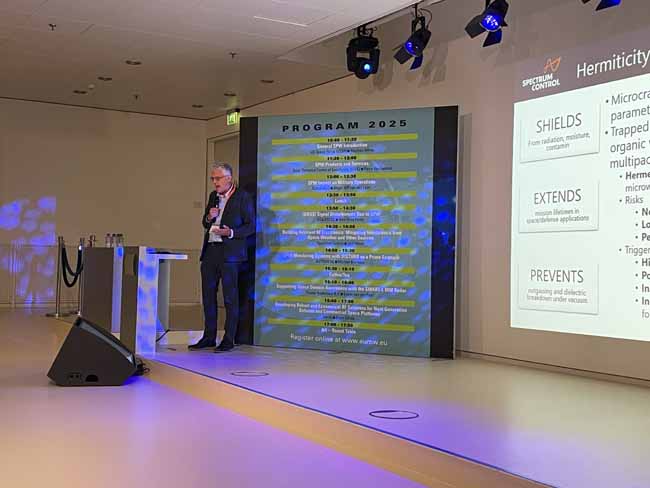 Spectrum Control featured their software-definable RF+ system blocks, which reduce the size and complexity of today's RF and digital systems with:
- Miniaturization and integration
- Software-instrumentation
- Dramatically reduced cost and development time
- No performance tradeoffs.
SPINNER is enabling engineers, researchers and manufacturers to fully leverage the capabilities of the new 0.5 mm connector system for measurements up to 250 GHz, with a comprehensive range of premium test accessories. The portfolio includes high-end adapters, cable connectors, PCB connectors and more. SPINNER GmbH collaborated with Keysight Technologies, Inc. to develop the new 0.5 mm test accessories. To ensure maximum versatility, SPINNER also offers specialized adapters from 0.5 mm to 0.8 mm, giving 0.5 mm users access to the established 0.8 mm ecosystem for applications where 167 GHz is sufficient. Pushing the limits, SPINNER enables customers to harness the full physical potential of the 0.8 mm connector system up to 167 GHz — backed by fully traceable calibration and verification kits, connector gauges, adapters, cable connectors, PCB connectors, rotary joints and more.
SWISSto12 announced the opening of a new facility in Madrid, Spain. The expansion will accelerate SWISSto12’s capabilities in developing advanced satellite payloads and user terminal systems. This buildout of a facility in a new region signals the company’s continued growth, with this investment into a Spanish footprint complementing SWISSto12’s other facilities in Switzerland, Europe and the United States. SWISSto12’s growing Spanish team, comprised of experienced engineers and architects of satellite payloads, antenna technologies and satellite systems, plays an important role in the company’s development of phased array antennas for both satellite payloads and ground terminals, as well as supporting the development and execution of the HummingSat product line. This office in Madrid also provides proximity to some of SWISSto12’s key industrial partners, suppliers and customers in Spain.
Tagore was featuring their SPDT 10/50 W peak power switches operating from 500 MHz to 12 GHz. They have low insertion of .3 to .8 dB and high isolation of 20 dB at 10 GHz. Switching time is 50 ns with no power derating, with power consumption less than 1 mW.
TMYTEK demonstrated their latest 5G/6G testbeds, radar and SATCOM innovations, supporting applications from research labs to real-world deployment. These included:
- 5G/6G OTA Testbed – True mmWave radio transmission, supporting FR2 up to 44 GHz and FR3 up to 30 GHz
- Scalable MIMO Testbed – Multiple 8×8 dual-polarized phased arrays, supporting SISO, 2×2 and 4×4 MIMO with <1 µs beam switching
- Tileable RIS for NLOS Coverage – Multi-band models (3.5/4.7/28 GHz) designed to boost signal strength and minimize dead zones
- Ku/Ka-Band FlatSATCOM Antenna – ESA and waveguide array technology, optimized for multi-orbit LEO/MEO/GEO, multi-band and defense applications.
United Monolithic Semiconductor (UMS) had over 20 products on display, including LNAs, drivers and PAs for satcom uplinks and downlinks and their brand new, unreleased GH10-10 V-band product for space and other harsh environment applications. Stay tuned for more news on the GH10-10; it was a show exclusive, and more info will be released soon! UMS also showcased its fully automated backend capabilities, including on-wafer test, automatic inspection, dicing, picking, die-attach and finished package test. An in-booth video animation showcased their digital twin test capabilities for on-wafer tests, available to all UMS foundry customers. It demonstrated the digital twins’ ability to produce statistical data visualization in real time. In addition to the exhibition, UMS was involved in the technical talks, including “GH10-UMS 100 nm GaN Technology” in the session on mmWave GaN.
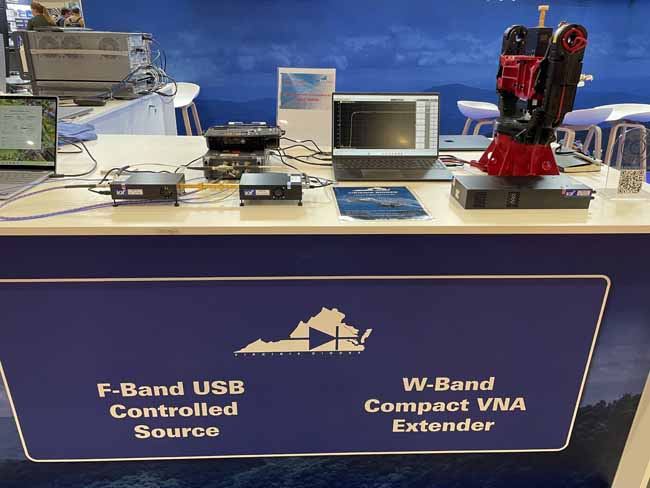 Virginia Diodes, known for their mmWave and THz equipment, made a splash at EuMW with a variety of high-frequency demos. They collaborated with a variety of partners for the demos, including Keysight, Mini-Circuits, Focus Microwaves and Maury. The demo highlights included a D-Band active load pull with wideband modulated signals, 300 GHz dual polarization OTA link, compact W-Band VNA extenders with high test port power and a collaboration with Mini-Circuits. VDI and Mini-Circuits demonstrated a high-frequency signal generator capable of sweeping from 90 to 140 GHz with flat output power. The advanced signal source operates in the F-Band frequency range and supports a wide range of emerging technologies. The demonstration highlights the potential of this solution to enable ultra-high-speed wireless networks for 6G, enhanced augmented and virtual reality experiences, high-resolution imaging, non-invasive sensing for medical and security applications and high-bandwidth wireless interconnects within data centers.
WAVEPIA released a new 32 to 37 GHz GaN MMIC power amplifier with a typical small-signal gain of 22.6 dB for communication, SATCOM and radar systems. It has a typical power gain of 16.8 dB, a typical output power of 45.4 dBm and a typical PAE of 19.7 percent at 28 to 32 V operation.