

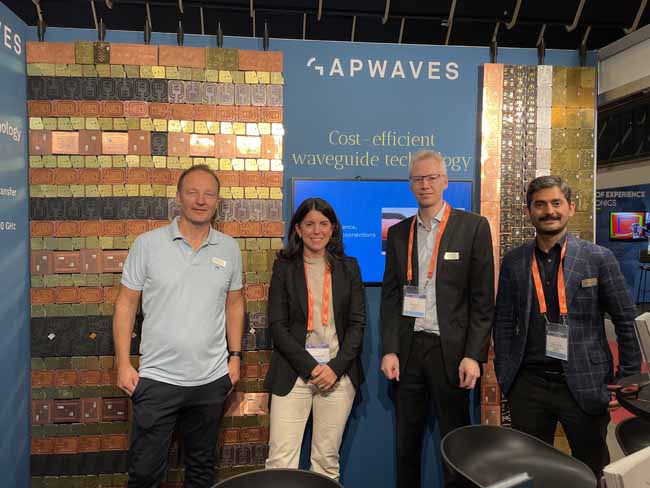
 Gapwaves showcased their latest waveguide technology, including their antenna wall of fame, complete with over 700 gap waveguide antennas, filters and connectors. The booth also included live product demos and Gapwaves Studio, a series of 9 minute in-booth presentations, including “Compact mmWave filters: optimizing for cost and performance”, “Agile pattern shaping with embedded lens-in-radome” and “Contactless interconnects: repeatable testing to robust system integration”. Gapwaves also had partner Sensrad in the booth, showcasing the Hugin D1 4D imaging radar and the Oden system.
In addition to their exhibition, Gapwaves team members hosted the keynote session at EuMC and gave a poster presentation at the Automotive Forum. Gapwave’s EuMC keynote session was titled “Passive Components, Active Innovation: Gap Waveguide Technology for Next Generation Millimeter Wave Circuits,” and the poster was entitled “Lens Integrated Radome for Modular Sensing Performance”.
Garlock WavePro showcased its wide variety of dielectric materials at EuMW. They had a variety of experts on site to discuss COTS and custom products for high-power, high-frequency and harsh environment applications. They also announced the opening of a new facility. Check out the video WavePro recorded with MWJ for more information.
Greenray Industries featured their T32 Series TCXO, which has been developed in an ultra-small 3.2 x 2.5 mm package. It can survive extremely high pyrotechnic shocks while providing very low acceleration sensitivity. The T32 operating temperature covers the full MIL range of -55 to +125 °C while holding a frequency stability of only ±1.0 ppm. Typical applications include telecommunications, high-shock electronics, mobile radio, mobile instrumentation, airborne communications, wireless communications and microwave receivers.
HUBER+SUHNER launched the SENCITY Urban 300, the latest addition to the indoor/outdoor directional antenna range, boosting the options for wireless operators and installers looking for high data throughput in a compact size in the 5G frequency range. The growing number of smart mobile devices is challenging the capacity of wireless networks. Small cell and distributed antenna systems are expected to play a key role in boosting network density, which allows wireless systems to support more users and faster speeds. This will improve coverage on city streets and in buildings such as airports, train stations, shopping malls and sports stadiums, which are otherwise difficult to reach using traditional macro cells.
Intelliconnect featured their Q-CON high-density cryogenic connector for quantum computing, medical and research applications, which provides reliable transmission of critical signals at very low temperatures. It features compact and simple connectivity up to 24 ways, with attenuators available to suppress thermal noise. They also featured their EZ-86-NbTi 50 Ω semi-rigid low-loss coaxial cable for quantum computing, featuring niobium-titanium center and outer conductors. Manufactured in the U.S., it offers reliable performance and supply chain security. The cable features a 0.086" diameter semi-rigid NbTi outer conductor, NbTi centre conductor, and PTFE dielectric. The Pisces range of waterproof RF connectors, providing a wide range of IP67 and IP68 waterproof/harsh environment connectors, is ideally suited to many applications, including mil-aerospace, SCADA, marine, medical, transportation and oil and gas. The series also features coaxial adaptors to facilitate inter-series connection, and they are waterproof when unmated due to an internal seal. Other products on display included RF connectors and adapters, RF cable and cable assemblies, a range of low-loss cables, the EzForm range of raw cable and assemblies and a selected range of samples from the Trexon Global group of companies.
JFW has added four new models that are 2-channel programmable attenuators with USB control. Each model consists of two individually controlled programmable attenuators. They are designed into a small benchtop enclosure with four SMA female connectors and one USB port. Each USB-controlled attenuator ships with test software. JFW also has a Python library (jfwusb.py) that allows their USB attenuators to be integrated into test scripts. Contact JFW’s engineering department for the Python library and examples.
Junkosha introduced their latest microwave/mmWave coaxial cable assembly solution capable of transmitting from DC to 250 GHz. As the first solution of its kind, the new 0.5 mm connector cable “MWX0A5” represents a unique capability in the marketplace, placing Junkosha at the forefront of high-frequency cable innovation for the demands of probe stations and test setups for advanced chips, especially those designed for AI accelerators. Developed from a blank slate collaboration with Keysight Technologies, MWX0A5 is engineered to meet the needs of engineers working at the limits of high-frequency testing for applications including semiconductor devices in AI-related chip characterization and emerging THz research. While no device under test (DUT) currently features a 0.5 mm interface, Junkosha’s latest 250 GHz interconnect lays the foundation for the next generation of mmWave measurement systems at the heart of the future’s highly sophisticated systems.
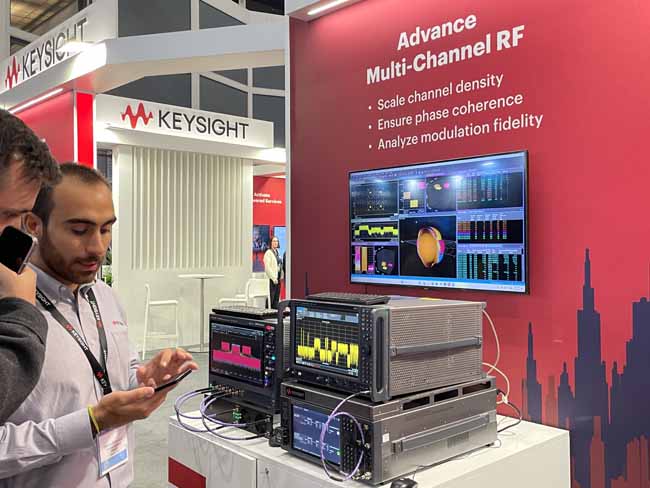 Keysight Technologies demonstrated cutting-edge solutions that accelerate RF and mmWave innovation across space, defense, automotive, broadband wireless, IoT networks, 5G and 6G applications.
- Keysight’s versatile VNA portfolio enables engineers to simplify linear and nonlinear device testing, minimize external equipment, prevent setup errors and scale to meet their specific needs. This demo showed how to extract a digital twin of an RF front-end operating under varying antenna loads.
- The new NA5307A frequency extender for the PNA-X Network Analyzer showed how compact and lightweight broadband frequency extension modules expand the frequency range of a PNA-X Network Analyzer, enabling fully calibrated broadband, single-sweep S-parameter measurements from 100 kHz / 10 MHz to 250 GHz.
- Keysight’s advanced phase noise testing demo showed techniques that deliver the sensitivity and frequency coverage needed for today’s high-performance RF and mmWave systems.
- Another demo showed how signals can be generated to simulate a virtual satellite flyover with arbitrary orbital parameters and real-life radio link conditions, including multipath fading and orbital kinematics. The demo showcased the validation of 5G NTN link handovers with real-time protocol analysis and testing to 3GPP standards.
- Another demo showed realistic radar and EW environments in the lab and range with Keysight’s advanced platforms. They generate dense signal environments with pulse descriptor word (PDW) streaming, create complex scenarios, simulate targets in real time and customize them through open software. These capabilities enable rigorous assessment and optimization of systems under demanding conditions.
- The last demo showed how to detect and flag activity, geolocate in real time and record/replay IQ data with Keysight’s advanced spectrum management tools. Analyze 5G NR signals with demodulation and KPI insights, plus show the FieldFox portfolio in action — featuring spectrum analysis to 170 GHz, the first handheld real-time spectrum analyzer (RTSA) for mmWave.
In addition to the exhibition hall, Keysight had a strong presence at the conferences, including hosting the welcoming events and giving a number of talks. Keysight talks included “When and How AI Meets 6G – Innovations, Challenges, and Future Directions” at the 6G Forum, “Measuring and Modeling Power Amplifier Performance under Varying Antenna Loads Using Wideband Active Load-pull (WALP)” in a workshop, “Linear Propagation of Uncertainty in Probe Position Compensated Multiline-TRL” during the On-Wafer Forum, “A Reliable 2nd-tier Procedure for Characterizing Devices with N+1 Ports Using an N-Port VNA” at EuMC and “Digital Twin Creation Using CLEAN for Radar Target Emulation” at EuRAD.
MathWorks had several demonstrations that highlight how MATLAB and Simulink support the design and simulation of advanced RF and wireless systems.
- Antenna-to-Bits: RF System Design from Antenna to Bits Model and simulate wireless communications and radar systems from antenna to bits, including large antenna arrays, RF transceivers, PCB boards, data converters, DSP algorithms and control logic. Learn how to build a digital twin to evaluate propagation scenarios and explore implementation tradeoffs.
- OFDM-Based Radar Sensing with USRP Radios Perform range-Doppler processing using a custom OFDM waveform transmitted via NI Ettus USRP E320 radios. MATLAB controls the signal loopback and bistatic processing, with visualizations showing target motion and algorithm performance.
- Satellite Communications: Modeling Non-Terrestrial Networks (NTNs) Simulate LEO satellite constellations, onboard antennas, signal propagation channels and receiver architectures. Discover the value of integrated modeling for next-generation SatCom systems.
MathWorks and Modelithics announced the launch of the new Modelithics Library for MATLAB, featuring Microwave Global Models™ for nearly 28,000 components from over 30 leading suppliers. These models integrate with RF Toolbox™ in MATLAB to support the design of filters, matching networks, amplifiers and more.
 Maury has acquired many companies, leading to a broad range of product offerings. They had many demos, including a D-Band phase measurement system based on the Maury HA7162D, which features cross-correlation. This standard feature enables the reduction of uncorrelated sources of system noise, such as that in the frequency extender, the local oscillators and the internal components of the phase noise analyzer. Another demo using the VRLP methodology provides S-parameter measurements and active load pull in the WR6.5 waveguide band (110 to 170 GHz) on a waveguide-connectorized amplifier, featuring Maury NT series tuners and the powerful InsightPro software. Another demo showed the new Maury Pulsed IV measurement system that allows IV characterization from DC to Pulsed IV of 200 ns. The setup supports gate sweeps from -30 to 30 V up to 1.5 A and drain sweeps from 0 to 28 V up to 40 A.
Maury Microwave interconnect solutions encompass a broad range of products designed to reduce measurement uncertainties and improve measurement accuracy and repeatability. Cable assemblies offer high flexibility and phase stability. The range of available adapters includes calibration-grade metrology adapters, color-coded precision adapters that combine high-performance with ease-of-identification and adapters that feature a quick-connect design with a push-on/pull-off capability. Color-coded precision coaxial attenuators reduce signal power without adding distortions, while additional testing tools span connector gauge kits to torque wrenches. Maury now supplies SSPAs up to 2 kW and up to 98 GHz for TWT replacement.
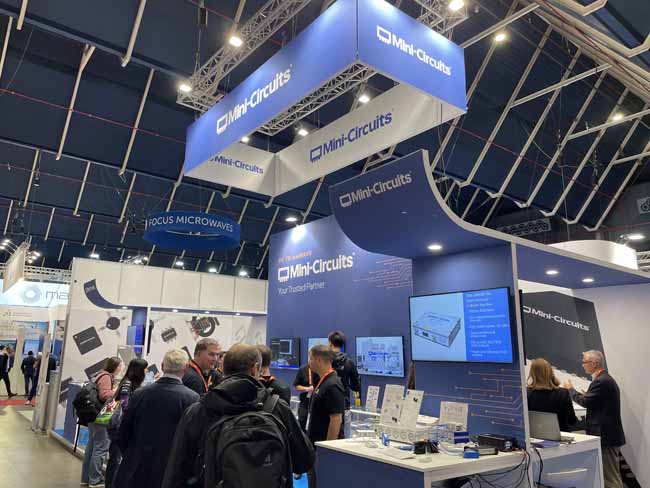 Mini-Circuits had interactive demos and product displays showcasing their latest MMICs, uCeramIQ passives, high-frequency modules, test solutions and accessories and filter technologies. They had a variety of demos throughout the booth, including a test bench created for small spaces and small budgets. Notably, Mini-Circuits and Virginia Diodes, Inc. had a joint demonstration of a high-frequency signal generator capable of sweeping from 90 to 140 GHz with flat output power.
MPG featured a compact, high-performance microwave tuner that features front-end preselection and multi-frequency conversion to reject unwanted signals within a 1 GHz wide instantaneous bandwidth at the lower intermediate frequency for easier processing of complex modern wideband radar signatures. It offers performance comparable to larger superheterodyne receivers and is ideal for ESM/ELINT applications. Standard SOSA-aligned open VPX architecture offers a scalable, modular design for scalable systems, optimizing performance, reducing costs and ensuring high-speed data transfer. It has a wide RF Input (0.5 to 18 GHz), high resolution (1 MHz), NF of 14 dB (typical), 1 GHz wide instantaneous bandwidth, 50 dB 2-tone SFDR and a phase coherent multichannel configuration option available. It is suitable for advanced ELINT, SIGINT and RESM operations.
Gruppo Pasquali, comprising Pasquali Microwave Systems, Vega Composites, RTW, Galvanica Pasquali and Pasquali Microwave USA, showcased their full RF product portfolio at EuMW, including bespoke materials, antennas, radomes and waveguide test and measurement components. Pasquali focuses on defense and space applications and had a team of experts at the booth to answer questions and share their technology. They also hosted their partner, Merlinhawk Aerospace, in their booth.
Pickering Interfaces announced a major expansion to its range of standard COTS LXI microwave switching solutions. The five new RFIU families provide the building blocks required to address a vast number of demanding RF testing applications. Previously available as customer-specified flexible (60 to 890) and turnkey (60 to 891) custom products, the product introductions cover new catalog offerings of two different variants of LXI microwave switch units—the company’s standard LXI range, consisting of multiple relays of a single type fitted to the unit’s front panel, and specific configurations of internally constructed, fully integrated multiplexer and matrix solutions. Making them standard COTS catalog parts simplifies the selection and ordering process for customers, as well as reduces lead times.
 Qorvo announced the release of a Ku-Band beamformer IC designed to meet the growing demand for terminals that support TDD in compact and power-sensitive SATCOM applications. TDD architectures enable a single antenna array to be used for both transmit and receive, reducing system size and complexity, enabling low-profile, electronically steered terminals. This new device expands Qorvo’s SATCOM portfolio, building on the company’s March launch of Ku-Band FDD beamformer ICs to offer a complete and scalable solution for both TDD and FDD terminal architectures. This new TDD solution is ideally suited for terminals in LEO constellations for airborne or mobile platforms, where power, performance and cost are critical. The AWMF-0247 supports Ku-Band operation from 13.75 to 14.5 GHz in transmit and 10.7 to 12.75 GHz in receive, enabling full compatibility with current and emerging SATCOM networks that require compact, electronically steered array architectures. It integrates transmit and receive functionality into a single device, providing significant efficiency and signal quality improvements. The AWMF-0247 reduces receive array power by 40 percent while improving signal clarity by over 20 percent and offers up to 5x greater transmit efficiency compared to competing solutions. Even in situations where EIRP efficiencies are similar, Qorvo achieves them with a significantly smaller die area, enabling easy integration and cost-effective terminal designs.
Quantic Electronics showed how its innovative solutions are enabling mission-critical applications. They displayed solutions from Ohmega Ticer, Planar Monolithics and X-Microwave, including:
- Modular RF & microwave building blocks: Accelerate your design, evaluation, prototyping and production cycles—faster, easier and at lower cost, with the X-Microwave modular design platform.
- Custom RF & microwave components and subsystems: Trusted solutions for mission-critical performance across military, communications, commercial and consumer markets.
- High-performance thin film embedded resistor foils: Explore OhmegaPly®, TCR® and TCR EHF®—industry-leading solutions for embedding resistors into RF, digital and specialty application PCBs.