We use cookies to provide you with a better experience. By continuing to browse the site you are agreeing to our use of cookies in accordance with our Privacy Policy.
The U.S. Department of Transportation’s National Highway Traffic Safety Administration announced that it is going to create a formal path forward for vehicle-to-vehicle communication for light vehicles. This means that NTHSA will start regulatory proposals on how this technology could become mandatory in the future.
The U.S. Army Tank-Automotive Research, Development and Engineering Center (TARDEC) and Lockheed Martin have demonstrated the ability of fully autonomous convoys to operate in urban environments with multiple vehicles of different models.
The U.S. Air Force has awarded Lockheed Martin more than $200 million in contract options to complete production of its fifth and sixth next-generation Global Positioning System satellites, known as GPS III.
Rohde & Schwarz has expanded the functionality of its R&S FSV and R&S FSW signal and spectrum analyzers to also support the IEEE 802.11p wireless standard. The new R&S FSV-K91p and R&S FSW-K91p measurement options are especially designed for IEEE 802.11p compliant signal analysis in V2V applications and ITS.
While the total number of stolen vehicle tracking solutions in use globally will increase from 35.5 million in 2013 to 143 million in 2018, the share of proprietary RF based systems will decrease from 24% in 2013 to 10% in 2018.
The face of traditional farming is rapidly changing to incorporate sophisticated technologies aimed at producing more food with less environmental impact. To support the influx of technology, product development firm Cambridge Consultants is using its expertise to design innovative, low-cost solutions for the farming industry. Its latest device draws on its background in advanced radar technology for a detection system to help agricultural vehicles avoid collisions.
Microwave Vision Group’sStarBot 4300 is a mobile, fully robotic near-field spherical scanner capable of measuring antennas placed anywhere on an aircraft.
In North America, the first driverless vehicles will appear in the beginning of the next decade, evolving to more than 10 million robotic vehicles shipping in 2032.
Cassidianis participating in the European R&D car-to-Car Content Delivery (CarCoDe) project aimed at developing a platform for ‘smart car-to-car content’. Applications will include for police cars, ambulances or fire engines.
Denver International Airport (DEN), CO, and Lambert-St. Louis International Airport (STL), MO, airports will use the ITT Exelis vehicle movement area transmitter (VMAT) solution to enhance airport surface safety and efficiency.


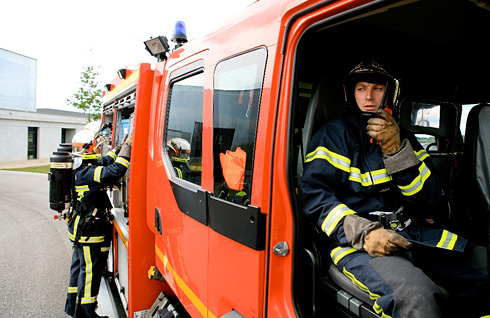 Cassidianis participating in the European R&D car-to-Car Content Delivery (CarCoDe) project aimed at developing a platform for ‘smart car-to-car content’. Applications will include for police cars, ambulances or fire engines.