

The low noise amplifier (LNA) is a critical part of an RF/microwave radio receiver. The LNA is the first active component after the antenna and amplifies often very weak signals to bring them above the noise so information on the carrier can be detected. Key specifications of an LNA include the noise figure (NF) that measures additive noise by the amplifier, gain, linearity (IP3, P1dB), frequency range, power consumption, stability and ruggedness. LNAs can be fabricated in many ways, by using discrete transistors and passive components for matching and biasing, to RF integrated circuits (RFICs) or MMICs which contain everything in one package. The benefits of RFIC/MMIC LNAs include reduced development time (plug-and-play), smaller footprint (compact, less board space), higher yield (using a pre-tested part) and lower part count (lower assembly cost and fewer parts to manage).
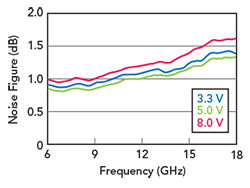
Fig. 1 Noise figure over frequency at 3.3, 5 and 8 V.
Altum RF has recently introduced a high performance MMIC LNA which covers 6 to 18 GHz with a 1 dB NF. The LNA is the ARF1221Q2, which is housed in a compact 2.5 × 2.5 × 0.8 mm3 QFN plastic package. This LNA is fabricated using a GaAs process and requires only a single positive bias, ranging from 3 to 8 V. The LNA has 24 dB gain, input and output return losses greater than 10 dB and an output referred P1dB of 6 dBm at 3.3 V, increasing to 12 dBm with a 5 V supply. The output referred IP3 is 20 dBm at 3.3 V, rising to 30 dBm at 5 V. The RF input and RF output are AC-coupled, so external coupling capacitors are not needed. The ARF1221Q2 has an integrated bias circuit for tighter temperature control and less performance variation from part to part.
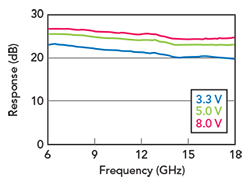
Fig. 2 Gain over frequency at 3.3, 5 and 8 V.
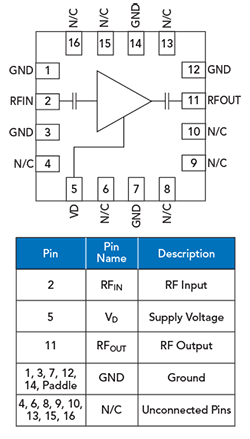
Fig. 3 Functional diagram with package pinout.
The ARF1221Q2 can be used as a versatile LNA in many market applications, including satcom, telecom, test and measurement (T&M) and aerospace and defense (A&D). The radio or radar receiver can be a narrow-band telecom or satcom application in the 6 to 18 GHz band, or a broadband receiver covering the entire 6 to 18 GHz spectrum for a T&M or A&D application. Another application could be a multi-band radar covering C-, X- and Ku-Band using this single LNA. Equipment manufacturers can also use the ARF1221Q2 for a variety of receiver products across different bands, requiring only one LNA instead of several different parts. The excellent performance, integrated features, reliability, ruggedness, low power consumption, compact size and value make this an ideal LNA choice for demanding receiver applications across the 6 to 18 GHz band.
Altum RF
Eindhoven, The Netherlands
+31 (0) 40 2390 888
info@altumrf.com