

Military defense and aerospace communication systems are evolving rapidly due to advances in semiconductor and sensor technologies, as well as in high frequency system design. Current sensor and communications architectures, such as mmWave radar and large-scale MIMO phase arrays, are essential enablers for achieving high frequency operation, improved resolution and reliable signal environments. However, operating at these elevated frequencies introduces increasing system complexity and cabling and interconnect solutions must be robust enough to withstand the rigors of any given scenario. Combined with the demand for real-time detection, tracking and secure connectivity, the next generation of wireless communication systems requires not only sophisticated RF sensing but also the most stringent phase and amplitude stability to enhance the functionality and performance of current designs.
Cable Problems: Phase/Amplitude Errors and Consequences
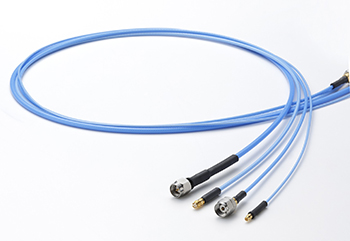
Fig 1 Junkosha’s new ePTFE tape wrapped phase stable MWX7 Series cable.
Modern military aerospace and defense systems must have RF systems designed to detect, track, connect and communicate with various planes, drones, missiles, helicopters, satellites, ground-based weapon systems, ships, submarines and more. As more RF subsystems are created to interface with these elements of a complex communications system, both characterization and deployment of these systems rely on RF interconnects for synchronization and to minimize drift over time. At mmWave miniaturized wavelengths, flexure and mechanical stress significantly impact the accuracy of results, an effect that is accentuated as frequencies increase.
The latest radar systems employ electronically steered beams across many TRX modules, which are often not co-located and may even operate at different frequencies. Any changes in phase, for instance, due to temperature variations or motion, will affect beam or radar accuracy. Although sophisticated phase-match control subsystems provide alignment, these systems must rely on the stability of RF interconnects across modules, which are often exposed to harsh environments, particularly in military deployment scenarios such as target-tracking or target-locking systems. In addition, radar clusters require coordinated control systems, which, in turn, require stable RF interconnects.
PTFE - a Little About Junkosha’s Dielectric as the Differentiator
Phase and amplitude stability are crucial in any test setting, and they become even more critical for metrology-grade cabling, where precision and long-term stability are required to support sensing and communications architectures in defense systems. When cables are flexed or moved, the dielectric is compressed and the internal geometry shifts, altering both the signal’s loss and phase at high frequencies. This is especially critical for phase-sensitive systems such as radar, phased arrays and systems that rely on precise synchronization between elements.
As pioneers in sophisticated fluoropolymer application technologies for the microwave interconnect sector, Junkosha has developed a custom expanded polytetrafluoroethylene (PTFE) tape-wrapping technology that is key to achieving a low dielectric constant. This provides excellent phase stability during flexure and under temperature variations, as well as consistent performance in both inter- and intra-batch quality.