

Space exploration and advanced defense technologies have ushered in a new era of engineering requirements — none more pressing than the relentless demand for reliability and performance amid adversity. In these fields, even the smallest electronic component must perform flawlessly for years or even decades, often in the face of punishing radiation, drastic temperature swings and intense mechanical stress. When failure is not an option, the importance of rigorous quality screening for radiation-hardened (rad-hard) Metal-oxide-semiconductor field-effect transistors (MOSFETs) becomes clear. These tiny yet critical devices underpin everything from satellite power systems to spacecraft propulsion, and their reliability is a cornerstone of mission success.
The Fundamentals of Rad-Hard MOSFETs
Rad-hard MOSFETs are central to the power management of spacecraft, satellites, planetary rovers and defense systems. They regulate voltage, protect sensitive components and ensure energy efficiency in subsystems such as motor controllers, DC-DC converters and bus converters. Given mission lifespans that often exceed 15 years, these components must endure operational extremes without deterioration.
A rad-hard MOSFET is specifically designed and manufactured to withstand the effects of ionizing radiation, such as total ionizing dose (TID) and single event effects (SEE), which can degrade or destroy standard commercial-off-the-shelf (COTS) electronics. This resilience is achieved through specialized silicon processing, robust design architectures and comprehensive testing. Features such as die layout, material selection and process controls are optimized to ensure the MOSFET continues to function even after exposure to high levels of cosmic and solar radiation. There are three standard rad-hard MOSFET architectures commonly used: planar-gate, trench-gate and superjunction, each with its own limitations and benefits (see Figure 1).
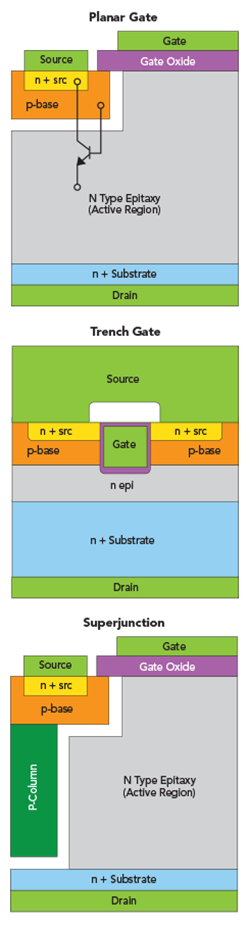
Fig 1 Different rad-hard MOSFET architectures.
Why Quality Screening Matters
Unlike terrestrial applications, where a failed component might mean field service or warranty replacement, a single MOSFET failure in space can be catastrophic and jeopardize an entire mission. The costs are staggering — not just in terms of hardware but also in terms of scientific opportunity, public reputation and sometimes national security. This high-stakes environment elevates quality screening from a best practice to an absolute necessity.
Quality screening involves subjecting every device to a battery of electrical, mechanical and environmental tests designed to identify and isolate nonconforming parts. At companies like Infineon IR HiRel (IR HiRel), 100 percent of components undergo strict screening in accordance with established standards. This process, along with periodic quality conformance inspections (QCI), ensures that only devices that meet or exceed the highest criteria reach the customer.
Global Standards for Quality Screening
The U.S. Defense Logistics Agency (DLA) sets the gold standard for discrete semiconductor reliability through specifications such as MIL-PRF-19500 and MIL-STD-750. These documents prescribe not only which tests must be conducted but also how, when and how often. JANS and JANTXV are two of the most critical quality levels, with JANS considered the most stringent and suitable for spaceflight applications.
In Europe, the European Space Agency’s (ESA) ESCC 5000 standard governs quality conformance for discrete semiconductors. It covers both hermetically sealed packages and bare die, ensuring a consistent approach to screening and reliability. ESCC 5000 has become the benchmark for European missions, with levels such as “P” (Professional) and “ES” (ESA Space) tailored to specific application needs.
By adhering to these standards, manufacturers provide customers with traceability, reliability and a clear pedigree for every component. These standards are not static; they evolve in response to new mission profiles, emerging threats and lessons learned from previous missions.
Standardized Screening Levels and Product Options
In the world of electronics testing and qualification, there are a myriad of governing specifications that define the requirements to be met. Below is a list of the standard screening levels and their meanings.
- JANS: The highest screening level, JANS products undergo exhaustive testing and documentation, including serialization, failure analysis and full traceability to a wafer lot. They are the go-to for space flight hardware.
- JANTXV: Slightly less rigorous than JANS but still robust, these devices meet high standards for visual inspection and environmental testing.
- QIRL: IR HiRel’s Qualified IR List, equivalent to JANS screening, ensures products are manufactured and tested with the same rigor as DLA-approved lines.
- SCD: Source Control Drawing products are built to customer-specific requirements.
- COTS: Commercial off-the-shelf devices, while cost-effective, do not include QCI and are typically reserved for non-critical applications.
- ESA “P” and “ES” Levels
P (Professional): Used in engineering modules, these components offer high reliability for development and testing environments.
ES (ESA Space): Qualified for flight modules, these are subject to the most rigorous ESA standards.
The Screening and Qualification Process: Step-by-Step
Like any good-quality process, it has clear actions and deliverables that must be met before moving on to the next step. Below is a simplified and abbreviated process flow to illustrate the rigorous planning and execution in the rad-hard quality process.
1. Wafer Lot Acceptance
Every batch of wafers undergoes acceptance testing to ensure baseline quality before assembly. This step is crucial for preventing defects from propagating through subsequent manufacturing stages.
2. Assembly and Visual Inspection
Internal visual inspection, per standards such as MIL-STD-750 and TM 2069, verifies that the assembly process has not introduced flaws or foreign materials. The inspection lot accumulation step ensures statistical validity of results.
3. Environmental and Burn-in Tests
These tests assess the reliability of electronic components. Environmental tests expose products to harsh conditions, while burn-in tests run devices under stress to detect early failures. Both ensure product durability and quality.