

4. High Temperature Stabilization
Temperature cycling and constant acceleration tests simulate the stresses a device will face during launch and operation. Burn-in procedures, such as High Temperature Gate Bias (HTGB) and High Temperature Reverse Bias (HTRB), accelerate potential failure mechanisms, ensuring only robust devices move forward.
5. Electrical Testing at Multiple Stages
Initial, interim and final electrical tests measure key parameters such as threshold voltage, breakdown voltage, gate leakage and on-resistanFQCce. These tests are performed at ambient, hot and cold temperatures to ensure stability across the full operational envelope.
6. Hermetic Sealing and Mechanical Stress
Hermeticity tests, including fine and gross leak detection, ensure that moisture and contaminants cannot compromise device integrity. Mechanical shock and vibration tests are vital for components destined for launch, where intense forces are the norm.
7. Packaging and Final Inspection
After passing all tests, devices are packaged, labeled and subject to configuration audits. The final visual examination provides a final safeguard before shipment. As an additional level of assurance, each tested lot is assigned a unique identifying code that enables wafer and die traceability.
Board-Level Qualification: Going Beyond the Chip
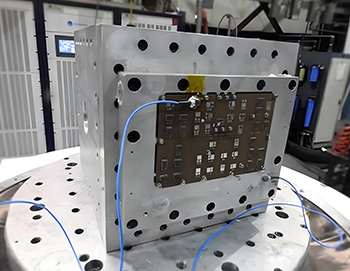
Fig 2 Board-level vibration testing.
While chip-level qualification is essential, it does not fully reflect the conditions encountered once a MOSFET is soldered onto a circuit board. Board-level qualification simulates real-world stresses, such as those experienced during rocket launches and in-orbit operation, providing a more accurate measure of reliability and performance.
IR HiRel’s protocols include random vibration, mechanical shock and thermal cycling (see Figures 2 and 3). Post-test inspections for fine and gross leaks and solder-joint integrity ensure that not only the device but the entire assembly can withstand extreme conditions.
Currently, no industry-wide standards exist for PCB-level qualification of high reliability discretes. IR HiRel’s protocols meet or exceed the most stringent test conditions in related standards, setting a benchmark for the industry and offering customers greater confidence.
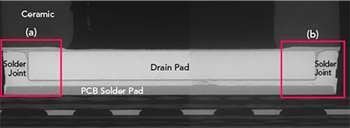
Fig 3 Resulting image of a cross-section of a device after thermal cycling.
Radiation Testing: Surviving the Harshest Environments
Space is one of the most challenging operating environments and even more so for electrical components like semiconductors. Depending on the orbit, you can plan on encountering varying degrees of space radiation comprised of high-energy particles just waiting to tear a hole through onboard circuits. Radiation testing is designed to simulate these events to ensure the devices cannot only survive a radiation event but also continue to operate without interruption. The following examples are common measures of the space worthiness of an electronic device.
Total Ionizing Dose (TID)
TID is a measure of the cumulative effect of ionizing radiation on a semiconductor. IR HiRel’s rad-hard MOSFETs are tested for TID levels ranging from 100 to 500 krad, ensuring reliable operation for many years, even in orbits where shielding is minimal (illustrated in Figure 4).
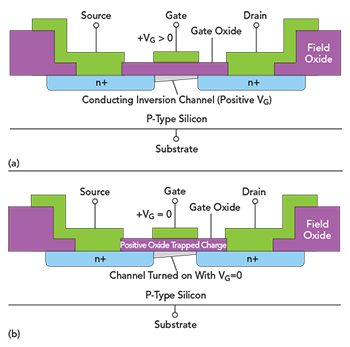
Fig 4 Normal operating condition of an N-channel MOSFET when a positive gate voltage is applied across the gate-to-source, creating an inversion layer which allows current to flow (a) and surplus holes trapped in the gate oxide, after being exposed to a high-energy particle, which allows a partial formation of an N-channel in the MOSFET (b).
Single Event Effects (SEE)
SEE testing exposes devices to high-energy ions to simulate cosmic ray strikes. Devices are qualified to withstand linear energy transfer (LET) levels ranging from 37 to 90 MeV/mg/cm², depending on their intended application, providing immunity against events that could otherwise trigger destructive failures like Single Event Burnout (SEB) or Single Event Gate Rupture (SEGR), as shown in Figure 5. An SEB occurs when a high-energy particle strikes a power device (like a transistor or MOSFET). This causes sudden, uncontrolled current flow through the device, which can permanently damage or destroy it. SEGR is initiated when an incident particle forms a conduction path in the gate oxide, resulting in charge accumulation in the dielectric around the gate of a power MOSFET. The localized field builds up enough that the field across the dielectric exceeds the dielectric breakdown voltage.
LET and Mission-Specific Requirements
Different missions face different radiation profiles. For example, spacecraft traveling to Jupiter must withstand far higher radiation than those in low Earth orbit. In some cases, a hybrid design can use both rad-hard and rad-tolerant parts within the same power circuit. This depends on the critical nature of certain functions within the circuit, even at lower orbits. That’s why it is important to work with a supplier who has experience in working with both screening levels, so they interface seamlessly.
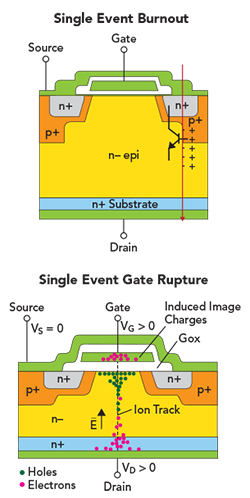
Fig 5 Single event effects, single event burnout and single event gate rupture.
Figure 6 shows the three types of orbits:
Geostationary Equatorial Orbit (GEO)
- Greater than 15 years mission life with LET up to 80 MeV/mg/cm2 with TID up to 100 krad
- Example: Communication satellites with high-throughput capability using radiation-hardened devices traditionally in hermetic packages.
Medium Earth Orbit (MEO)
- Five to 10 years mission life with LET < 43 MeV/mg/cm2 and TID < 50 krad
- Example: Government and scientific satellites with combinations of hermetic and plastic packages.
Low Earth Orbit (LEO)
- Typically, three to five years mission life with LET < 30 MeV/mg/cm2 and TID < 15 krad
- Example: Commercial constellation satellites using plastic packages.
QCI
As an added layer of quality assurance, IR HiRel routinely conducts QCI to ensure that nothing is left to chance. QCI is not a one-time event but rather a continuous commitment to quality. By maintaining a robust QCI program, manufacturers can adapt to evolving requirements and maintain customer trust throughout the product’s life cycle.
Quality conformance is maintained through periodic group testing:
• Group A: Electrical verification of production lots
• Group B: Long-term performance verification, including environmental and life tests
• Group C: Packaging and mechanical inspection, performed annually for each package type
• Group D: Radiation hardness assurance inspection
• Group E: Product qualification for new or modified devices.
These group tests provide a statistical measure of ongoing quality and enable early detection of process drifts or emerging failure modes.
The Importance of Space Heritage
For over 50 years, Infineon IR HiRel has made history by powering countless space missions that continue to unlock the secrets of our universe. At the core of their success is their diverse portfolio of industry-leading radiation-hardened MOSFETs. From their R4 and R5 generations that continue to power Voyager 1 for over 50 years to their new R9 superjunction MOSFETs that will support the next generation of history-making missions like Artemis 2 and beyond.
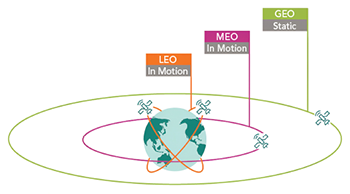
Fig 6 Varying radiation requirements for different space orbits.
Confidence is built not only on technical excellence but on transparency, documentation and a willingness to go beyond the minimum required. Holistic investments, continuous improvement and open communication with customers create a culture where quality is never compromised.
The Future of Quality in Space Electronics
As space missions grow more ambitious and application demands intensify, the importance of quality screening for rad-hard MOSFETs will only increase. Through rigorous screening, conformance to global standards, board-level qualification and robust radiation testing, manufacturers ensure that these devices are ready for the toughest challenges. In this environment, quality is more than a specification — it is the foundation of mission assurance, scientific discovery and technological progress.