

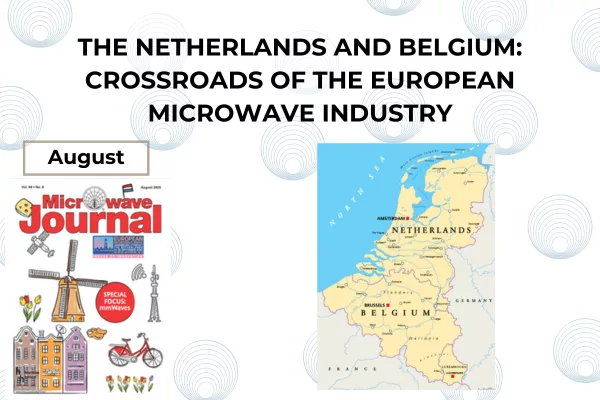
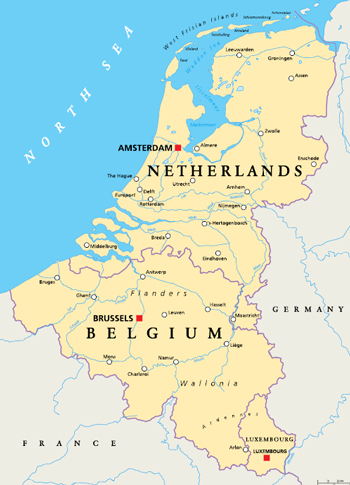
Figure 1 Map of the Benelux region.
Belgium has frequently been called “the crossroads of Europe,” and its neighbor, the Netherlands, can rightly share in that description too. The region is collectively known as Benelux, incorporating the tiny Grand Duchy of Luxembourg (population 660,000) as well as the Netherlands and Belgium, with populations of 17.8 million and 11.7 million, respectively. The Benelux region is bordered by France to the south and by Germany to the east, with the U.K. just a short hop across the English Channel (or a short train ride via the Channel Tunnel).
It was fitting that the Netherlands was chosen as the location for the very first European Microwave Week (EuMW), which took place in Amsterdam in 1998. At the center of Europe, it was a choice that recognized the notable concentration of EU research and development (R&D) capability in the region.
Utrecht was originally intended to be the venue for EuMW 2020, but the COVID-19 pandemic intervened, forcing the cancellation of the physical conference and exhibition, which was replaced by a virtual event online. 2025 will therefore be the first time since its inception that EuMW has taken place in Utrecht — a picturesque city that can easily be reached in around 30 minutes by train, direct from Amsterdam Schiphol airport.
Benelux can truly be called the birthplace of today’s EU, since the 1958 Treaty of the Benelux Economic Union — which made Benelux the world’s first free international labor market — later provided the blueprint for the foundation of the European Economic Community, forerunner of the EU. The region still plays a key role in the government of the EU, being home to the Community Research and Development Information Service (CORDIS), which coordinates and disseminates the results from Horizon 2020 and other projects funded by the EU’s framework programs for research and innovation.
SEMICONDUCTOR EXCELLENCE
Astonishingly, for a country that makes up only 4 percent of the total EU population, the Netherlands can boast the largest semiconductor industry in Europe — even larger than Germany’s. This is due to the world-leading position of ASML Holding NV, the Veldhoven-based manufacturer of photolithography equipment. ASML produces the only equipment capable of fabricating chip geometries below 7 nm.
In the manufacture of the chips themselves, however, it is the legacy of the former Philips Semiconductor in Eindhoven that dominates. Philips was once a leader in the consumer and professional electronics sectors, but now specializes in healthcare technology. There are many surviving RF and microwave spinoffs from Philips, like NXP (which later absorbed Freescale Semiconductor) and Ampleon, as well as startups founded by its alumni. This means there is a concentration of semiconductor expertise around Eindhoven and the other former Philips facility in Nijmegen. The ecosystem around these campuses continues to foster new startups.
While NXP’s flagship design and manufacturing operations are located at the Eindhoven High Tech Campus (HTCE), most of its RF work takes place in Nijmegen, where the ICN8 8-in. SiGe wafer fab is located, along with further R&D facilities. The fab produces a range of RF ICs for applications such as near field communication (NFC), secure identification, smart antennas for 5G and various industrial and IoT applications. However, NXP is increasingly focusing its efforts on automotive applications, as evidenced by its acquisition earlier this year of TTTech Auto. RF products for automotive currently include the Trimension Ultra-Wideband (UWB) IC family for smart access, KW45/47 wireless MCUs for Bluetooth Low Energy and the NCx332x automotive NFC frontend.
There have been reports that NXP plans to cease production at ICN8 over the next few years, as well as at three 8-in. fabs in the U.S., in favor of transitioning to 12-in. (300 mm) production at its new joint venture in Singapore, VSMC, where it is partnered with Vanguard International Semiconductor. NXP is also a partner in the European Semiconductor Manufacturing Company (ESMC) in Dresden, along with TSMC, Bosch and Infineon. 300 mm production is planned to start at both VSMC and ESMC in 2027. Nevertheless, there is speculation that the Nijmegen fab could be sold to another semiconductor company rather than be closed.
RF power specialist Ampleon was founded in Nijmegen in 2015 and offers a range of discrete transistors, MMICs, pallets and modules in LDMOS, as well as GaN technology for applications such as mobile broadband infrastructure, radar and air-traffic control, RF cooking, heating and plasma lighting and other industrial applications.
New in May this year was the CLF24H4LS300P and CLP24H4S30P high-efficiency GaN-on-SiC-based 2.4 GHz RF power amplifier (PA) lineup, designed for ISM applications and shown in Figure 2. With up to 350 W CW output, the pair provides a compact, rugged, solid-state alternative to traditional magnetron-based systems.
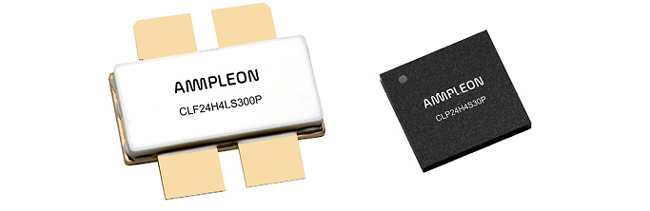
Figure 2 The Ampleon CLF24H4LS300P power amplifier and CLP24H4S30P driver amplifier.
The CLF24H4LS300P final stage and CLP24H4S30P driver amplifier cover the full 2.4 to 2.5 GHz ISM band. The dual-stage architecture achieves more than 66 percent drain efficiency, which not only helps reduce power consumption but also simplifies thermal management. It is suited to applications such as industrial heating, medical therapies, plasma generation, microwave chemistry, MW-PECVD processes and solid-state cooking, including combi oven systems.
Featuring an internally matched 50 Ohm input and output, onboard analog temperature sensor, surface-mount circulator and directional coupler, real-time monitoring and system-level protection are enabled. The compact 105 × 33 mm footprint makes it easy to integrate into space-constrained environments, and the amplifier lineup performs under mismatch conditions up to 20:1 VSWR at 50 V.
TECH CAMPUS
Smaller RF and microwave companies and startups with connections to the Noviotech Campus in Nijmegen, where both NXP and Ampleon are based, include:
- pinkRF, which specializes in solid-state RF energy systems for applications in the industrial, medical and scientific sectors. Its flagship products are solid-state RF signal generators and power generators, including a four-channel 2.45 GHz RF power generator, MPG4×250S, in which the channels can be used either as independent 250 W generators in coherent or incoherent operation, or with an optional external combiner as a single-channel, 1000 W generator.
- Leijenaar Electronics became a full-time business at the Novitech Campus in 2021 but then relocated to Venray in 2024 to acquire more space for further expansion. The company provides RF and microwave design services from the initial concept to a working product, for applications that include RF energy, satcom, CATV, satellite transponders, antennas and IoT. It has the equipment and expertise to test and characterize devices up to 20 GHz and in the field of RF power, it has an automated setup that can measure up to 2 kW and above in CW mode, with a frequency range of up to 3 GHz.
EINDHOVEN
Altum RF in Eindhoven designs and manufactures high performance RF to mmWave components for systems with demanding performance requirements, including telecoms, satcom, radar and test and measurement.
At this year’s IMS, Altum RF introduced a new family of bare die E-Band PAs and low noise amplifiers to support mmWave telecom and satcom applications, with the PAs featuring high output power and gain levels for longer-range links. ARF1018 is a 71 to 76 GHz PA offering 1.8 W (32.5 dBm) saturated output power and 27 dB gain, with a power-added efficiency (PAE) of 18 percent and 39 dBm output IP3. The ARF1019 high-band PA at 81 to 86 GHz has 1.6 W (32 dBm) Psat, 15 percent PAE and an OIP3 level of 38 dBm. Both E-Band PAs integrate an on-chip power detector.
A companion LNA, ARF1206, operates across the full 71 to 86 GHz band with a noise figure of 2.5 dB to 3.5 dB, a gain of 20 dB and a typical input and output return loss of 10 dB. It consumes 45 mA of current from a 4 V supply, and has a footprint of 1.3 × 1.35 mm.
ANTENNAS
In January of this year, Altum RF announced a milestone in its partnership with The Antenna Company, a startup also based at Eindhoven’s HTCE. The A-3 Project is supported by the Metropoolregio Eindhoven (Metropolitan Region Eindhoven), a collaboration between 21 municipalities in the Eindhoven area — also known as the Brainport Region — set up to foster the local economy and business relationships, particularly in the technology ecosystem that has built up with NXP and ASML at its center.
The A-3 Project has focused on antenna-amplifier co-design to improve efficiency and interface characteristics at frequencies around 6 GHz and above, and on the development of new antenna arrays using LTCC technology to improve heat management. The initiative has so far yielded two antenna prototypes, one for 5.8 GHz Wi-Fi and another for mmWave 5G at 28 GHz.
The Antenna Company’s other products include both standard and customized solutions for 4G/5G, NB-IoT, LoRa, Bluetooth, UWB, GPS/GNSS, Wi-Fi and mmWave, at frequency ranges from 410 MHz to 39 GHz.
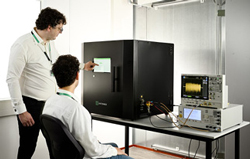
Figure 3 The Antennex over-the-air measurement system for antennas.
Antennex develops advanced over-the-air (OTA) test systems tailored for integrated antennas and complex RF front-ends. Headquartered in Eindhoven, the company works with leading aerospace, telecom and automotive customers to streamline performance characterization in integrated environments. Introduced at IMS2025, a new radar testing feature, shown in Figure 3, allows engineers to measure chirp rate, chirp linearity and radiated power spectral density accurately OTA on high frequency radar systems, independent of the direction of radiation of the radar. The system can rapidly acquire radiated signal measurements, allowing tests over several GHz of bandwidth in a few seconds.