

The tremendous growth of manufacturing automation and the increasing complexity of products in all industries continue to create a strong demand for modular test solutions. One of the most popular choices for advanced test and measurement is the PXIe platform. This platform uses a variety of instrument modules from DC to mmWave to create flexible, high performance solutions for validation and production testing.
These modules include instruments such as switches, multiplexers and vector and signal analyzers often using up to 20 SMA connectors on the module panel, or in the case of multiplexer modules, over 50 SMB connectors. Demand across the frequency spectrum for higher performing PXIe modules is creating the need for connector performance beyond what these traditional connectors can provide. The Phoenix Company’s series of instrumentation connectors provides the next generation of mechanical and electrical performance, augmenting high density with superior performance.
INSTRUMENT MODULES
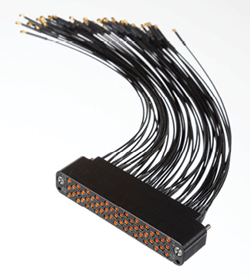
Figure 1 53-pin panel mount receptacle.
The PXI chassis is the foundation of the test system and has a fixed number of slots to accept test modules. Most modules have a single slot width but may increase to double or triple slot widths depending on functionality or the required space for connectors. Modules using many RF connectors such as the SMB, often require a double slot width to mount all connectors, wasting valuable chassis space. Existing multipin connectors can fit a single-slot module; however, limited connector performance may reduce bandwidth specifications.
CONTACT DESIGN AND PERFORMANCE
The Phoenix Company developed a new family of multipin connectors, shown in Figure 1, to improve single-slot efficiency. This was accomplished with a high density of size-16 PkZ® microwave contacts that also achieve electrical performance beyond that of the existing SMB or multipin connectors. The heart of this connector system is the PkZ microwave contact designed to overcome tolerance gaps found in modular mating applications. Mating up to 53 microwave contacts at one time requires careful control of design and manufacturing tolerances to avoid exceeding the mating limits of the connector system. The PkZ provides a forgiving solution through an air dielectric and careful control over internal conductor ratios to perform well even when not fully mated.
Figure 2 shows the gated VSWR performance to 18 GHz of a mated pair of size-16 PkZ contacts. The chart demonstrates the unique ability of the PkZ contact to provide constant impedance over mating gap conditions. The plot shows three traces representing the contacts at different mating conditions: full mating, a 0.025 in. separation and a 0.050 in. separation. As seen, there is no material performance difference over this mating range. This is important because tolerance stack-up always occurs. Eliminating this mechanical consideration from the electrical performance allows the PkZ to operate to higher frequencies in a high-density platform and sets it apart from legacy multipin connectors.
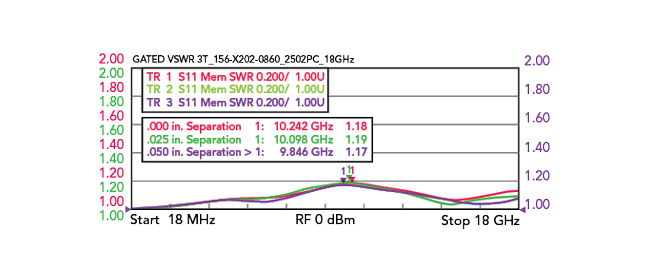
Figure 2 Gated VSWR at three mating conditions.
HOUSINGS
As mentioned, one of the most important design goals of a connector system is limiting tolerances in areas critical to microwave performance. Reliably mating large quantities of microwave contacts involves careful consideration of the following mechanical features in a multipin housing:
- Radial contact stability
- Contact retention
- Axial mating tolerance
- Insertion forces
- De-mating forces
- Cable type, termination and cable management.
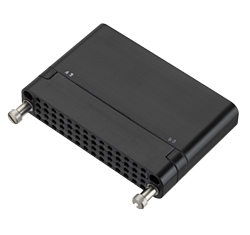
Figure 3 53-pin plug housing.
Addressing each of these objectives requires unique design features in the contacts and the housings to achieve a robust design with the precision to operate into the mmWave region. The PkZ contacts snap into the housing and have a specific design feature in length and diameter that limits the radial float. The plug and receptacle housings have corresponding features to provide optimal contact stability. Contact retention in the housing is specified at a minimum of 10 lbs. per contact. Each contact design features a solder termination to the cable shield to achieve superior electrical and mechanical performance.
PkZ contact radial stability in the plug housing is further enhanced with guide pins and a cable guide plate that isolates the cable’s bend radius from the PkZ contact. This eliminates the need for a traditional backshell and clamp, which may deform the cable and affect microwave performance. Housings are available in 13-, 26-, 28- and 53-pin sizes, all in single-slot widths. Insertion and de-mating forces become significant at this level. They are addressed through integrated jackscrew hardware shown in Figure 3, which not only draws the mating halves together but also manages the separation in a controlled manner to avoid damage.
50 Ω and 75 Ω Cable Versatility
The PkZ contact accommodates standard 50 Ω RG cable groups and 1.37 mm cable for improved flexibility in applications like routing cables inside a single-slot module. For higher frequencies, contacts are available for RG-405 cables to 50 GHz and M17/151 0.047 in. cables to 67 GHz. 75 Ω contacts are available in a size-12 format with performance to 18 GHz. Figure 4 shows gated performance for a mated pair of the 75 Ω PkZ series on Harbour Industries SS75086 cable to 18 GHz.
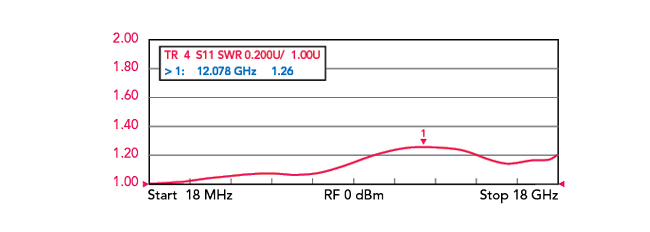
Figure 4 Gated performance of the 75 Ω PkZ series.
This family of multipin connectors and microwave contacts from the Phoenix Company incorporates specific features designed to offer the PXI test market a new choice for high frequency performance in a high-density package.
The Phoenix Company of Chicago, Inc.
Naugatuck, Conn.
phoenixofchicago.com