

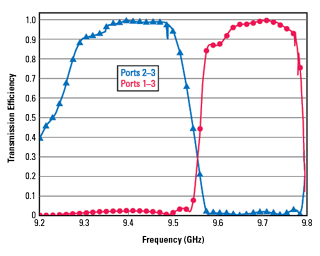
Figure 3 Simulated combiner frequency response.
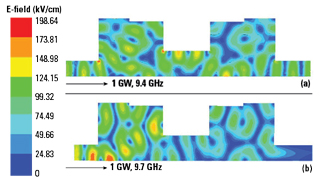
Figure 4 Simulated 9.4 GHz filter E-field distributions for 9.4 (a) and 9.7 (b) GHz.
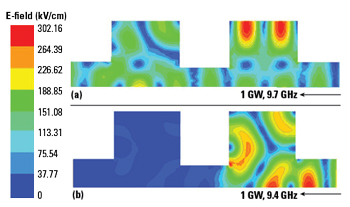
Figure 5 Simulated 9.7 GHz filter E-field distributions for 9.7 (a) and 9.4 (b) GHz.
The entire combiner was simulated with the branching and combining structure and 90-degree coaxial waveguide bend (see Figure 3). The simulation shows the transmission efficiencies of the TEM mode from port 1 to 3 and port 2 to 3 are both over 98 percent within the ±150 MHz passband. The bandwidth is broad enough for the narrowband HPM sources. The transmission characteristics of the combiner also verify the high transmission efficiency and high isolation of the two filter designs. Since propagation is by traveling waves within the filters and standing waves within the other parts of the combiner, the maximum E-field occurs inside the corresponding filters when transmitting the 9.4 and 9.7 GHz signals, respectively. Simulated E-field distributions in the 9.4 GHz coaxial waveguide filter are shown in Figures 4a and b. The input wave is reflected at 9.7 GHz and passed at 9.4 GHz. E-field distributions of the 9.7 GHz coaxial waveguide filter are shown in Figures 5a and b. Here, the input wave is reflected at 9.4 GHz and passed at 9.7 GHz. The 9.7 GHz signal propagates through the 9.7 GHz filter and is reflected by the 9.4 GHz filter, which forms standing waves to be extracted. The mechanism at 9.4 GHz works in a likewise manner.
The input and output modes of the filters are both TEM. With both ports 1 and 2 fed by a 1.0 GW microwave input, the maximum E-fields inside the 9.4 and 9.7 GHz filters were calculated to be 198.64 and 302.16 kV/cm, respectively. It is noteworthy that the E-field enhancement occurring at the corner of the step discontinuities of both filters is less than 200 kV/cm, not high enough to affect the transmission characteristic. Generally, the combiner is pumped to a high vacuum state for the HPM application, in which the E-field breakdown threshold is greater than 500 kV/cm.1 According to Equation 6, the combiner can realize the power combining of several GWs.

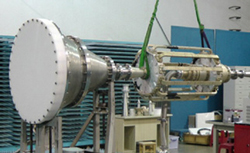
Figure 6 Fabricated high-power coaxial waveguide combiner.
MEASUREMENTS
To verify the simulated performance and power handling, the combiner shown in Figure 6 was fabricated and tested, using a 9.38 GHz, 100 ns relativistic backward wave oscillator (RBWO) and a 9.7 GHz, 9 ns RBWO as sources. The input powers were 1.78 and 1.5 GW, respectively.14 The test layout is shown in Figure 7. To ensure accuracy, two angles, 14 and 20 degrees, were chosen to measure the output power.
Figure 8 shows the output waveforms at 9.38 and 9.7 GHz with pulse durations of 100 and 95 ns and measured at 14 degrees. The blue waveforms represent the far-field measurements of the 9.38 and 9.7 GHz RBWOs, respectively. The green waveforms represent the inline measurements used to monitor the working condition of the HPM source. Measurement of the radiation field was done with the same diode voltage and beam current to acquire the power handling capacity and transmission efficiency. With long pulses, the average power levels detected by antennas 1 and 2 were 1.7 and 1.43 GW, respectively. From this, the insertion loss of the combiner was calculated to be 4.5 percent and the transmission efficiency about 95.5 percent. No microwave breakdown or pulse shortening phenomena were observed during testing.
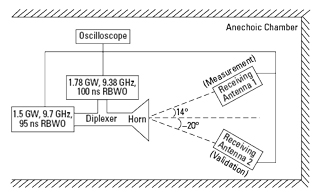
Figure 7 Test setup.
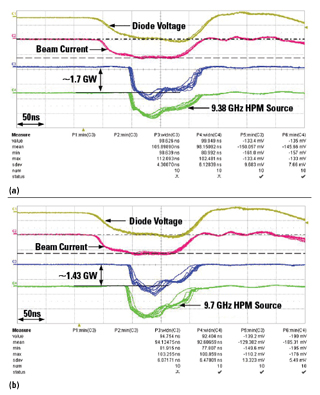
Figure 8 Output waveforms at 9.38 (a) and 9.7 (b) GHz.
CONCLUSION
A multi-way waveguide structure featuring high-power handling with low loss combined 9.38 and 9.7 GHz HPM sources. No breakdown or pulse shortening phenomenon was detected with 100 ns, 1.78 GW and 95 ns, 1.5 GW pulses, respectively. The transmission efficiency was greater than 95.5 percent within the ±150 MHz passband.
References
- J. Benford, J. A. Swegle and E. Schamiloglu, High Power Microwaves, Taylor & Francis, New York, 2007, 2nd edition.
- R. J. Barker and E. Schamiloglu, High-Power Microwave Sources and Technologies, IEEE Press, New York, NY, 2001.
- A. P. Smirnov, N. V. Suetin and A. B. Shmelev, “Two-Dimensional Bounce-Averaged Fokker-Planck Modelling of an Electron Cyclotron Resonance Plasma Source,” Journal of Plasma Physics, Vol. 59, No. 2, February 1998, pp. 243–257.
- J. Benford, “Space Applications of High-Power Microwaves,” IEEE Transactions on Plasma Science, Vol. 36, No. 3, June 2008, pp. 569–581.
- J. T. He, H. -H. Zhong and Y. G. Liu, “A New Low-Impedance High Power Microwave Source,” Chinese Physics Letters, Vol. 21, No. 6, June 2004, pp. 1111–1113.
- D. Wang, F. Qin, D. B. Chen, J. Wen and X. Jin, “X Band Bifrequency Coaxial Relativistic Backward Wave Oscillator,” AIP Advances, Vol. 1, No. 4, November 2011.
- Z. Jin, J. Zhang, J. Yang, H. Zhong, B. Qian, T. Shu, J. Zhang, S. Zhou and L. Xu, “A Repetitive S-Band Long-Pulse Relativistic Backward-Wave Oscillator,” Review of Scientific Instruments, Vol. 82, No. 8, August 2011.
- J. Zhang, H. H. Zhong and L. Luo, “A Novel Overmoded Slow-Wave High-Power Microwave (HPM) Generator,” IEEE Transactions on Plasma Science, Vol. 32, No. 6, December 2004, pp. 2236–2242.
- Q. Zhang, C, Yuan and L. Liu, “T-Junction Waveguide-Based Combining High Power Microwave Beams,” Physics of Plasmas, Vol. 18, No. 8, August 2011.
- Q. Zhang, S. Peng, C. Yuan and L. Liu, “Waveguide-Based Combining S-Band High Power Microwaves,” IET Microwaves, Antennas & Propagation, Vol. 8, No. 10, July 2014, pp. 770–774.
- G. -L Li, T. Shu and C. W. Yuan, “Output Multiplexer for S Band High Power Microwave,” High Power Laser & Particle Beams, Vol. 19, No. 4, April 2007, pp. 667–670.
- G. L. James and B. M. Thomas, “TE /sub 11/ to HE /sub11/ Cylindrical Waveguide Mode Converters Using Ring-Loaded Slots,” IEEE Transactions on Microwave Theory & Techniques, Vol. 30, No. 3, March 1982, pp. 278–285.
- C. Y. Fang, J. S. Gao and H. Liu, “A Novel Metamaterial Filter with Stable Passband Performance Based on Frequency Selective Surface,” AIP Advances, Vol. 4, No. 7, July 2014.
- J. Zhang, Z. Jin, J. Yang and H. Zhong, “Design and Experiment of X-Band Long-Pulse High Power Microwave Source,” High Power Laser & Particle Beams, Vol. 22, No. 11, November 2010, pp. 2643–2647.