Engineers at BE CAE & Test (Catania, Italy) have taken the simulation process well beyond the typical approach of “run a test / deliver a report.” Instead, using the COMSOL Multiphysics software and the Application Builder, they have created a series of easy-to-use custom applications that perform state-of-the-art virtual prototyping of their customers’ surface-mount device designs. The apps hide the complexity of the underlying detailed model, yet still provide access to the powerful functionality of the simulation.


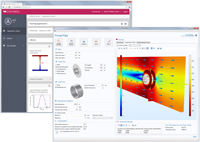 COMSOL Inc. announced the release of COMSOL Multiphysics® version 5.2 providing the simulation community the only fully integrated environment for creating simulation apps. This version of COMSOL Multiphysics® and COMSOL Server™ simulation software environment delivers new features, improved stability and robustness and faster execution.
 COMSOL Inc. brings to the simulation community the only fully integrated environment for creating simulation apps by announcing the pre-release of COMSOL Multiphysics 5.2 at the COMSOL Conference 2015 Boston. As the leading provider of multiphysics modeling and simulation software, COMSOL delivers major productivity updates to COMSOL Multiphysics and COMSOL Server with new features, improved stability and robustness, and faster execution.
  R&D engineers at Cypress are creating simulation apps that streamline their touchscreen design processes using the Application Builder and COMSOL Server™, released with COMSOL Multiphysics® simulation software version 5.
 COMSOL, the leading provider of multiphysics modeling and simulation software, announced the release of the COMSOL Multiphysics® software version 5.1, the first and only integrated simulation environment for building multiphysics models and for creating and sharing easy-to-use simulation apps.
 COMSOL, Inc. announced the release of COMSOL Server™, a new product developed specifically for running applications built with the Application Builder. The Application Builder allows COMSOL Multiphysics® software users to build an intuitive interface around their COMSOL model that can be run by anyone — even those without prior simulation experience.
 COMSOL Multiphysics users are already building applications and exploring the benefits of sharing their models with colleagues and customers worldwide. Arkansas Power Electronics Intl. (APEI) introduces the first multiphysics simulation app built with COMSOL's Application Builder.