

To illustrate, an ANN-based surrogate model was extracted for a set of inductors with varying geometries in a GaN MMIC process, as shown in Figure 9. First, EM simulations are performed using Keysight RFPro for each unique set of inductor geometry parameters, such as width, spacing, number of turns and diameter. Next, a modified pi network with 11 components is fitted to the EM data. Then, for each circuit element in the pi network, a separate ANN is extracted using Keysight’s proprietary ANN engine, available as a Python function in ADS.6 The ANN produces Verilog-A functions that relate the physical parameters (w, s, N, D) to the circuit element values (capacitors, inductors and resistors). The result is a fast model that mirrors physical results and has input parameters that can be tuned or optimized.
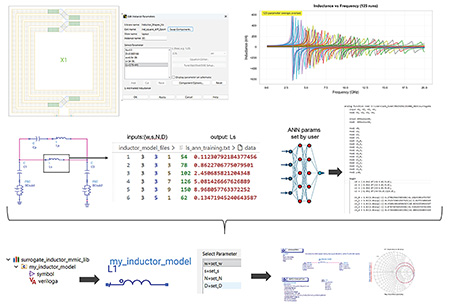
Fig. 9 An ANN model of an inductor is validated and synthesized in a circuit via a Python script.
The surrogate model was then used to quickly tune and optimize an output-matching network that presents the proper external impedances to the device, yielding near-ideal Class J operation, as shown in Figure 10.
As more details of lower-level engineering processes are diagrammed and captured in Nexus Connect, routine tasks become increasingly automated, allowing engineers using AI tools to focus on higher-level design. The path also leads to natural language interfaces that can augment or replace GUIs and scripts.
In summary, shifting from ad hoc simulations to executable, flowchart-based orchestration makes RF design workflows more repeatable, scalable and easier to share across teams. This approach enables engineers to capture complex design processes more effectively, exposes clear interfaces for automation and sets the stage for AI to accelerate design cycles while keeping engineers in control.
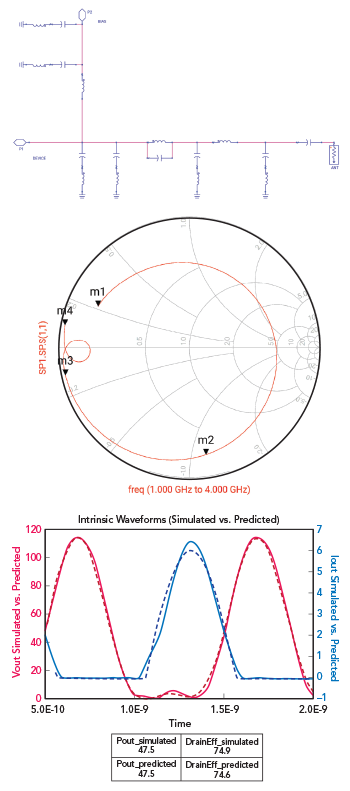
Fig. 10 Output matching network tuned to Class J extrinsic targets using inductor surrogate models.
References
- C. Pujol and M. Ozalas, “Reimagining Possibilities for Next-Gen Simulation in RF EDA,” Microwave Journal, July 2025.
- M. Ozalas,“A Synthesis-Based Approach to Quickly and Easily Design a Class E Amplifier,” Microwave Journal, July 2015.
- N. Khalid and A. Soury, “State-of-the-Art Load-Pull Simulation Methods for Next-Generation Power Amplifier Design,” 2025 IEEE Wireless and Microwave Technology Conference (WAMICON), Cocoa Beach, Fla., USA, April 2025, pp. 1-4.
- Y. Guo et al., “Dall-EM: Generative AI with Diffusion Models for New Design Space Discovery and Target-To-Electromagnetic Structure Synthesis,” 2025 IEEE/MTT-S International Microwave Symposium - IMS 2025, San Francisco, Calif., USA, 2025, pp. 926-929.
- P. W. Shu, X. Zhou, T. Shama, L. Zhou and W. S. Chan, “Harmonic-Tuned Power Amplifier Using Artificial Intelligence-Assisted Topology Generation Algorithm,” IEEE Microwave and Wireless Technology Letters, Vol. 35, No. 5, May 2025, pp. 561-564.
- J. Xu, D. Gunyan, M. Iwamoto, A. Cognata and D. E. Root, “Measurement-Based Non-Quasi-Static Large-Signal FET Model Using Artificial Neural Networks,” IEEE MTT-S International Microwave Symposium - IMS 2025, San Francisco, Calif., USA, 2025, pp. 926-929.