

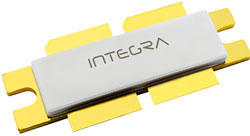
There are moments in the history of RF and microwave technology when a single device changes the terms of the conversation for an entire industry. The announcement by Integra Technologies of the world’s first single-transistor capable of delivering 10 kW of pulsed RF output power is one of those moments.
For the first time in the history of the RF and microwave industry, a solid-state transistor has crossed the 10 kW threshold — a power level that, until now, was the exclusive domain of vacuum electron devices (VEDs) such as traveling wave tubes (TWTs), klystrons and magnetrons. Integra’s single 150 V High Voltage Gallium Nitride on Silicon Carbide (HV GaN/SiC) device has surpassed this limit, this is not an incremental advance, It is a categorical one.
ONE TRANSISTOR, TEN KILOWATTS, NEW INDUSTRY BENCHMARK
To understand why this announcement carries the weight it does, it is worth considering what made 10 kW from a single solid-state device so elusive for so long. Conventional GaN/SiC transistors, while transformative for RF power at lower voltages, have been constrained in how much output power they can deliver from a single die. As power and efficiency demands increase, the physics of 50 V GaN processes limit peak power density and in turn the maximum output power of the transistor.
Integra’s HV GaN/SiC pushes beyond this limitation and redefines what power density and output power is possible. Integra’s HV GaN — a proprietary technology platform developed over the last decade enables transistor operation.
The result is a transistor that does what no RF or microwave solid-state device has done before: deliver 10 kW of pulsed saturated output power from a single package at L-Band. The RF and microwave industry has a new benchmark for single transistor power Integra’s IGN1030S10000. The IGN1030S10000 offers high power RF system architects an unparalled tool to enable the next generation of high power RF systems.
A PRACTICAL, SOLID-STATE REPLACEMENT FOR VACUUM ELECTRON DEVICES
The second defining dimension of this announcement is what it means for the decades-long effort to replace VEDs with solid-state technology in high-power RF architectures. TWTs, klystrons and magnetrons have remained entrenched in radar, industrial and scientific systems because solid-state alternatives simply could not match their peak output power at an acceptable system cost and complexity.
That equation has now fundamentally changed. As Suja Ramnath, Integra’s President and CEO, stated at the time of the announcement, “Prior to Integra’s HV GaN/SiC, the practical solid-state replacement of Vacuum Electron Devices was limited to 10 kW. Now, Integra has extended practical, solid-state replacement of VEDs to the megawatt level in high-power architectures — opening a new chapter for system architects long constrained by the limits of existing solutions.”
Solid-state high-power RF systems are built from combining networks — arrays of devices whose individual outputs are power combined to reach system-level power targets. When the per-device power available is low, reaching high system power requires large numbers of combining stages, each of which introduces insertion loss, thermal complexity and SWaP-C (size, weight, power and cost) burden. When a single device delivers 10 kW, the number of combining stages required to reach 100 kW, 500 kW or 1 MW is drastically reduced. Fewer stages means less insertion loss, a smaller physical footprint, lower thermal management overhead and a system cost profile that, for the first time, makes Integra’s solid-state IGN1030S10000 solution a genuinely practical alternative to VED-based architectures at the megawatt power level.
APPLICATIONS AND THE ROAD AHEAD
The new IGN1030S10000 is intended for applications in L-Band. Integra will be releasing additional 10 kW transistors targeted for UHF applications in Q2, 2026. The platform is extendable to other frequency bands, consistent with the company’s history of leveraging HV GaN/SiC process advances across an expanding range of application frequencies as the technology matures. The 10 kW L-Band device establishes both a new performance benchmark and a process foundation from which different high-power variants will be developed.
As Ramnath concluded, “This is not incremental progress. This is a fundamental shift in what is possible, and Integra intends to keep leading it.”
For the RF and microwave engineering community, the arrival of the industry’s first 10 kW solid-state transistor marks the opening of a new design era — one in which the power ceiling that defined the boundary between megawatt solid-state and vacuum technology no longer exists.
For more information, visit www.integratechnologies.com