

LEVEL 2: CONVERSATIONAL AI REDUCES FRICTION
Conversational AI can also reduce some of the day-to-day friction associated with sophisticated RF design tools. Instead of searching through menus, documentation or old project files, engineers can ask questions in natural language and receive context-aware guidance within the design environment. See Figure 8.
Using natural language, users can request a testbench setup, a graph configuration, a script migration and general guidance on the design environment. For experienced users, the benefit is speed. For less experienced users, it is access to know-how without having to leave the application or search through large swaths of user reference materials. A natural-language interface allows engineers to ask questions about AWR technology and get accurate answers from Cadence AWR documentation, which can also be supplemented with a company’s proprietary design reference material.
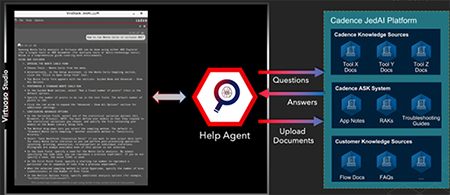
Fig. 8 Level 2 conversational LLM provides access to documentation information through a natural language interface.
LEVEL 3: REASONING AGENTS HELP EXECUTE DESIGN TASKS
At Level 3, agents combine reasoning with context awareness to execute tasks directly within the tools. They can respond to user requests with actions directly relevant to the current state of the schematic, layout or testbench in the Virtuoso platform or in the AWR Design Environment, carrying out tasks that previously required the designer to drive manually.
Many of these tasks are not conceptually difficult. Still, they are tedious and time-consuming because they often require several small, coordinated steps that an engineer with the necessary tool knowledge would take in the workflow. Level 3 agents take those steps, supporting a series of design and simulation tasks under the user’s guidance.
LEVEL 4: AGENTIC WORKFLOWS THAT LEAD TOWARD FUTURE AUTONOMOUS RF DESIGN FLOW (LEVEL 5)
The largest productivity gains are likely to come when AI can coordinate multiple steps across the design flow rather than assist with individual tasks.
Super agents are intended to support that kind of connected execution across setup, migration, optimization, circuit analysis, EM analysis and related activities. The advantage is not just the automation of individual commands. It is the orchestration across tools and abstraction levels that remains a persistent source of lost time in RF development.
As an example, consider the multiple steps involved in developing an MMIC power amplifier (PA). Using task agents in the Virtuoso Studio RF platform or Microwave Office software, an agentic flow supports MMIC PA development by orchestrating the otherwise manual steps of design entry, device sizing and characterization (including load-pull and stability analyses), test bench setup, matching network design, optimization and EM sign-off. In this design flow, a Cadence RF super agent will guide the designer through design creation with foundry-approved PDKs and testbench templating, then drive early studies such as device selection and sizing, stability checks and source/load-pull characterization to determine impedance targets for matching.
From there, the agent can generate and iterate on matching network candidates and run multi-objective optimization loops against the required PA metrics, while invoking on-demand full-wave EM extraction (planar or 3D FEM) directly from layout, providing in-design EM analysis data (S-parameters) embedded in the circuit simulations for greater accuracy. In effect, the “agentic” value does not replace the PA designer’s intent. Still, it automates the repetitive setup, execution and iteration steps — keeping the workflow anchored to foundry-validated PDK constructs while accelerating the path from nonlinear characterization to EM-verified implementation.
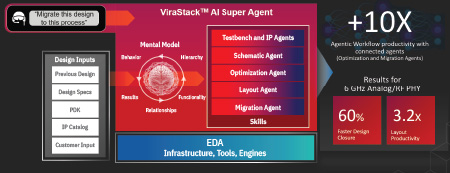
Fig. 9 The ViraStack AI Super Agent orchestrates activity of specialized agents to achieve over a 10X productivity gain in node migration for 6 GHz analog/RF PHY design.
By combining shared design context with domain-specific execution, this approach could help organizations apply expert methods more consistently across teams. This is especially relevant in many RF groups, where a small number of senior designers often hold a disproportionate share of tool setup and firsthand design knowledge.
DEMONSTRATED IMPACT
In a demonstrated 6 GHz analog/RF PHY migration flow, Cadence combined AI-driven optimization, conversational assistance, reasoning agents and agentic workflow coordination to accelerate execution across migration, optimization, layout and validation. See Figure 9.
- 60 percent faster design closure
- More than 10x improvement in agentic workflow productivity
- Coordinated execution across migration, optimization, layout and validation tasks.
SUMMARY
For RF designers, the most credible promise of AI is not fully automated design from scratch. It is faster execution of the work that relies on real engineering judgment: setup, exploration, migration, optimization, results analysis and cross-tool coordination. Cadence is noteworthy because it is pursuing AI through computational software and workflow infrastructure that already matter in production, including trusted simulation and optimization engines, integrated EM analysis, unified data models and design environments closely tied to implementation. As agentic workflows mature, that foundation gives companies embracing AI an advantage in delivering better products faster and helps address the growing challenges of limited RF expertise in the workforce.