

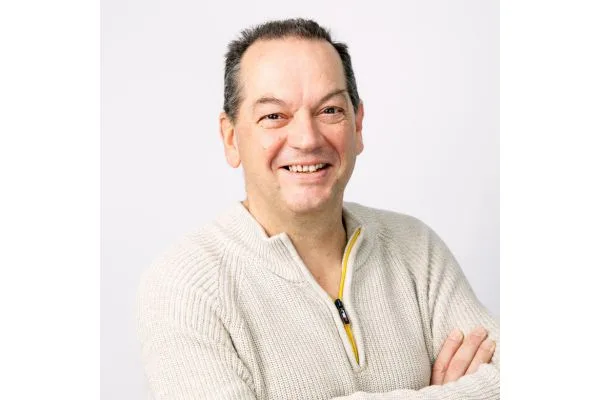
1. Ronald, you have had a successful career bringing unique technology to the cost-sensitive consumer market. How has your career path brought you to Forefront RF?
I have always been fascinated by cellular communications because it is one of the fastest moving and most demanding technology sectors in the world. I started my career at Ericsson working on Bluetooth and wireless connectivity solutions during a period when mobile devices were rapidly evolving from simple communication tools into highly integrated computing platforms.
Over time, I moved from engineering into product management and focused increasingly on RF system challenges associated with smartphones and connected consumer devices. One of the biggest long-term industry challenges has been the growing complexity of RF front-ends, driven by the expansion of global spectrum allocations, carrier aggregation and the introduction of 4G and 5G technologies.
Historically, the industry solved this problem by adding more fixed SAW and BAW filters, duplexers and switch paths for every additional frequency band. While that approach has been successful, it has also increased RF front-end size, insertion loss, power consumption and overall system complexity.
Forefront RF is approaching this challenge differently. Our proprietary tunable duplexer technology, Foretune™, enables RF front-ends to dynamically adapt across multiple cellular bands using significantly fewer fixed hardware components. Rather than relying solely on dedicated filters for every band combination, we combine tunable RF techniques with adaptive signal cancellation to create a more flexible and software-controlled RF architecture.
For me, Forefront RF represents the next logical evolution of mobile RF design. As wireless systems continue becoming more fragmented and complex, the industry will increasingly need programmable and adaptive RF front-ends rather than purely fixed hardware architectures.
2. There are other tunable filter technologies out there, how is the Forefront RF solution different?
Most tunable filter technologies focus on shifting the resonant frequency of a conventional filter structure using MEMS, varactors or switched capacitor techniques. Forefront RF takes a broader system-level approach by combining tunable duplexer technology with adaptive signal cancellation.
Modern devices may need to support more than 40 cellular bands spanning frequencies from 600 MHz through to 6 GHz. Supporting this wide range of operating bands using fixed acoustic filtering significantly increases switch complexity, PCB area and insertion loss.
Foretune™ enables a single RF architecture to operate dynamically across multiple frequency bands using software control. Rather than relying entirely on fixed high-Q acoustic filters, our solution uses adaptive cancellation techniques to maintain transmit-receive isolation across different operating conditions and frequency ranges.
The cancellation loop dynamically adjusts phase and amplitude alignment to suppress transmitter leakage while maintaining receiver sensitivity. This approach allows strong isolation performance to be maintained across wider tuning ranges without requiring a dedicated acoustic filter path for every operating band.
The result is a more scalable and flexible RF front-end architecture that can reduce component count, simplify system integration and better support future wireless standards.
3. Where are you seeing the greatest acceptance for your tunable filter technology?
Our initial commercial focus is the cellular-enabled smartwatch market, where RF design constraints are particularly challenging because most devices operate using a single shared antenna for both transmit and receive operation.
Unlike smartphones, wearables have extremely limited PCB space, strict thermal constraints and very demanding battery life requirements. At the same time, consumers increasingly expect standalone cellular connectivity, global roaming capability and support for multiple LTE and 5G bands.
Traditional fixed-filter RF architectures consume valuable board area and introduce additional insertion loss and switching complexity, all of which directly impact antenna efficiency and battery performance. In wearables, every tenth of a dB of RF loss matters.
Forefront RF’s tunable duplexer technology is particularly well suited to this environment because it enables flexible multi-band operation while significantly reducing the number of fixed RF front-end components required.
We are currently working with ecosystem partners evaluating integration into next-generation wearable RF platforms, and we believe wearables represent a strong entry point for broader adoption of adaptive RF architectures.
Longer term, we see significant opportunities in smartphones, IoT and other highly integrated wireless devices as RF requirements continue increasing with 5G Advanced and future 6G deployments.
4. What are the benefits of using a software-defined radio in an RF front-end?
Software-defined radio principles bring flexibility, adaptability and intelligence into the RF front-end. Traditional RF architectures rely on dedicated filters and duplexers optimized for specific frequency bands, but modern wireless devices increasingly need to support hundreds of possible band combinations across global networks.
Historically, software-defined concepts have been applied mainly at the modem and base-band level. We believe the next major industry transition is bringing programmability directly into the RF front-end itself.
A software-controlled RF front-end can dynamically adapt to regional spectrum allocations, carrier aggregation requirements and changing operating conditions without requiring dedicated hardware paths for every use case. This enables manufacturers to reduce hardware duplication, simplify RF architectures and create more globally scalable device platforms.
The result is lower SKU complexity, more efficient supply chains and improved manufacturing flexibility. As wireless standards continue evolving, adaptive RF systems will become increasingly important because they can support new spectrum allocations and operating modes without requiring a complete hardware redesign.
5. SAW and BAW technologies have been around for decades. Are your tunable solutions cost-competitive?
SAW and BAW technologies are extremely mature and highly optimized from an individual component perspective. The challenge facing the industry today is not necessarily the cost of a single filter, but the growing inefficiency of the overall RF front-end architecture.
Modern smartphones may contain well over 100 RF front-end components to support global frequency bands, carrier aggregation combinations and regional operator requirements. As RF complexity increases, the cumulative impact on PCB area, insertion loss, integration complexity and supply chain management becomes increasingly significant.
Forefront RF’s tunable duplexer technology reduces the number of dedicated filters and switching elements required by enabling adaptive multi-band operation within a smaller number of RF chains.
By simplifying the overall architecture, manufacturers can reduce board space requirements, improve design flexibility and potentially lower total system cost at the device level rather than focusing solely on the cost of individual components.
Our technology is being developed for scalable commercial deployment using standard semi-conductor manufacturing flows, and we believe adaptive RF architectures will become increasingly compelling as wireless complexity continues growing.
6. Isolation in duplexers is a critical parameter. How does the Forefront RF solution achieve market-acceptable isolation in its products?
Isolation is critical because the transmitter and receiver must operate simultaneously while sharing closely spaced frequency allocations. Traditional SAW and BAW duplexers achieve this using highly selective fixed acoustic filtering.
Forefront RF combines tunable filtering with adaptive signal cancellation techniques that dynamically compensate for transmitter leakage appearing in the receiver path.
Our architecture analyses unwanted coupling between the transmit and receive chains and generates a controlled cancellation signal with the appropriate phase and amplitude characteristics to suppress interference through destructive cancellation.
Because the cancellation parameters are adaptively controlled, the system can maintain effective isolation performance across multiple frequency bands and varying operating conditions while preserving the flexibility advantages of tunable duplexer technology.
7. Please explain adaptive signal cancellation and how it is used in your filter devices.
Adaptive signal cancellation is a technique used to suppress unwanted RF interference by generating a controlled inverse signal that counteracts transmitter leakage.
In conventional duplexers, isolation is achieved primarily through fixed SAW or BAW filtering. Forefront RF supplements tunable filtering with adaptive cancellation techniques to achieve strong isolation performance across multiple operating bands.
The system analyses leakage energy appearing at the receiver path and dynamically generates a cancellation signal with the correct phase and amplitude alignment to reduce interference through destructive cancellation.
Because the cancellation parameters can be continuously adjusted, the architecture can compensate for changing operating conditions, impedance variations and different frequency allocations in real time.
This enables a more flexible and scalable duplexer architecture without requiring a dedicated fixed acoustic filter for every supported operating band.
8. What exciting new products and market entries can we expect from Forefront RF over the next few years?
Our focus over the next few years is accelerating the commercial adoption of tunable duplexer technology across multiple wireless markets.
We are expanding our product portfolio to support a broader range of low-band and mid-band cellular frequencies, including important global 5G allocations such as the 1700 to 2700 MHz spectrum.
In the near term, our priority is moving tunable duplexer technology from engineering validation into high-volume consumer deployment, initially targeting cellular-enabled wearable platforms where the value proposition is particularly strong.
Longer term, we see significant opportunities in smartphones, IoT and automotive connectivity as RF systems continue evolving toward more adaptive and programmable architectures driven by 5G Advanced and eventually 6G.
We believe the industry is approaching a point where traditional fixed RF front-end scaling becomes increasingly difficult, creating strong demand for more software-controlled and flexible RF solutions.
9. Is there anything else you’d like the MWJ readers to know about you and Forefront RF?
Forefront RF was founded on the belief that the wireless industry needs a more adaptive approach to RF front-end design.
For many years, the industry successfully addressed growing wireless complexity by adding more fixed hardware. However, that approach is becoming increasingly difficult to sustain as devices become smaller, more power sensitive and required to support more global frequency bands and carrier combinations.
Our mission is to allow device manufacturers to treat connectivity more like a commodity — simple to integrate, scalable across global markets and less constrained by fixed band-specific hardware architectures.
By enabling smarter and more flexible RF front-end solutions, we aim to simplify device design, improve system efficiency and help support the next generation of highly connected consumer devices.
We believe the next major RF industry transition will be the move from fixed hardware-defined front-ends toward adaptive and programmable RF architectures, and Forefront RF is excited to help drive that transition forward.