
This article discusses how, why and when engineers can use automotive-qualified components in their Mil/Aero designs. This approach helps them pass system-level qualifications while providing critical competitive advantages.
One of the proximate issues in the components market is that the line between automotive and defense and/or aerospace (Mil/Aero) electronics has grown increasingly blurred. The components, semiconductors and all other parts used in these two distinct markets are subject to rigorous qualification standards to ensure consistent performance under extreme conditions. Two of the most recognized frameworks are military standards (MIL-STD) for defense and aerospace systems and the AEC-Q standards from the Automotive Electronics Council (AEC) for automotive applications. While applications engineers designing for these two markets share a common goal of achieving uncompromising reliability, they must also navigate the differences in documentation, qualification philosophies and cost structures.
Why Military and Aerospace Engineers are Looking at AEC-Q
Today, we see common off-the-shelf materials being used to develop technically sophisticated, highly effective weapons, especially air- and sea-based UAVs and drones, as well as autonomous vehicles like boats. These systems are being designed and built, iterated and improved quickly, at a low cost, with a very impressive ROI. This means that if someone can adapt faster, cheaper and better systems, they are likely to win.
Applying the OODA Loop Concept to Mil/Aero Technology
In the world of defense and aerospace, a driving technology trend is a race to develop and deploy highly-reliable and cost-effective applications faster than the adversary. This goal can be seen as the technology-based equivalent of the “observe, orient, decide and act” OODA loop military strategy created by Colonel John Boyd in the mid-1950s, see Figure 1.
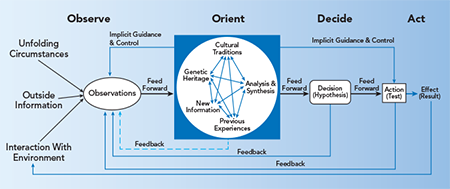
Fig. 1 OODA loop concept applicable to Mil/Aero technology trends.
The concept can be applied to the development and sale of advanced technologies in the Mil/Aero market as follows: you can respond to an engineer’s request faster than the competitor (adversary) by acquiring samples and data more quickly, thereby winning. The cost, response speed and timing are competitive “weapons” that stand in for Colonel Boyd’s OODA loop concept of observing, orienting, deciding and acting.
Applying the common-sense OODA loop concept to component-technology sales is especially relevant when all parties across competing companies/contractors are chasing the same bid or contract. It is far easier to get real-time inventory on AEC-Q100-rated parts than to find specialized rad-hard or unscreened parts. Using AEC-Q alternatives can help estimate upfront costs, since there tend to be more prototype tests and front-end tests than tests on the actual product released into the field. Time is of the essence. Thus, if the weapons systems manufacturer can close the OODA loop faster than their opponent, they will gain an advantage.
The Changing Landscape of the High-Reliability Electronics Market
How can the Mil/Aero industry respond faster to gain this competitive advantage? For decades, military-grade components defined the gold standard for reliability. Each part was tested to rigorous military standards, including MIL-STD-883, MIL-PRF-38535, MIL-STD-202 and the QPL program, ensuring survivability under extreme conditions of shock, radiation and wide temperature ranges, as well as long lifetimes.
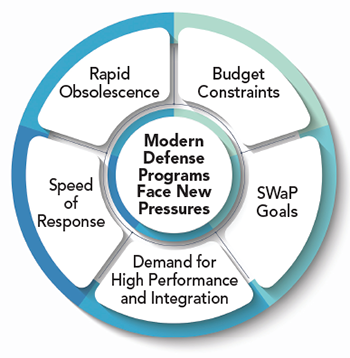
Fig. 2 Five pressures facing modern defense programs.
Today, however, modern defense programs face new pressures as summarized in Figure 2:
- Rapid obsolescence of electronic components, including semiconductors
- Budget constraints and the drive toward cost-effective procurement
- Demand for higher performance and integration, especially in advanced computing, AI and radar systems (along with COTS concerns)
- Meeting size, weight and power consumption (SWAP) goals and requirements
- Today’s necessity of speed of response (OODA loop), plus, historically, the Mil/Aero “military industrial complex” is not “wired” for speed.
AEC-Q vs. MIL-STD
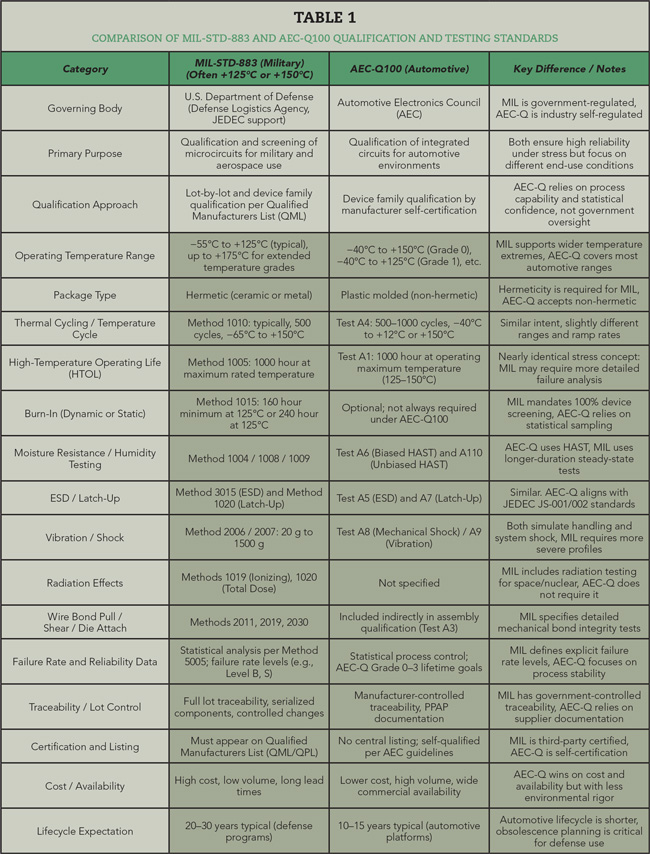
The automotive sector, driven by the rise of electric and autonomous vehicles, has evolved its own reliability standard: the AEC specifications. Parts that meet AEC-Q100 (for ICs) or AEC-Q101 (for discrete devices) undergo extensive qualification for thermal cycling, vibration, humidity, HALT, HAST, HTRB, HTOL, ESD and electrical overstress, many of which are the same stresses found in aerospace environments. While AEC-Q100 and MIL-STD-883 share many test categories, such as thermal cycling, ESD and vibration, their intent and rigor differ. Military standards emphasize absolute reliability, hermeticity and traceability under the harshest conditions. AEC-Q focuses on statistical robustness and cost-effective reliability for long-term automotive use, see Table 1.