


The satellite market is gaining strong momentum as demand rises for ultra-high-capacity, low-latency, and secure data transmission across space networks. Growth is supported by the increasing deployment of low Earth orbit (LEO) satellite constellations for broadband connectivity, Earth observation (EO), and defense communications. Operators are prioritizing inter-satellite laser links and optical ground terminals to overcome spectrum congestion, enhance data throughput, and improve network resilience. Satellite manufacturers and communication payload providers are accelerating advancements in compact laser terminals, precision pointing and tracking systems, adaptive optics, and integrated photonics. These innovations enable higher data rates, lower power consumption, and reduced size, weight, and power (SWaP), resulting in more efficient and scalable optical communication architectures. As a result, optical satellite communication platforms are becoming increasingly adaptable for a broad range of commercial, government, and defense applications, including secure connectivity, real-time data relay, and next-generation space infrastructure.
MARKET SCENARIO

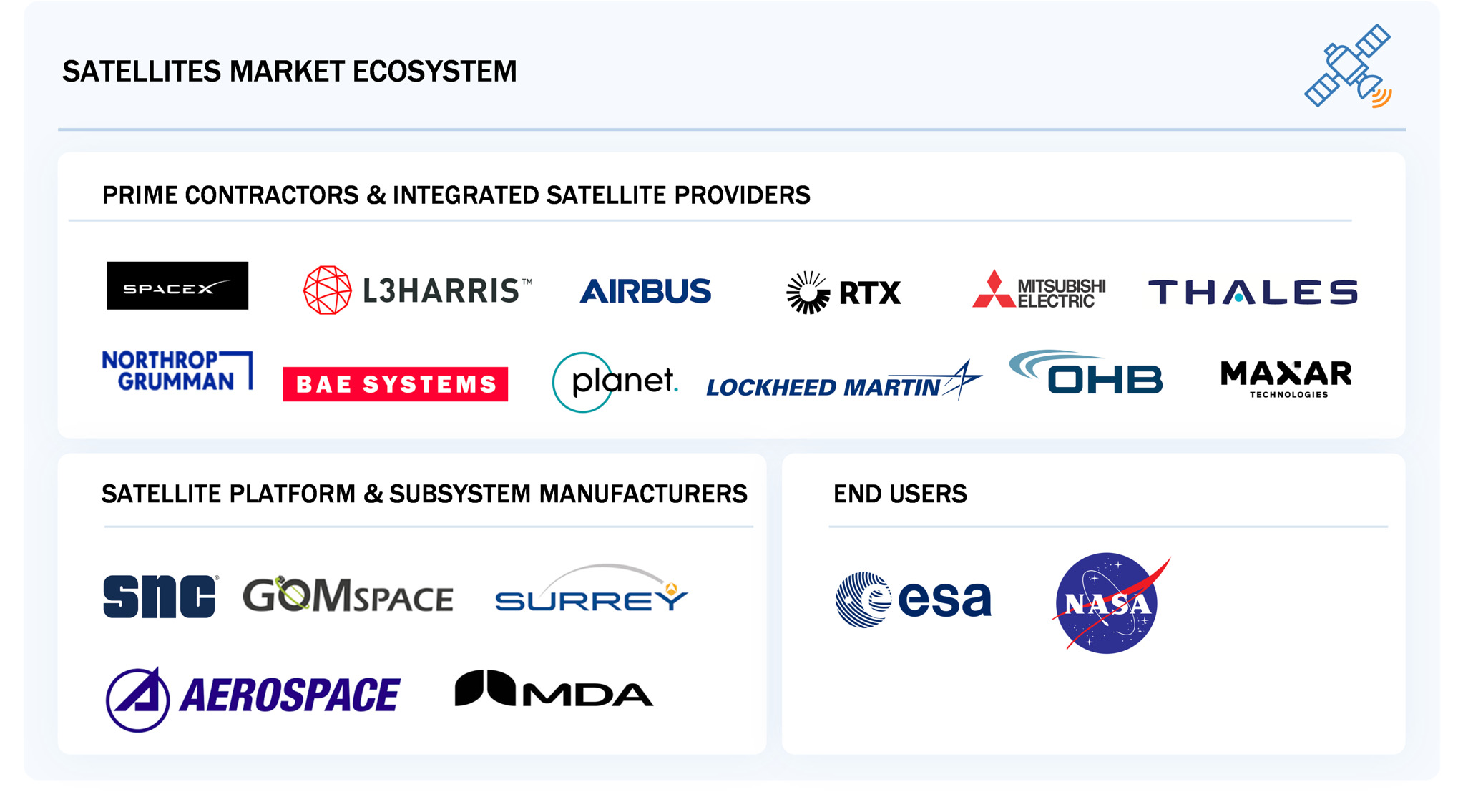
The competitive landscape of the global satellites market is shaped by clear differences in product innovation intensity, partnership depth, and scale-driven expansion strategies. SpaceX (US) stands out for its strong performance across product launches and expansions, driven by rapid deployment of the Starlink constellation, vertical integration, and continuous network upgrades, setting new benchmarks for scale, cost efficiency, and deployment speed. Lockheed Martin (US) maintains a balanced strategic posture, combining steady product development with long-term government partnerships and selective acquisitions that reinforce its role in secure, mission-critical satellite systems. Airbus (France) demonstrates a more measured but consistent approach, leveraging partnerships, joint ventures, and incremental product upgrades to support institutional, defense, and commercial satellite programs, particularly in Europe and allied markets. Northrop Grumman (US) shows strength in agreements, collaborations, and targeted expansions, reflecting its focus on defense-oriented satellite architectures, resilient communications, and integration with broader national security space ecosystems. Thales Alenia Space (France) continues to perform strongly across partnerships and expansions, underpinned by deep involvement in government and agency-led programs, with long development cycles and assured demand favor experienced system integrators. Collectively, these strategies indicate an industry moving toward higher launch cadence, deeper ecosystem collaboration, and scaled constellation deployment, as demand accelerates for secure, high-capacity, and resilient satellite communications across both commercial and defense applications.
The global space industry is undergoing a significant transformation driven by rising commercialization, increased private sector participation, and expanding government and institutional satellite programs. These developments are directly influencing the satellite market by accelerating deployment timelines, increasing satellite production volumes, and expanding demand across communications, Earth observation, navigation, and defense applications. Satellite operators are prioritizing operational flexibility, mission resilience, and regulatory compliance, leading to greater emphasis on system reliability, lifecycle management, and in-orbit sustainability across satellite missions.
A key industry trend impacting the satellite market is the continued evolution of satellite architectures, including greater use of modular designs, digital payloads, and scalable platforms. Growth in large-scale constellations and high-capability satellites is driving demand for adaptable subsystems that support orbit insertion, station-keeping, collision avoidance, and controlled end-of-life disposal. As satellite missions become more complex and data-intensive, system architectures are increasingly optimized to balance performance, mass, power consumption, and operational efficiency across different orbital regimes.
The space industry is witnessing increased adoption of automation, digitalization, and software-defined spacecraft operations. Advanced onboard processing, autonomous guidance and control, and AI-enabled mission management are being integrated to improve operational efficiency, reduce ground intervention, and enhance responsiveness in congested orbital environments. These capabilities are particularly important for multi-satellite fleets, where automation supports scalable operations, improved maneuver planning, and reduced operational risk over long mission durations.
Finally, sustainability and regulatory alignment are becoming central to the evolution of the satellite market. Regulatory authorities and international bodies are strengthening requirements related to debris mitigation, space traffic management, spectrum efficiency, and post-mission disposal. In response, satellite manufacturers and operators are incorporating sustainability considerations into system design and mission planning, emphasizing longer operational lifetimes, responsible orbital behavior, and compliance-driven innovation. These trends are shaping a more regulated, resilient, and sustainable satellite ecosystem aligned with long-term space governance objectives.
ECOSYSTEM ANALYSIS
ADVANCED PROPULSION SYSTEMS
Advanced propulsion systems encompass a range of technologies designed to provide efficient orbit insertion, station keeping, maneuvering, and end-of-life disposal for satellites. These systems include electric, hybrid, and other high-efficiency propulsion solutions that optimize fuel usage while delivering precise thrust control. In the satellite market, advanced propulsion plays a critical role in extending satellite operational lifetimes, enabling complex maneuvering, and supporting compliance with debris mitigation and disposal requirements. Improved propulsion efficiency reduces launch mass, lowers deployment costs, and allows satellites to perform additional missions or maintain service continuity for longer periods. As regulatory and sustainability requirements become more stringent, propulsion systems are increasingly viewed not only as mobility enablers but also as essential contributors to mission assurance, operational flexibility, and long-term sustainability of satellite operations.
AUTONOMOUS OPERATIONS AND ONBOARD DECISION-MAKING
Autonomous operations and onboard decision-making technologies enable satellites to perform mission-critical functions with minimal dependence on ground control by using advanced onboard processing, artificial intelligence, and adaptive control algorithms. These capabilities allow satellites to autonomously manage orbit maintenance, collision avoidance, fault detection and recovery, and resource optimization in real time. In the satellite market, autonomy is becoming increasingly important due to rising orbital congestion, larger satellite fleets, and the need for faster operational response. Autonomous decision-making reduces operational complexity and ground segment workload while improving mission resilience, particularly in scenarios where communication with ground stations is delayed, disrupted, or contested. As satellite missions grow in scale and complexity, autonomous operations support more efficient fleet management, enhanced survivability, and compliance with emerging space traffic management and debris mitigation requirements, making them a foundational technology for next-generation satellite systems.
Space situational awareness and threat-monitoring payloads comprise onboard sensors and data-processing systems designed to detect, track, and characterize objects and activities in the space environment. These payloads support continuous monitoring of resident space objects, potential collision risks, and hostile or anomalous behavior in orbit. In the satellite market, SSA capabilities are increasingly critical as orbital congestion intensifies and the strategic importance of space assets grows. Threat monitoring payloads enable satellite operators and defense organizations to maintain awareness of the space domain, assess risks to critical satellite infrastructure, and support informed decision-making for maneuvering planning and asset protection. The integration of SSA payloads enhances operational safety, supports collision-avoidance regulatory compliance, and strengthens space security, driving increased demand for satellites equipped with monitoring and sensing capabilities across defense and government programs.