

The Menlo Microsystems MM5130-03NLX RF switch represents a significant advancement in high-power, wideband switching technology, leveraging the company’s proprietary Ideal Switch® MEMS process to deliver a compelling alternative to both electromechanical relays and traditional solid-state switches. Critically, this technology enables relay-class RF performance in a solid-state-like footprint, directly addressing the size, weight, power, cost (SWaP-C) and reliability constraints of modern defense platforms and commercial unmanned aerial systems (UAS). Designed for demanding high power standoff in RF and microwave applications, the device combines excellent linearity, low insertion loss and high-power handling in an ultra-compact form factor, making it well-suited for protecting RF front-ends in defense and aerospace systems including missiles, drones, loitering munitions and high performance commercial UAVs.
The MM5130-03NLX is a single-pole, three-throw (SP3T) micro-mechanical switch operating from DC to 26 GHz. This wide frequency coverage allows a single device to support multi-band communications, navigation, sensing and radar functions within highly-integrated airborne RF architectures. The device supports Menlo Micro’s “Super-Port” mode, a configuration that enhances RF performance by enabling flexible signal routing between ports while improving isolation and return loss. For adaptive RF front-ends — such as reconfigurable filters, shared apertures and multi-mission payloads — this capability enables dynamic signal routing without the insertion loss or distortion penalties typical of semiconductor switches.
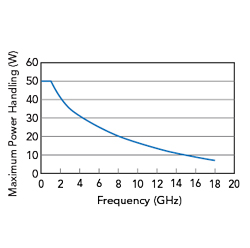
Figure 1 Maximum average power handling vs frequency (the power handling below 5 MHz drops off to 20 W and below).
One of the defining attributes of the MM5130-03NLX is its combination of high-power handling, high power limiting and low loss. The device supports up to 25 W continuous wave power at 6 GHz and 17 W at 10 GHz, with peak pulsed power exceeding 150 W (see Figure 1). These power levels align directly with radar, electronic warfare (EW) and high-power telemetry links commonly deployed on defense platforms and advanced drones. In open-state conditions, the switch demonstrates impressive standoff capability, handling nearly 480 W of pulsed power under specified test conditions. This high standoff power is particularly valuable for protecting sensitive receiver chains in radar and EW front-ends during high-power transmission or jamming events. These characteristics position the device as a strong candidate for replacing bulky electromechanical relays, particularly in systems where size, weight and reliability are critical constraints.
Insertion loss is a key parameter in RF system design, and the MM5130-03NLX delivers excellent performance in this area, with a typical on-state insertion loss of approximately 0.3 dB at 6 GHz (see Figure 2). Low insertion loss directly translates to extended range, improved link margins and reduced power amplifier back-off — important advantages for battery-powered commercial drones and long-endurance military platforms alike. Complementing this is a high level of isolation — around 45 dB at 6 GHz — ensuring minimal signal leakage between channels, which is essential in tightly-packed RF front-ends supporting multiple radios, sensors and navigation systems on a single airframe.
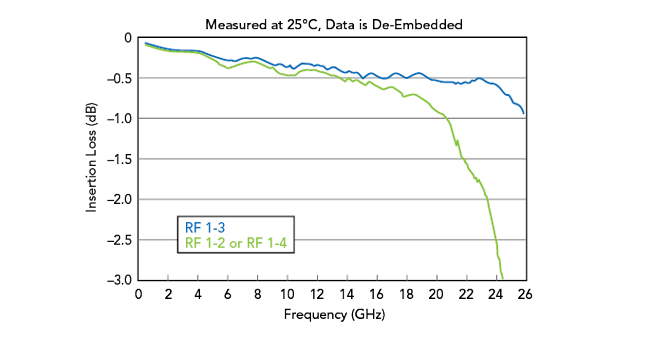
Figure 2 Insertion loss versus frequency at room temperature.
Linearity is another standout feature. With a typical third-order intercept point (IIP3) of 95 dBm, the switch supports high dynamic range applications and minimizes distortion in complex signal environments. This exceptional linearity is particularly beneficial for EW receivers, SIGINT payloads and frequency-agile communications systems operating in contested or congested RF spectra, where intermodulation distortion can severely degrade performance.
Reliability is often a limiting factor for mechanical switching technologies, but the MM5130-03NLX is rated for more than 3 billion switching cycles, significantly exceeding the lifecycle of traditional electromechanical relays. This long operational life, combined with resistance to shock and vibration, is especially important for radar, manpack communications and high-G UAV applications. Fast switching speeds — on the order of microseconds — further enable real-time RF reconfiguration, such as adaptive filtering, antenna selection and rapid band switching in dynamic mission environments.
The device’s compact 2.5 × 2.5 mm wafer-level chip-scale package further enhances its appeal for modern system designs, where board space is at a premium. This ultra-small footprint enables high-density RF integration and supports distributed front-end architectures that reduce coaxial cabling, connectors and associated losses. Despite its small footprint, the switch integrates multiple RF paths with individual gate control, allowing flexible configuration and control. Each channel can be independently controlled by applying gate voltage to the corresponding pin with sub microwatt power draw, minimizing the need for onboard system power supplies typical of PIN-diode-based solutions.
Thermal performance and power dissipation are also carefully addressed in the design. While the device maintains low self-heating under typical conditions, high-power operation requires careful thermal management to keep the case temperature within specified limits. This makes the device compatible with both conduction-cooled military electronics and lightweight commercial drone avionics. The datasheet provides guidance on calculating power handling as a function of insertion loss and frequency, enabling engineers to optimize performance within safe operating boundaries.
The MM5130-03NLX is particularly well-suited for applications such as switched filter banks, tunable filters, antenna tuning networks and low loss switch matrices. In defense systems, the 480 W of RF withstand makes the switch ideal as a limiter protecting the highly-sensitive front end of guided munitions and airborne platforms. This new product addition particularly serves the need for high RF withstand while Menlo Microsystems’ other product families have been addressing RF switch needs for instrumentation and automated test systems, where precision and repeatability are paramount.
From a system-level perspective, the MM5130-03NLX enables a new class of RF architecture that balances performance, size, efficiency with best-in-class high RF power withstand. By replacing traditional RF relays and overcoming the power and linearity limitations of solid-state switches, it enables highly-integrated, reconfigurable RF front ends suitable for next-generation drones, missiles and airborne platforms. By bridging the gap between solid-state and electromechanical switching technologies, it offers designers a versatile solution that meets the increasingly stringent requirements of modern RF and microwave systems.
Menlo Micro
Irvine, Calif.
www.menlomicro.com
sales@menlomicro.com