

Emerging from the theoretical into the practical domain, quantum computing continues to advance, with more and more organizations developing functional machines. Building on the ideas of scientists such as Max Planck, Albert Einstein, Max Born, Werner Heisenberg and Paul Dirac, and not forgetting Schrödinger’s dichotomic cat, physicists and engineers have overcome a plethora of challenges to put entanglement and quantum theory to use. While their algorithm execution capabilities are currently limited, the technology is benefiting from the Internet age, allowing researchers and the curious to explore quantum weirdness first-hand through simulators and cloud-based access to hardware.
As in the early years of classic processor development, there is still a lot of work ahead. There is little clarity on which of the current approaches to building a quantum computer will prevail, or even whether this is necessary, with perhaps several architectures required for differing needs. On this journey of continual design optimization in ion-trapped systems, one approach has replaced lasers with microwaves, delivering more accurate control and reducing power consumption by 80 percent of the most critical part of a quantum computer — its qubits.
THE LIMITATIONS OF CLASSIC COMPUTING
Despite decades of improvements in classical processor architectures, much of the performance still relies on either higher operating frequency, additional cores operating in parallel or modifications that optimize the processor for a specific task, as is the case with graphical processing units (GPUs). The current upper operating frequency limit depends on improvements in semiconductor technology. With clocks on existing production processors peaking at 5 to 6 GHz and no technological breakthroughs on the horizon, it is unlikely we’ll see clock-frequency-related improvements in the near term.
Instead, processor manufacturers have been placing ever more processing cores onto a single chip. While each additional processor theoretically adds the same level of processing performance, the means to leverage it is limited, firstly by our ability to implement our chosen algorithm for parallel execution and, secondly, by the processors’ limited ability to access shared memory optimally. Inevitably, the gains of parallel operation are impeded by periods of waiting to access or store data.
PROBLEMS SUITED FOR QUANTUM COMPUTING
This is an issue because classical computing reaches its limits as computing tasks become exponentially more complex, such as simulating atoms and molecules, modeling the intricacies of weather patterns or discovering new drugs. Luckily, these are precisely the types of problems that quantum computers are predicted to be good at.
So, where do the apparent superpowers of quantum computing come from? Unlike classical computers, which operate on bits of data, quantum computers use qubits. Using Dirac notation, qubits have one of two states (orthonormal) denoted by |0〉 and |1〉, or |g〉 and |e〉 for ground and excited. However, due to superposition, both of these states can occur simultaneously. This allows a quantum computer executing an algorithm to process multiple possibilities simultaneously.
In a paper published in Nature,1 Google claimed the first verifiable quantum advantage for this technology, running an out-of-time-order correlator algorithm in just over two hours. For comparison, they determined that the 1.3 exaflops Frontier supercomputer would have required almost three-and-a-quarter years to complete the same calculation.
FINDING AN ARCHITECTURE
There are parallels between the early days of classic semiconductor-based processor development and quantum computing. Implementing either a Harvard or a Von Neumann architecture, they competed on points of simplicity, flexibility, performance, determinism and cost. Over time, the industry has converged on a modified Harvard architecture, prioritizing performance over architectural purity.
The resulting processors operate on binary data, consisting of 1s and 0s. At a simple level, instructions move data from memory to a processor register and further instructions manipulate the data bit by bit or perform mathematical operations. Once the list of instructions has been executed, the result is then moved back into memory. Continuous repetition of such a list leads to the execution of an entire algorithm and completion of a task, such as encoding video data to a file.
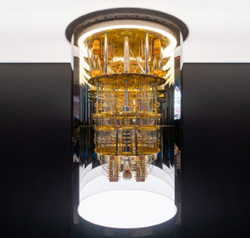
Figure 1 The ‘golden chandelier’ is the instantly recognizable design of superconducting quantum computers.
In the world of quantum computing, perhaps the most recognizable design is the superconductor-based architecture. Photographs show what appears to be a golden chandelier that becomes successively smaller, plated with gold and covered in intricate pipework (see Figure 1). The top stores the RF sources and room-temperature amplifiers. As we descend through the stacked plates, each stage is cryogenically cooled to ever lower temperatures until, at the bottom, we find the quantum processor chip. This is held at around 10 degrees mK. The chip itself is a semiconductor device that implements tiny resonators, coupling elements and control lines, which use microwave pulses to manipulate the qubits.
Trapped-ion quantum computers take a completely different approach and have simpler cooling requirements. They start by isolating charged ions using a laser from materials in the IIA and IIB groups of the periodic table. The ions are then confined in a Paul trap (quadrapole ion trap). This uses a combination of static and oscillating fields to confine ions that naturally repel one another into a chain-like structure. Before they can be used, the ions’ kinetic energy is removed using lasers to dampen their motion through Doppler and resolved-sideband cooling.
At this point, the ions are manipulated into their ground state using a laser, then configured to perform the desired task. Rather than using instructions as a classical processor does, an algorithm is implemented as a quantum circuit using a series of quantum gates and run to completion — accessing a qubit during operation would destroy its quantum state. The result is read using a laser and a detector (camera), with |0〉 state qubits absorbing the light and emitting a photon. Since the output is statistical, calculations are repeated multiple times to generate a consensus on the result.
QUBITS ARE NOT A MEASURE OF PERFORMANCE
Because the trapped-ion approach only requires the quantum circuit to be cooled to a few degrees Kelvin rather than milli-Kelvin, the required equipment and overall complexity are significantly lower than those of the superconducting approach. However, both face many challenges before the execution of practical quantum algorithms becomes viable.
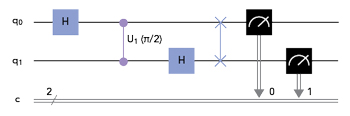
Figure 2 The total number of qubits needed for algorithm implementation, such as for this two-bit Quantum Fourier Transform, depends on the architecture of the quantum computer. Source: Quantum Computing UK.
According to American Scientist,2 one of their seven benchmark problems will require over 4,500 qubits; IBM’s Condor superconducting quantum processor has only recently broken the 1,000-qubit barrier.3 Thus, the scalability of qubit designs is the current challenge in tackling practical tasks. However, it should also be noted that comparisons between architectures cannot be drawn based on the number of qubits. Superconducting designs can only entangle neighboring qubits, meaning a quantum Fourier transform can require anywhere between 3x and 10x more qubits than a trapped-ion machine (see Figure 2).
Additionally, there are issues in correcting errors and maintaining coherence during operation. Superconducting quantum processors have faster gates and currently offer better scaling. In contrast, the trapped-ion approach offers better ion-to-ion connectivity, enabling simpler algorithm design with fewer qubits, higher fidelity and orders-of-magnitude longer coherence times.
USING MICROWAVES TO ACHIEVE SCALABILITY
In their ongoing research to improve trapped-ion designs, quantum computing developer eleQtron has developed a method that simplifies qubit manipulation (see Figure 3). Using ions from ytterbium atoms (171Yb+) that are trapped in a 20 MHz RF signal and a magnetic field in an architecture known as Magnetic Gradient Induced Coupling (MAGIC), it replaces one of the lasers typically used with a lower-power, more accurate microwave signal.

Figure 3 Internal view of quantum computing demonstrator developed by eleQtron together with NXP and ParityQC. Source: eleQtron GmbH.
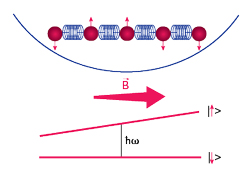
Figure 4 Ions are held in a harmonic trap (top) with an increasing magnetic field (bottom) that causes position-dependent shift, or hyperfine states, of the qubit resonances. These can then be controlled by a microwave signal. Source: Siegen University.
To set the initial qubit state, a microwave signal at 12.6 GHz, the frequency of the Yb+ hyperfine splitting, is used. Each ion is addressable at a distance of a few megahertz (see Figure 4). By comparison, lasers require complex optics and modulation schemes to steer the light to each ion, which, due to the wider signal bandwidth, results in higher crosstalk between qubits and lowers performance.
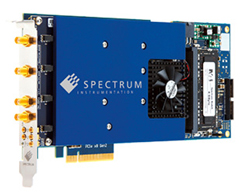
Figure 5 The M4i.6631-x8 16-bit AWG is a PCIe form-factor card that offers one, two or four synchronous channels.
The key to controlling the trapped ions is a signal generator that can be programmed to deliver the required signal frequency, amplitude and phase. Calculating this in the time domain is exceptionally challenging, which led eleQtron to seek an arbitrary waveform generator (AWG) that could meet their exact requirements.
The team reached out to Spectrum Instrumentation, which led to the evaluation of the M4i.6631-x8 16 bit AWG, a PCIe card that offers one, two or four synchronous channels (see Figure 5). Its 16-bit, 1.25 GSPS outputs, with up to 400 MHz of bandwidth, are backed by a large on-board memory that can be segmented to replay different waveforms. However, it was the direct digital synthesis (DDS) firmware option, coupled with close technical support, that helped overcome the challenges of previous AWG hardware.
Rather than prepare and upload gigabytes of AWG data, DDS allows the definition of up to 20 sine waves on a single channel, or 23 across up to four channels. Through the C++ programming application programming interface (API), each parameter change (frequency, amplitude, phase) require a single command. DDS commands can also be buffered in on-board memory, allowing the signal to be updated by external trigger sources, internal timers or in response to a command, without glitches or jitter and with a timing resolution as low as 6.4 ns (see Figure 6). In addition to static parameters, dynamic parameters, such as frequency and amplitude slopes, can be defined for intrinsic linear changes in the output signal.
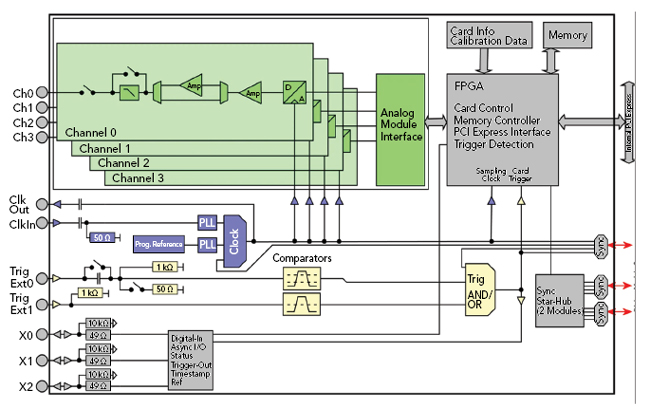
Figure 6 DDS enables glitch- and jitter-free synchronous modification of the signal based on trigger sources (bottom left) or commands from the C++ API.
WORKING TOWARD SERIAL PRODUCTION
While lasers still play an essential role in a trapped-ion quantum computer architecture, the replacement of lasers with microwaves for setting the quantum ground state of the qubits is key to the success of eleQtron’s approach, enabling precise control of the frequency, amplitude and phase at the required 1 Hz spectral width and lowering power consumption.
Currently, systems with 30 qubits are in operation, and institutes such as the Jülich Supercomputing Center are developing a quantum supercomputer4 that combines this quantum computing architecture with classic computing modules. This should result in a 60-qubit machine ready for serial production by 2027. Coupled with simpler cooling requirements and more extended periods of coherence than in superconducting designs, this could be the architectural path to the practical application of quantum computing.
References
- D. A. Abanin, et al. “Observation of Constructive Interference at the Edge of Quantum Ergodicity,” Nature, Vol. 646, No. 8086, Oct. 2025, pp. 825–30, Web: https://www.nature.com/articles/s41586-025-09526-6.
- B. Hayes, “Programming Your Quantum Computer,” American Scientist, Feb. 6, 2017, Web: https://www.americanscientist.org/article/programming-your-quantum-computer.
- J. Gambetta, “IBM Quantum Computing Blog | the Hardware and Software for the Era of Quantum Utility Is Here,” IBM.com, Dec. 4, 2023, Web: https://www.ibm.com/quantum/blog/quantum-roadmap-2033.
- “EPIQ: A Quantum Supercomputer Made in North Rhine-Westphalia,” Jülich Forschungszentrum, March 25, 2024, Web: https://www.fz-juelich.de/de/aktuelles/news/pressemitteilungen/2024/epiq-ein-quanten-supercomputer-made-in-nrw.