

In recent years, 5G communication technology has developed rapidly. Compared with previous generations of communication systems, 5G systems operate at higher frequencies and offer wider bandwidth. It represents a new generation of mobile communication technology characterized by high speed, low latency and massive connection capacity. The three main application scenarios of 5G technology are: enhanced mobile broadband, ultra-reliable low latency communication and machine-type communication. It can meet various application requirements, such as industrial control, autonomous driving, smart homes and smart cities. 5G communication facilities are the network infrastructure for achieving human-machine-object interconnection. Correspondingly, the requirements for antennas applied in 5G systems are also higher. They need ultra-wideband antennas covering the operating frequency band and, at the same time, meeting characteristics such as dual polarization, high cross-polarization isolation and high port isolation.
A-INFO offers the dual polarized antenna model LB-SJ-180500, which operates in the 5G frequency bands. Its operating frequency band covers 18 to 50 GHz. It has high cross-polarization isolation and a stable radiation pattern across the frequency band. The antenna features a rectangular quad-ridge horn structure. This configuration can be viewed as a quad-ridge waveguide structure with an open termination. The electromagnetic waves mainly concentrate between the two opposite ridges and gradually radiate into free space as the angle of the open-end increases. The outer contour curve of the ridge structure is an important factor affecting the electromagnetic wave radiation state. The antenna is a dual-port feed and the feeding ports can be selected with different connector structures according to requirements. This antenna can provide dual polarized radiation and maintain stable gain characteristics across the frequency band. The physical structure is shown in Figure 1.
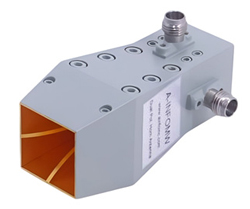
Figure 1 Model LB-SJ-180500 antenna.
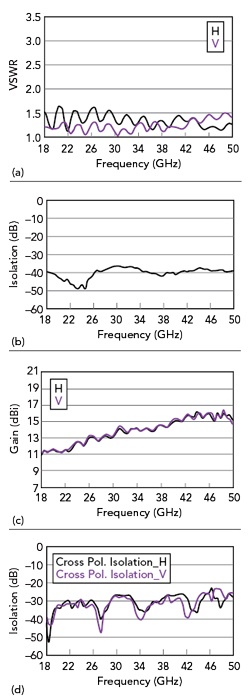
Figure 2 Measured results of antenna LB-SJ-180500: VSWR (a); port isolation (b); gain (c) and cross polarization (d).
Figure 2 shows the measured performance results. Across the operating frequency band, the VSWR remains below 2, the port isolation is less than -35 dB, the gain results are between 8 to 15 dBi and the cross-polarization isolation is less than -30 dB. The dual polarized antenna has significant advantages in communication systems. Dual linear polarized antennas can operate in duplex mode. A single antenna can simultaneously transmit and receive orthogonal electromagnetic waves, thereby improving communication efficiency, reducing polarization-mismatch losses and enhancing signal reception stability. This eliminates the need for multiple units, saving installation space and reducing operational costs, with additional benefits in limited-space environments. A dual polarized antenna can provide diversity gain, offer wide signal coverage, improve edge coverage and enhance communication quality. To meet the needs of practical use, A-INFO has designed various dual polarized antenna products, including dual line polarized antennas and dual circular polarized antennas.
To offer customers more choices, A-INFO provides antenna products with different indicators and structures within the same operating frequency band and polarization state. For example, as shown in Figure 3, LB-SJ-180500L is based on the basic model LB-SJ-180500, with adjustments to the antenna design. While maintaining structural and appearance similarities to the base LB-SJ-180500, it can offer a wider beam width. The structure of LB-SJ-180500H, shown in Figure 4, is based on the LB-SJ-180500 antenna structure and adds a connection structure between the radiation surface and free space, widening and heightening the radiation surface, thereby achieving higher gain within the same operation frequency band.
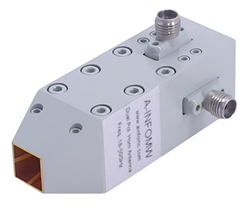
Figure 3 Model LB-SJ-180500L.
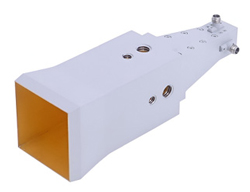
Figure 4 Model LB-SJ-180500H.
Related antenna series include the LB-SJ-180540 (15 to 54 GHz) and LB-SJ-180550 (18 to 55 GHz) models. While maintaining stable performance, these antennas expand the operating frequency range to 18 to 55 GHz, enabling them to meet more application scenarios for customers. Additionally, when a dual polarization antenna is used in combination with a hybrid, circular or dual circular polarization antenna can be obtained. The usage method is more flexible and convenient. All of the above antenna series can provide outdoor application versions with a radome, enabling the antennas to adapt to a wider range of application environments and more stringent requirements. Field verification confirms that the LB-SJ-180500/180540/180550 antenna series delivers excellent performance in practical applications.
A-INFO, Inc.
Irvine, Calif.
www.ainfoinc.com