

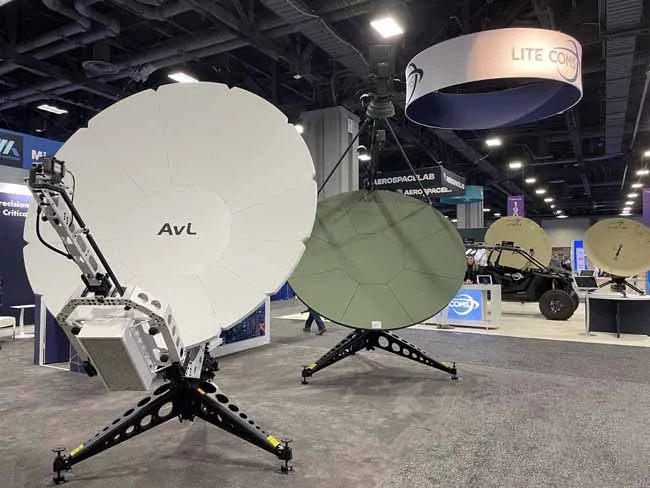
SATELLITE 2026 is the satellite industry’s largest gathering of commercial leaders, engineers, government and military decision-makers, innovators, and end-users for collaboration and technical exchanges taking place in Washington, D.C. From the ground to orbit, SATELLITE showcases the technologies, applications, and people pushing the boundaries of technology. GovMilSpace is a dedicated event for defense, intelligence, and government professionals and was co-located with the event.
Here is our photo gallery from the event.
From an RF/microwave perspective, the hot topics were non-terrestrial networks (NTN) and flat panel arrays. 5G NTN is enabling satellite networks to be part of the commercial mobile space with direct-to-device and IoT services where terrestrial coverage is not available. Flat panel arrays continue to capture significant market share in commercial aircraft and ships for in-flight Internet service and on-the-move comms.
Flat-panel arrays have enabled more compact in-flight connectivity and mobile communications for the military. In the last couple of years, new multi-orbit, multi-band solutions have been developed, enabling connectivity to multi-satellite networks and across multiple frequency bands.
We visited the exhibition for two days and found the following products and technologies on the show floor:
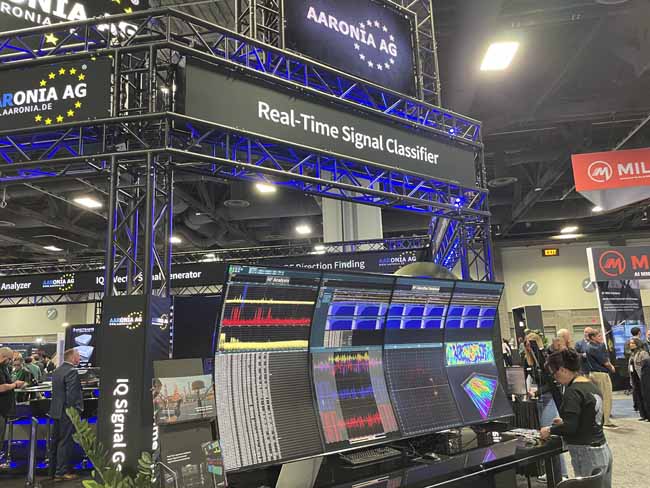 Aaronia showed off its latest USB real-time spectrum analyzers, antenna technology, and—in addition to the leading drone detection system, Aartos—its entire product portfolio for spectrum dominance. The SPECTRAN V6 real-time spectrum analyzers of the XPR family, equipped with sweep rates of >3 THz/s and state-of-the-art waveguide technology, enable reliable analysis and evaluation of high-frequency, rapidly changing signals in the microwave range. The SPECTRAN V6 PLUS XPR 250XB-WR12, for example, offers 10 dB LF at 77 GHz. With the SPECTRAN V6 Command Center, Aaronia AG is introducing what is currently the fastest real-time spectrum analysis solution, designed for mobile high-end signal analysis. The system enables extremely fast broadband frequency monitoring with simultaneous detailed analysis, including data recording. This allows any signals to be displayed in a wide variety of ways. Demodulation or decoding of many signal types can also be performed without difficulty.
Airbus Defence and Space and Greenerwave announced the strengthening of their strategic partnership by expanding their collaboration. Through these agreements, Airbus Defense and Space is enhancing its end-to-end satellite communications (SATCOM) solutions by leveraging Greenerwave’s innovative flat-panel antennas, recognized for their multi-orbit capability and very low power consumption. This enables flexible, easy-to-deploy, reliable, and resource-efficient solutions in demanding environments.
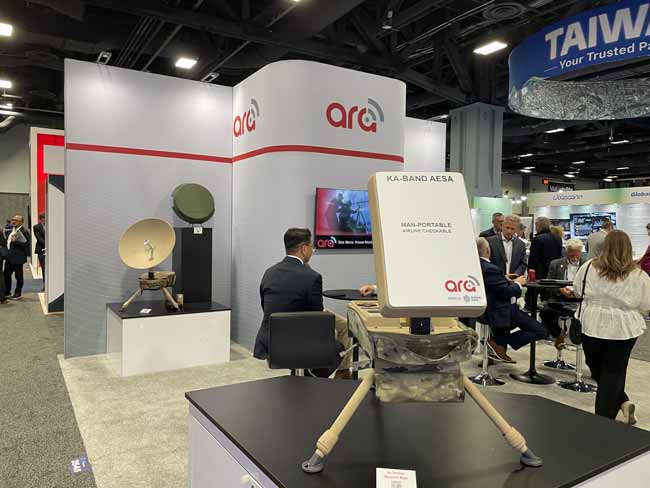 ARA exhibited a range of advanced systems underscoring its commitment to solving modern challenges with next-generation technology. The company recently announced the new, modular Saterra terminal, which offers a complete family of systems in a single, transportable VSAT, offering flexibility and resiliency for planning. The modular concept offers 3 interchangeable multi-focal feeds, 4 reflector sizes using a common base and positioner. The terminals are available individually or as a set.
- X/Ku/Ka bands• 0.6/0.8/1.0/1.3m apertures
- Single push button auto acquisition in <3min
- Interchangeable feeds and reflectors
Also on display were ARA’s new Ku- & Ka-Band Manpack AESAs, developed in collaboration with France-based Greenerwave, and the PRS-11 GBS Manpack Terminal, a government program of record terminal transforming the way warfighters access critical communications in the field. Also featured were ARA’s 2577MLW Lightweight MUOS Antenna, 380LV Flat Panel MUOS Antenna, Software Defined Antenna and Dismounted Antenna Solutions.
Cinch was focused on providing faster speed-to-market and lower-cost deployment through space-qualified, commercial-off-the-shelf interconnect solutions. Alongside their deep history in space and satellite applications, their engineers provide custom solutions for a range of wireless and RF applications.
Cubic Secure Communications (a business unit of Cubic Defense) showcased its Vector multi-band, multi-beam, multi-orbit SATCOM antenna. Vector delivers resilient, assured communications across satellite networks. Engineered for air, ground and surface platforms, Vector enables simultaneous connectivity across LEO, MEO, and GEO constellations in both Ku- and Ka-bands, helping resolve critical gaps in wideband tactical communications. Vector is a modular, low-SWaP-optimized phased array antenna built on a software-defined, digitally beamformed architecture. Designed to support hybrid SATCOM and line-of-sight networks and expanded multi-function capabilities, Vector consolidates multiple apertures and functions into a single extensible system, providing a trade space between reduced SWaP-C and operational performance.
Empower RF’s amplifier portfolio delivers cutting-edge solid-state solutions designed to meet the demanding requirements of SATCOM uplinks and space EW systems. Leveraging high-power GaN-on-SiC and LDMOS device technologies, these amplifiers span from tens of watts to multi-kilowatts in both CW and pulsed modes, with spectrum coverage from HF to X-Band. A core advantage of Empower’s patented architecture is dramatic size and weight reduction, and power density improvements. These solid-state amplifiers are more compact, rugged, and efficient than traditional tube-based architectures and offer reliability and spectral fidelity needed for complex modulations and high data throughput. These amplifiers are also designed for flexibility and resilience. Standard features include embedded high-speed processing for remote monitoring & control, automatic gain (AGC) and level control (ALC) modes to ensure precise control, SW-driven system protection for fault or mismatch conditions to ensure survivability, and a robust mechanical design to protect against environmental stress.
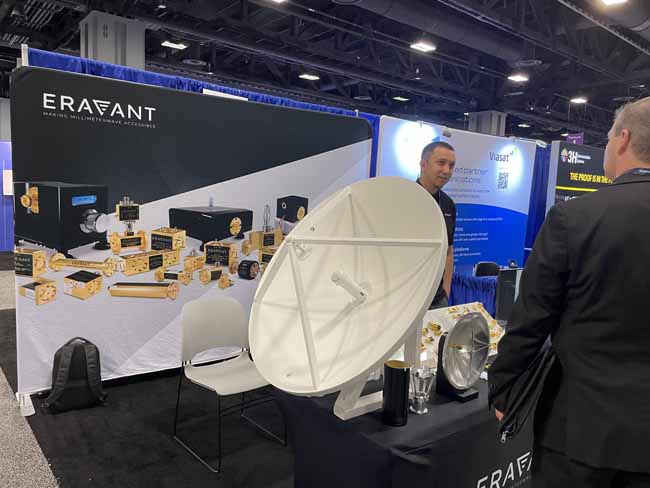 Eravant featured several Q/V-Band components, such as the SAU-403503854-22-DCP1, a high-performance, dual-circular-polarized antenna-feeding network assembly designed for Q/V-band satellite communication ground station applications. The feed network is designed to operate in the popular Q/V-band frequency spectrum with a Rx frequency range from 37.5 to 42.5 GHz and a Tx frequency range from 47.2 to 52.4 GHz. The feed network comprises an integrated linear-to-circular polarizer, an orthomode transducer (OMT), and two diplexers. The feed network allows antennas to support both left- and right-handed circular polarizations in the Tx and Rx channels simultaneously. The feed network is designed for outdoor conditions and features internal O-ring sealing and a corrosion-resistant chem-film surface treatment on the external aluminum enclosure.
ERZIA’s New Space COTS amplifier line has been specifically developed to address the stringent requirements of New Space applications. Evolved from our trusted commercial off-the-shelf line, each amplifier combines superior RF performance with advanced engineering to withstand the extreme vibration, shock, and thermal stresses of space missions. They have added five new high-performance modules, designed for scalable satellite constellations and demanding new space applications. All products are space-tolerant, reliable, and ready for deployment.
Global Invacom Group (through its wholly owned subsidiary, Global Invacom Limited) and Satwave Arrays signed a Memorandum of Understanding to enable the commercial production of a multi-orbit Flat Panel Antenna for Ka/Ku-band. Through the MoU, Global Invacom intends to bring to the market an innovative FPA which will be motorized, and will feature pan and tilt capability, enabling it to seamlessly switch between LEO, MEO and GEO orbits without signal loss, for enhanced operating flexibility and availability. The MoU establishes a partnership under which Global Invacom and Satwave Arrays will jointly collaborate, integrating their technology to produce the next-generation terminal. The resulting antenna will be compact, lightweight, and designed to withstand being in constant motion. They also recently launched their XY antenna range, designed to deliver fast, reliable multi‑orbit and multi‑band connectivity in the most demanding operational environments. The expanded range is now available in four sizes — 0.98m, 1.2m, 1.8m and 2.4m — enabling Global Invacom to better support the evolving requirements of government, defence, and commercial operator customers worldwide.
Guerrilla RF announced its expanded focus and readiness to support the rapidly evolving SATCOM market. With a deep portfolio spanning low-noise small-signal devices through high-power RF power amplifiers, Guerrilla RF now offers more than 100 component solutions engineered for mission-critical SatCom applications across both ground-based infrastructure and spaceborne platforms. As commercial off-the-shelf (COTS) devices, Guerrilla RF’s components are becoming increasingly popular choices for engineers seeking cost-effective, readily available, and field-proven high-performance RFICs. These solutions enable designers to accelerate development cycles while maintaining the performance and reliability demanded by modern satellite communications systems.
Infineon Hi-Rel discussed the company's latest radiation-hardened, radiation-tolerant, and high-reliability power, memory, and RF solutions, including:
- Rad hard MOSFETs, featuring Infineon's latest R9 generation SMD-0.5e enhanced package, which offers optimal thermal solutions in a space-saving footprint
- The industry's first DLA JANS-qualified rad-hard GaN transistor, a 2025 MAE Innovator's Award Platinum-level recipient.
 Intellian Technologies was showcasing its next-generation 2.4m flyaway antenna designed for communications-on-the-pause. Anticipated to be the industry's first tactical WGS flyaway system capable of simultaneous X-band and Mil Ka-band connectivity, this technology is built to solve critical government and defense challenges. In the aero sector, they were showing the OW11FA user terminal for OneWeb LEO, developed in a strategic partnership with Panasonic Avionics. The company also offered previews of an upcoming L-band solution for both UAVs and USVs, alongside a highly anticipated next-generation UAV design for LEO currently in development. Intellian’s rapidly growing Flat Panel Series, powered by its advanced Electronically Steered Array technology, continues to capture significant market share. The newly available, highly agile Manpack solution is on display, alongside a preview of their NGO Ka-band solutions.
Keysight featured demonstrations during the show including:
-
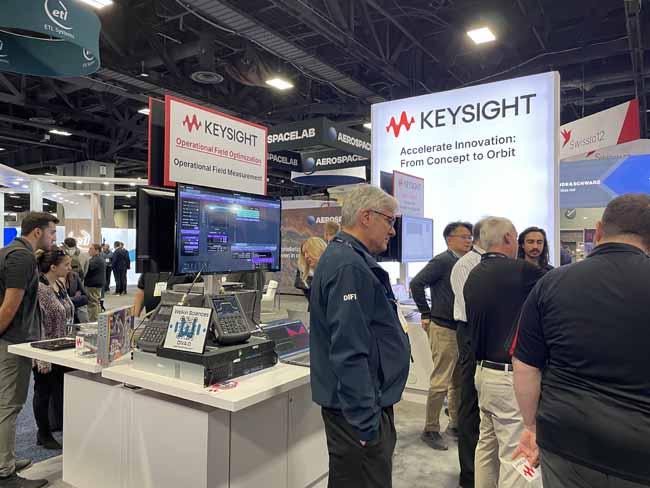 Enabling Interoperable SatCom with DIFI
 - Digital Twin-Enabled Design of 5G & 6G Satellite Links
- How D2D Technology Can Enable New Use Cases for USG
- GNSS Simulation
- OTA Measurement Link Analysis.
Keysight was showing off its compact antenna test range (CATR) OTA test chambers, which deliver highly repeatable OTA measurements from sub-6 GHz to mmWave frequencies in compact, integrated enclosures. Designed for 5G, 6G, and satellite communication device testing, these turnkey chambers combine precision reflector technology, wide angular coverage, and low-reflection environments to enable consistent, standards-compliant results, without the footprint of a full anechoic chamber. Whether you're performing R&D, conformance, or production testing, Keysight CATR chambers support high dynamic range, fast switching, and automated test control to accelerate your device evaluation with confidence.
Kymeta announced its new Kestrel u5 – the smallest multi-orbit SATCOM terminal designed for national security sectors, unmanned systems, and high-speed mobility operations, where vibration, environments, and constant movement often challenge reliable connectivity. The Kestrel u5 provides reliable, critical connectivity for government and military teams to stay connected and adapt to multiple mission profiles. Its ability to seamlessly switch between beams in under 1 millisecond across networks, constellations, and multiple orbits – ensures stable connectivity and low-profile in extreme conditions. Kymeta also revealed specifications for its first multi-band, multi-orbit, single aperture antenna – as part of a revolutionary new user terminal set to make other SATCOM technologies secondary when mission comes first. Named in development as the ‘Kymeta KuKa 8 Series’, this next-generation electronically steered user terminal has the highest capability density of any satcom antenna ever designed. It enables simultaneous operation across both Ku and Ka frequency bands within a single, compact, low-profile flat-panel antenna. It supports seamless switching across satellite networks spanning multiple orbits and frequency bands, while enabling simultaneous access to multiple constellations.
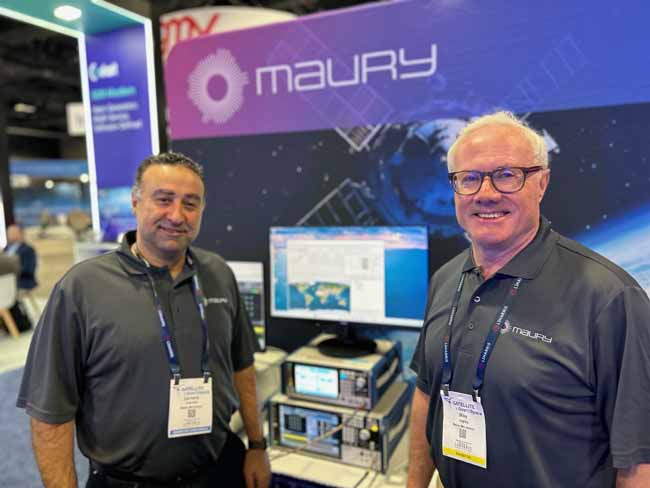 Maury Microwave was demonstrating doppler shift that must be emulated during satellite link testing to evaluate LEO modem performance. This demonstration uses SATGEN, a satellite impairment modeling software program for the Maury Microwave ACE9000 Advanced Channel Emulator, to generate a dynamic Doppler shift scenario. In this demo, a LEO satellite traveling at approximately 17,500 mph produces about 20 kHz of Doppler frequency shift on the RF link between the ground station transmitter and the onboard satellite receiver. Using two-line element orbital data, SATGEN calculates time-varying signal delay, frequency offset, and attenuation associated with the moving satellite. The resulting Doppler profile is applied to a CW signal generated by the Maury SGX1000 RF signal generator. A spectrum analyzer displays the carrier frequency shift over time, illustrating the dynamic Doppler effect observed during a LEO satellite pass. Another demonstration for Satellite Link Channel Modeling applies IMUX/OMUX filtering and amplifier compression using the Payload feature in the Maury Microwave ACE9000 Advanced Channel Emulator GUI. A user-defined IMUX/OMUX filter profile is created to model the RF characteristics of the channel. A wideband AWGN signal generated by the Maury NGX1000 or UFX7000B is applied to the ACE9000, so the resulting filter response across the entire IF bandwidth can be clearly observed at the output. The GUI capture mode displays the signal spectrum before and after filtering. Amplifier compression is then applied using the ACE9000 non-linearity wizard to illustrate the resulting reduction in SNR and dynamic range.
Microchip showed off a wide variety of products and solutions for Small Satellites Constellation and New Space programs, Moon and Mars exploration, Satellite buses and platforms, Satellite payloads, and Launchers. The company also offers a suite of use cases, evaluation cards, software IP and development environments to accelerate application designs.
Microsembly highlighted its end-to-end partner services for RF and microwave microelectronics, supporting customers from early engineering through full production, testing, and qualification. What differentiates Microsembly is not just its manufacturing capability, but its ability to eliminate friction across the entire hardware lifecycle—reducing risk, avoiding costly redesigns, and accelerating time-to-mission.
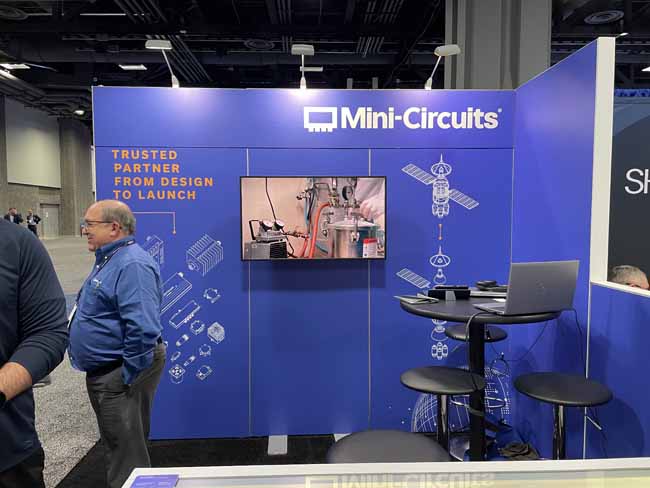 Satellite is a growing area for Mini-Circuits for ground terminals, in-satellite and test/measurement applications. They are meeting the demand for wider bandwidths and higher frequencies. Mini-Circuits’ CEO, Jin Bains, was interviewed by Rachel Jewett from Via Satellite at SATShow Week 2026 in Washington, D.C., on March 24, and discussed the satellite market for RF and microwave products and how Mini-Circuits is supporting the growing range of space and satellite applications. Here is a link to the interview to learn more about their space upscreening and launch prep program: https://www.minicircuits.com/ads/space-upscreening.html.
NexSat Space Systems Corporation (NexSat) unveiled its first groundbreaking product, ACE (Aero Conformal ESA) — an industry-first, fully integrated Ku/Ka-band electronically steered antenna (ESA), known as “The Invisible Antenna.” Working with Qorvo, NexSat will deliver the next wave of global connectivity to the SATCOM and aero market. ACE is a fully conformal, embedded Ku/Ka-band ESA, enabled by Qorvo beamformer IC (BFIC) technologies and SATCOM systems expertise, integrated into a resilient composite matrix. Leveraging Qorvo’s latest advances in BFIC technology and phased-array systems expertise, the ultra-thin, conformal architecture minimizes aerodynamic drag while delivering continuous multi-orbit connectivity across dynamic flight envelopes, including high-G, supersonic, and hypersonic regimes. This revolutionary system seamlessly embeds the antenna into aircraft surfaces using a patented 3D robotic Additive Manufacturing and Compression Mold (AM-CM) process, eliminating the need for traditional radomes and external apertures.
NXGSAT, in partnership with ETL Systems, has successfully demonstrated an interoperable, fully productized 5G NTN solution, combining NXGSAT’s software-defined 5G NTN user equipment modem with ETL’s GENUS Digital platform, integrated through the Digital IF Interoperability (DIFI) standard. This joint showcase highlights how open, virtualized and modular satellite communication architectures can be realized in practice, using standardized digital interfaces to simplify integration and accelerate deployment of 5G NTN networks.
Nuvotronics highlighted a portfolio of compact, high-performance RF components designed to address the size, weight, and performance demands of modern satellite payloads and ground infrastructure. Featured solutions include surface-mount SatCom filters with space heritage spanning Ku through E/W band frequencies, multiplexers and switched filter banks, couplers and combiners, and wideband antennas. Built using Nuvotronics’ proprietary PolyStrata® technology, these components deliver high-Q performance, low insertion loss and compact form factors suited for space and ground applications. Nuvotronics will also demonstrate StrataWorks™, its online RF filter design tool that enables engineers to design, simulate, and order production-ready filters from 7 to 60 GHz.
Open Cosmos unveiled its new global space-based IoT service - the only offering to fuse global IoT connectivity with real-time Earth Observation data to deliver contextual intelligence to governments and institutions across the world. The platform represents the world’s largest and most advanced integrated data ecosystem, powered by the company’s unique multi-layer satellite architecture – a trilogy of broadband secure connectivity, Earth observation, and IoT. It will enable organizations to monitor, understand, and respond to events on Earth with unprecedented speed and insight.
Optical Zonu explained that traditional RF distribution approaches, such as coax and waveguide, can become problematic for D2D/NTN gateways. Traditional RF systems:
- Coax losses grow quickly with frequency and distance
- Waveguide adds weight, installation burden, alignment sensitivity, and maintenance complexity
- Electrical pathways invite EMI/EMC complications, especially in dense RF sites
- Centralized RF equipment architecture
- Distributed antenna layouts across facilities create long RF runs and inconsistent performance
Analog RFoF directly addresses these constraints by moving RF as light:
- Low-loss transport over long distances (without RF coax penalties)
- EMI immunity and improved survivability in high-RF/industrial environments
- Flexible antenna placement and simplified site design
- Centralized processing (modems/RAN/SDR resources can be consolidated)
- Phase-stable, multi-channel transport suited for calibration, beamforming support, and high-fidelity test
This matters for both commercial and defense-aligned deployments because gateway sites increasingly need to be modular, disaggregated, and rapidly scalable.
Pickering Interfaces showcased its HIL sensor simulation demo. The HIL sensor simulation demo is housed in Pickering’s 8-slot Gen3 PXIe full hybrid modular chassis (42-924), featuring an intelligent chassis management system that monitors the power supply voltage, internal temperature, and cooling fan speed. Inside the chassis, there are several Pickering PXI modules, including:
- PXIe embedded controller (43-920)
- PXI millivolt thermocouple simulator module (41-760)
The demo also features a thermocouple sensor from Omega and a data logger from Pico.
Plextek showcased its mmWave radar technology with a live demonstration of their radar system in action. It highlighted how the system addresses challenges that cameras and LiDAR struggle to overcome in space environments. The technology enables reliable sensing in conditions such as darkness, solar interference, and dust-obscured environments. Applications include millimeter-scale debris detection for LEO, rendezvous and proximity operations, and sensing solutions designed for challenging lunar environments.
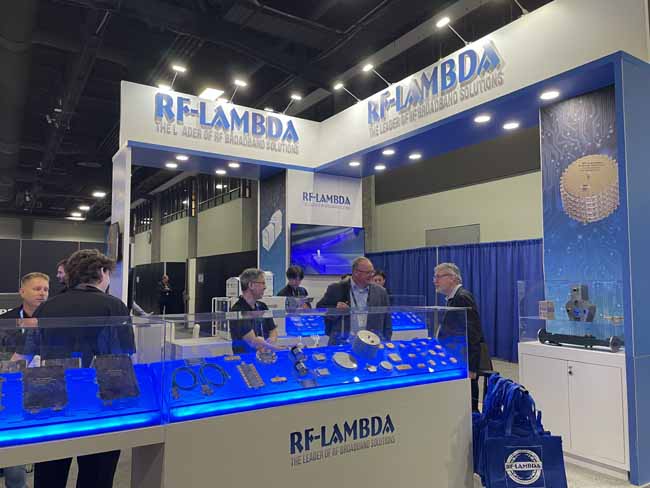 RF Lambda is a global company that continues to grow and evolve through challenging the boundaries of technology. They are a industry leader in manufacturing RF components, specializing in RF broadband and high-power solutions. Their highly innovative designs and extensive customization capabilities are creating new and unimaginable solutions that connect people, places, and things through high-powered applications that go beyond expectations. ISO and ITAR registered, we are empowering and revolutionizing RF components for military defense, aerospace, and commercial applications. Their products include all types of RF/microwave components and systems.
RFMW was hosting CML Micro and Knowles in their booth. CML Micro displayed their MMA-121633-M5, a 12.5–15.5GHz 2W power amplifier, designed to deliver high efficiency and linearity for demanding satellite communications applications and CMX90A705, a 27.5–31GHz 5.5W Ka-band GaN power amplifier, designed to deliver high efficiency and linearity for demanding satellite communications systems.
As higher-frequency technology evolves to incorporate Surface Mount assembly and the latest packaging for Active Devices, Knowles sees the need for complementary filter and other passive device products. Dielectric Laboratories Brand Microwave products can fill this need with their temperature-stable dielectric materials and highly reliable designs. Catalog and custom design options available.
Rohde & Schwarz featured many aspects of its business, including the R&S®MSR4, a compact and versatile SATCOM receiver designed for ground stations. With four tunable channels in the L-band (500 MHz to 3 GHz), this small-form-factor solution is ideal for easy integration into various scenarios. Experience the flexibility of our SDR platform, enabling applications such as:
- IQ streaming
- Internal record and replay
- DVB-S2X receiver applications
 Plus, combine the R&S MSR4 with R&S GSACSM for advanced SATCOM link monitoring capabilities.
The R&S®SATCOM Link Observer, the advanced communications system monitoring solution for SATCOM, enables customers facing these challenges to keep tabs on SATCOM system reliability with:
- Automatic error detection and correction capabilities enable quick identification and resolution through early warning; reduce reaction time so that countermeasures can be initiated as soon as possible, thus reducing downtimes and failures, minimizing impact on operations
- Identification of impairments during operation, allowing prompt resolution and minimizing the impact on communications; enables maintenance of reliable and secure communication links, even in challenging environments
- Device access for users worldwide allows operators to conduct flexible monitoring
- High efficiency through a combination of features (including classic spectrum analyzer functions, 24/7 trapping systems, advanced signal detection, and signal analysis and classification) in one system, reducing the personnel needed for monitoring tasks
- Continuous measurements and event logging capabilities enhance SATCOM system resilience
- Future-ready solution with both graphical and application programming interfaces that addresses the challenges of non-standardized SATCOM systems, evolving industry activities, mission-critical communications links, and growing spectrum interference
- Supports various Rohde & Schwarz sensors to meet individual customer requirements
The Space Data Association (SDA) is a non-profit international association of satellite operators that supports the controlled, reliable, and efficient sharing of data critical to the safety and integrity of the space environment. The SDA is open to all satellite operators and other participants. Its membership comprises many of the world’s major satellite communications companies, as well as key operators of scientific, remote sensing, and environmental satellite systems. Director members include Eutelsat, SES, and Viasat. The organization is publishing an article with Microwave Journal in April on the DiFi standard interface for RF.
SWISSto12 announced the inauguration of a purpose-built assembly facility at its headquarters in Renens, Switzerland, to support the industrial-scale production of its HummingSat geostationary satellite platform. HummingSat is SWISSto12’s next-generation geostationary satellite. With first deliveries scheduled for 2027, the solution offers nations and operators agile, sovereign satellite communications at a fraction of the delivery time, size, and cost of legacy GEO satellite solutions. The new dedicated cleanroom is Switzerland’s first end-to-end manufacturing hub for this class of satellites and will bolster SWISSto12’s efforts to serve customers requiring quick, reliable deployment.
The move shortly follows SWISSto12’s €73 million investment from the European Space Agency, highlighting not only the industry’s confidence in HummingSat’s market readiness but also SWISSto12’s dedication and success in providing advanced satellite systems and any orbit payload technologies to a global market.
 Teledyne Technologies showcased live demonstrations of the EV10AS940 ADC using Non‑Uniform Sampling (NUS) to reduce satellite data throughput while preserving signal integrity, and a 16-core Arm® Cortex® A72 radiation‑tolerant processor running real‑time AI image processing. Additional products on display include the TDLNA0840EP, the industry’s lowest‑power 4 GHz low‑noise amplifier (LNA); the TDOC8012-04CC0 high‑voltage optocoupler; the TSA-226001 digitally tunable YIG band‑reject filter (2–20 GHz); high‑power amplifiers; space‑qualified coaxial switches and relays; rugged SATCOM systems with radiation monitoring and geospatial analytics; and rapid RF/microwave PCB prototyping with five‑day turnaround.
TE Connectivity traces its heritage in space exploration back to the days of the Explorer 1 satellite and Project Mercury manned flights, up to technology on today’s key missions such as the Curiosity Rover on Mars, Juno spacecraft exploring Jupiter, and the BepiColombo spacecraft on its way to Mercury. The company discussed:
- The data capacity challenges in space, and how to meet growing demand for connectors that can handle increased data rates without traditional SWaP limitations
- The latest on the new space station and NASA Lunar Exploration Projects TE Connectivity is supporting
- How industry standards are evolving with flexible, space-grade components.
ThinKom Solutions announced the launch of its new Containerized Digital Array for the enterprise and defense markets. This solution is a transportable ground station that replaces vulnerable dish-based ground-entry points with a compact, rapidly deployable ground node, enabling decentralized communications for mission-critical operations. Powered by advanced VICTS technology and equipped with all the advantages of ThinKom’s digital beamforming technology, the Containerized Digital Array features concealed, coherently combined phased-array antenna modules integrated within a rugged shipping container to leverage established logistics and minimal site preparation. including servers, networking, and power systems, with options for enhanced security and environmental controls. The software-defined system features an adaptable, scalable architecture supporting multi-beam, multi-orbit, multi-band, and multi-network operations across LEO, MEO, GEO, and HEO satellite networks. Combined with high survivability and low visual/heat/wind signature, the Containerized Digital Array lays the groundwork for a proliferated ground segment.