

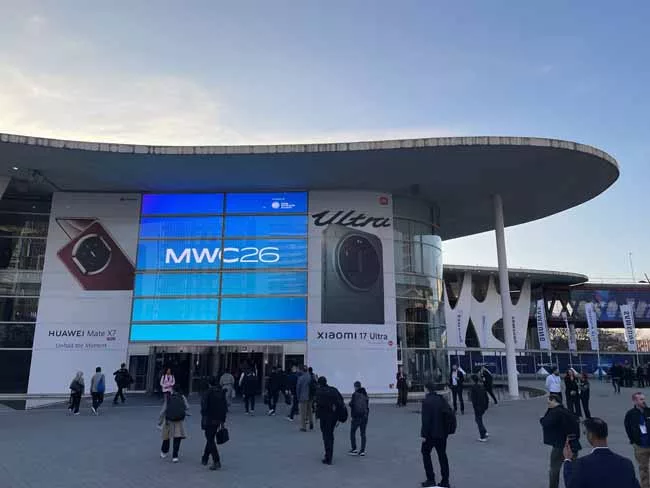
MWC26 celebrated 20 years in Barcelona, bringing together exhibitors, thought leaders, startups and policymakers. Despite some travel disruptions in the Middle East, there were nearly 105,000 attendees from 207 countries and territories; 2,900 exhibitors, sponsors and partners; and over 1,700 speakers and thought leaders. The event highlighted a major shift in the telecom industry toward AI-driven connectivity and the early foundations of 6G networks. Artificial intelligence was embedded across devices, networks, and services, with vendors demonstrating AI-native network architectures, autonomous network management, and AI assistants integrated into smartphones and telecom platforms. Chip and infrastructure companies emphasized AI computing for telecom, while operators explored AI-RAN and automation of network operations. At the same time, the industry accelerated work on 6G concepts and standards, including AI-native architectures and sensing capabilities for future networks. Another key trend was the rapid progress in satellite-to-device and non-terrestrial networks (NTN), aimed at extending coverage globally and complementing terrestrial cellular systems.
Here is a link to our videos of demos from Keysight and R&S, along with our photo gallery from the event. Some news from companies I saw at the event:
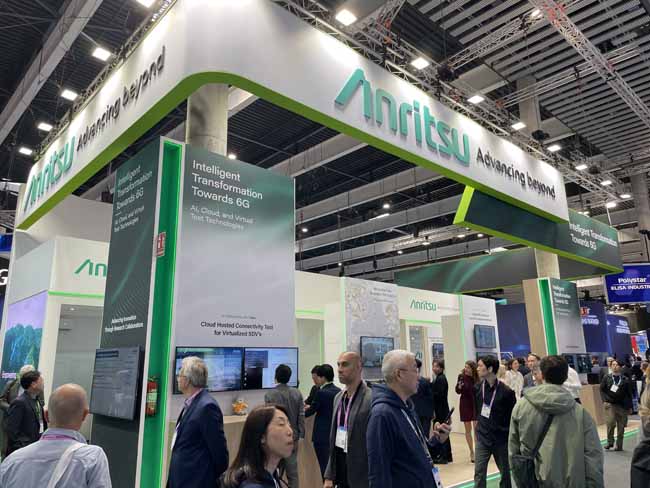 Anritsu and MediaTek successfully verified the AI QoS and AI L4S Technologies featured in MediaTek’s T930 5G CPE platform by using Anritsu’s Radio Communication Test Station MT8000A. By establishing an end-to-end connection between the client and the game server through the CPE and the MT8000A, the setup recreates a cloud gaming environment. Within this scenario, Anritsu and MediaTek can verify the low latency performance delivered by the AI Acceleration technology. MediaTek’s Intelligent CPE with AI QoS and AI L4S is an advanced latency compensation technology that significantly enhances the user experience in latency sensitive applications such as online gaming. As advanced 5G and future 6G technologies become foundational to the evolution of online gaming, XR, drone/remote control, and live commerce, this technology is expected to play a key role.
Celeste Technologies announced the successful completion of a 5G NTN interoperability test campaign at the Qualcomm Technologies laboratories in France, marking a significant milestone with Sateliot's Payload for the sovereign European LEO direct-to-device constellation.
Dassault Systèmes showcased how the enable companies to:
- Accelerate semiconductor and smart product innovation
- Engineer and validate connected, autonomous systems with greater precision
- Optimize digital infrastructures like AI Factories and manufacturing operations
- Align product, operations, and business transformation on a unified platform.
Through science-based virtual twins, modeling and simulation, and model-based systems engineering, we help organizations reduce risk, shorten development cycles, and improve decision-making before physical investment.
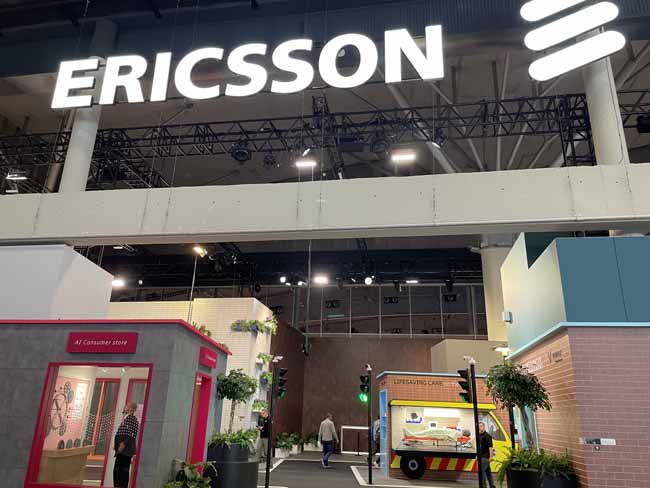 Ericsson announced it has successfully completed the world’s first 6G pre-standard over-the-air (OTA) session, marking a major milestone towards commercial 6G networks and reinforcing U.S. leadership in next-generation wireless innovation. This milestone was achieved on a pre-standard 6G system using a trusted, end-to-end architecture designed to be AI and cloud native. Conducted at Ericsson’s U.S. headquarters in Plano, Texas, the OTA session validates the readiness of key 6G building blocks. The demonstration features radio hardware, RAN Compute, software-defined air interfaces, and cloud platforms. Ericsson’s future-proof software architecture is deployable on multiple hardware platforms, including CPU and GPU. This achievement supports the U.S. government’s focus on 6G leadership, including early research, global standards, and forward-looking spectrum policy. 6G is a critical infrastructure for national security, economic competitiveness, and AI-driven innovation. Ericsson’s work directly supports those priorities by showing how future networks can deliver secure, high-performance, AI-native connectivity that underpins U.S. economic competitiveness, innovation, and national security. Ericsson also announced a successful live proof of concept of its ISAC (Integrated Sensing and Communication) technology at the company’s U.S. Headquarters in Plano, Texas, signaling a major step forward in the evolution of networks that both connect and sense the world around them. The live proof of concept centered on drone detection using Ericsson’s massive-MIMO radios, showcasing the network’s ability to track unmanned aerial vehicles (UAVs) within the surrounding airspace.
Ericsson and Intel are pooling their next-generation technology leadership to help accelerate ecosystem readiness for seamless transition to AI-native 6G deployments and use cases. The collaboration will span mobile connectivity, cloud technologies, and compute capabilities across AI-driven RAN and packet core use cases, as well as platform-level security and network capabilities, to help enhance ecosystem enablement and time-to-market for cloud-native solutions.
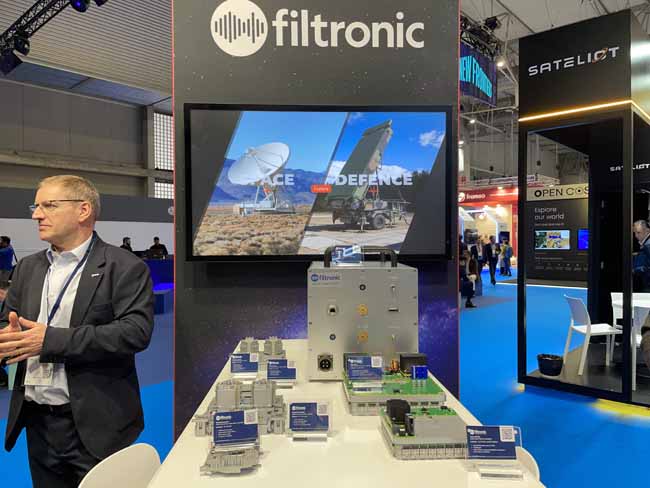 Filtronic recently published an article with MWJ on operating from 37 to 52 GHz, outlining how Q- and V-Bands enable significantly larger data pipelines; however, reaching these higher frequencies poses new technical challenges. While many feeder links in the satellite communications (satcom) market today operate at Ka-Band, the push toward Q- and V-Bands is gaining momentum. This shift is being driven by the ever-growing need to move larger volumes of data, especially in satcom and Earth observation.
An interesting find was Forefront RF, which has developed the first commercially available tunable duplexer technology, reducing overall size and space. Foretune™ replaces banks of fixed RF hardware with a single adaptive solution, transforming how mobile devices are designed, built, and scaled. Innovating with intent to resolve longstanding industry challenges with technology that dynamically adapts to any low-band frequency, reducing the component count, power consumption and design complexity. They are enabling RF connectivity to be treated as a commodity with a single-SKU, software-defined solution.
In the Japanese Pavilion there were many companies displaying RF/microwave products. Yokowo, with Yonezawa Bussan, to introduce a flexible waveguide solution, developed using Japanese fiber‑braiding (kumihimo) techniques, combined with Yokowo’s compact connector technology. This solution is designed to support high‑frequency signal transmission with greater flexibility and practicality compared with conventional approaches. Sumtomo Electric Industries (SEI) presented mmWave-ready DAS: semiDASTM is a mmWave-ready distributed antenna system with ultra-compact remote nodes and ultra-low power consumption. Designed for indoor deployments, it uses omnidirectional antennas to deliver a simple and highly practical coverage solution. Fujikura showcased high-frequency parts for 5G mmWave communication operated on the 3GPP frequency bands, such as Phased Array Antenna Module, ICs, Filters, and AiP. This module is a highly integrated module with a Beamformer IC, a frequency converter IC, an array antenna, and a filter. Fujikura has designed all these components in-house and has been optimizing the module's performance. The module can support tens of thousands of beams with quick beam switching and provides calibration-free, precise beam scanning. The module is primarily developed for infrastructure applications and is suitable for various use cases, such as mobile network access and fixed wireless access. Visban is developing millimeter-wave solutions that make high-capacity wireless networks faster and easier to deploy. Their proprietary RF-on-Glass™ Network-Controlled Repeaters connect to form V-Mesh™, an intelligent mmWave mesh system that extends coverage across indoor and outdoor environments without new infrastructure. Managed by the AI-based Visban Orchestrator, the system dynamically selects and directs signal paths to maintain performance in obstructed and non-line-of-sight conditions — challenges that typically limit mmWave deployments. V-Mesh installs in weeks rather than months, supporting advanced 5G services today and the evolution toward 6G networks. Testing MIMO and carrier aggregation using conventional methods—such as multiple monopole antennas or horn antennas—presents significant challenges. Protocol and EVM testing also become less cost-effective due to the large size and complexity of the required equipment. To address these limitations, MORITA TECH proposes an OTA test environment that enables easy evaluation within a compact shielded box. Instead of relying on traditional large-scale anechoic or reverberation chambers, we offer a desktop-scale OTA testing solution featuring a shielded box and antenna couplers. By using MIMO test antenna couplers, users can efficiently perform throughput, protocol, and handover tests between terminals and base stations. The compact OTA shielded box supports various configurations—including 4×4 MIMO, 8×8 MIMO, ENDC, and NRDC—and is equipped with an internal cooling fan. Enplas has contributed to building a more prosperous society with the high-precision molding technology it developed in 1962. Enplas has introduced a variety of high-precision lenses for the visible, infrared, and ultraviolet regions. Now Enplas is introducing the Enplas Lens Antenna by applying the high-precision processing technology it has developed in the short wavelength field to the RF region.
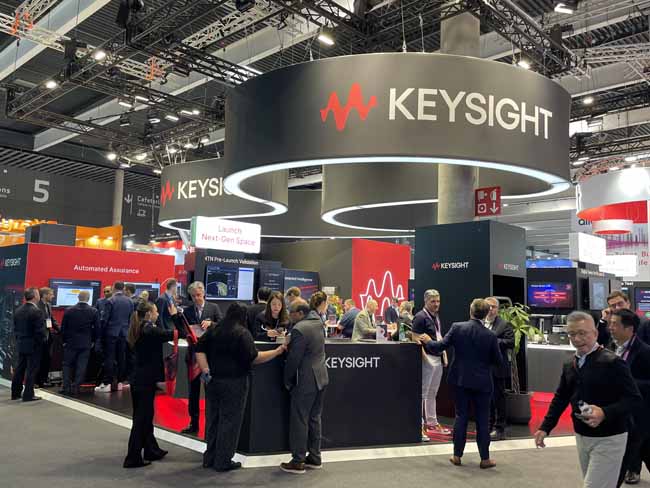 Keysight Technologies and Samsung Electronics are collaborating with NVIDIA to demonstrate an end-to-end Artificial Intelligence Radio Access Network (AI-RAN) testing and validation workflow. The demonstration shows how Keysight’s AI-RAN solution streamlines the validation of AI-driven RAN modules using the physical uplink shared-channel estimation use case, bringing together data generation, artificial intelligence/machine learning training, and performance benchmarking into a single automated workflow to accelerate innovation and reduce deployment risk for operators and vendors. They also had a demo showing how they use Digital Twin technology to emulate the wireless channel to improve efficiency, working with Nokia. Keysight Technologies and Ericsson collaborated to troubleshoot and validate interoperability between an Ericsson pre-6G base station (gNB) and prototype pre-6G devices, using Keysight’s WaveJudge Wireless Analyzer Solutions. The work demonstrates full-stack pre-6G interoperability testing using real network infrastructure and devices, supporting early validation of emerging 6G concepts as standards development continues. Keysight had a variety of demos for AI RAN, AI powered devices test, AI/ML channel estimation, 6G simulation to emulation, 6G digital twins, 6G FR3, 6G AI design automation, 5G demos, WiFi 7, ORAN and security.
LitePoint, along with Aethertek and Metanoia, announced a three‑way collaboration to accelerate the development, validation, and commercialization of next‑generation 5G FR2 (mmWave) Open Radio Units (O‑RUs). The collaboration expects to enable very high user throughput, high capacity in congested environments, and support for data‑hungry applications such as video streaming, AR/VR, and cloud-based gaming.
MatSing introduced a new WiFi 6E lens antenna designed for the next wave of high-density venue upgrades. It supports 16 independent beams with 4x4 MIMO across the 6 GHz band, enabling thousands of simultaneous users to be served from a single centralized mount point. Instead of deploying dozens of distributed panel antennas throughout a stadium, venues can consolidate infrastructure while increasing sector capacity. As stadiums push to support record fan data consumption and adopt WiFi 6E, operators and venue owners are rethinking how to scale performance without adding hardware complexity or visual clutter.
NTT DOCOMO and Keio University Haptics Research Center announced today that they have successfully conducted a demonstration of high-precision remote robot operation over commercial 5G. By combining Configured Grant, a low-latency network slicing technology, with Keio's Real Haptics® technology, delicate force feedback and tactile sensations were transmitted stably. This marks the world's first demonstration of Configured Grant enabling practical robot teleoperation over commercial 5G.
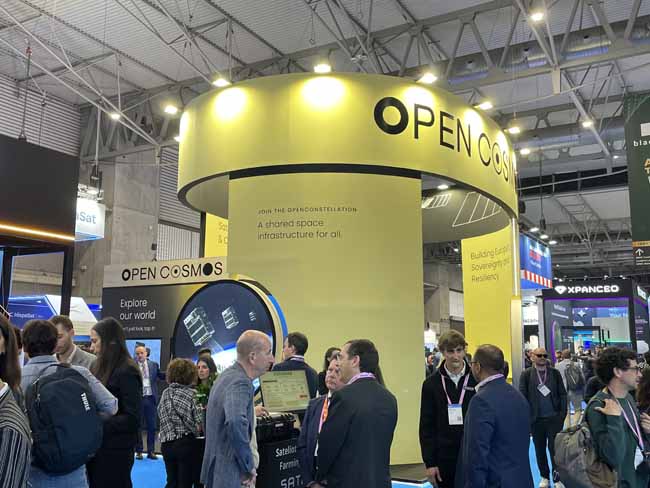 OpenComos, a company building satellites to understand and connect the world, launched the first satellites in its new proprietary LEO telecom constellation, just one week after securing high-priority Ka-Band spectrum. They also announced ConnectedCosmos – a new LEO constellation that will provide sovereign and secure communications and resilient capabilities for businesses and government bodies across the globe. Counteracting overreliance on transcontinental mega-constellations, ConnectedCosmos will also connect Open Cosmos’ Earth Observation capabilities deployed in the Open Constellation with a new Sovereign Connectivity LEO backbone that enables real-time data wherever needed. The new constellation combines point-to-point broadband with direct-to-device IoT, enabling users to detect threats in real time and utilize actionable intelligence to address them.
Qorvo announced in Jan that Danalto successfully integrated successful integration of Danalto’s Cardinal™ Cloud Location Engine (CLE) with Qorvo’s latest Ultra-Wideband (UWB) System-on-Chip (SoC) and industrial and enterprise SDK. This milestone brings enterprise customers one step closer to scalable, cloud-first UWB Real-Time Location System (RTLS) solutions capable of powering next-generation asset tracking, indoor navigation, and smart facility applications. By combining Qorvo’s UWB performance with Danalto’s cloud-native multi-technology positioning framework, developers and integrators can now evaluate and prototype high-accuracy location services with reduced integration complexity and enhanced scalability.
Qualcomm demonstrated how it is building a future where AI and connectivity are deeply integrated. They are designing devices, networks, and wireless systems with AI at their core—reimagining wireless architecture from the ground up. They had major announcements across personal AI and intelligent wearables, as well as advances in physical and industrial AI, underscoring Qualcomm’s leadership toward AI‑native 6G, where connectivity and compute work together in real time to bring AI everywhere. Beyond cellular, AI‑driven demand is also reshaping the broader networking landscape, accelerating the need for AI‑native Wi‑Fi, including our Wi‑Fi 8 portfolio. A central system-level 6G prototype explored how new spectrum use, wide bandwidth and advanced techniques can deliver the next leap in wireless performance. The prototype showcased Giga‑MIMO, probabilistic shaping and sub‑band full duplex, combining higher spectral efficiency with improved uplink and downlink throughput. These foundational innovations point toward a smarter, more efficient 6G system designed to support future data‑intensive applications. Integrated sensing and communications (ISAC) extends wireless beyond connectivity into perception. ISAC, together with AI and radio digital twins, creates new service opportunities and new ways to operate wireless systems efficiently. They had a demonstration that highlights real-time detection, tracking, and classification through three live scenarios: detection and classification of drones, detection of vehicles at large distances within defined zones, and precise tracking of a vehicle. The work extends mobile networks beyond connectivity to enable applications for safety, security and smart-city intelligence, and it opens the door to new services and new possibilities for digital twin platforms. There were many other displays, but too many to cover here.
 Rohde & Schwarz, in collaboration with Broadcom, displayed its multi-technology multi-channel signaling tester with newly added Wi-Fi 8 testing capabilities. The setup validated a prototype Wi-Fi 8 device from Broadcom, showcasing physical-layer features unique to Wi-Fi 8. Qualcomm Technologies has used the CMP180 radio communication tester from Rohde & Schwarz to validate advanced multi-antenna capabilities that are designed into its next-generation Wi-Fi 8 platforms, including support for 5x5 MIMO in the 2.4, 5, and 6 GHz bands. Advanced 5x5 MIMO architectures help Wi‑Fi 8 platforms deliver higher capacity and more reliable connectivity across a wider range of real‑world deployment scenarios. In a joint 6G AI proof-of-concept demonstration with KT, the CMX500 one-box tester also demonstrated significant downlink throughput gains in AI-based wireless transmission compared to conventional non-AI technology. Additionally, the demonstration illustrates how this translates to an enhanced video streaming user experience. This collaboration validates the feasibility of multi-vendor AI interoperability for future 6G standardization. Rohde & Schwarz and Qualcomm Technologies presented a live demonstration at the that aggregates a mid-band channel around 2.5 GHz (FR1) with an upper mid-band channel around 7 GHz (FR3), using 4x4 MIMO on both bands and higher-order modulation. With this setup, the two companies validate end-to-end device behavior across the aggregated spectrum. Rohde & Schwarz also showcased a new milestone in AI-driven wireless system testing. The testbed, developed in collaboration with NVIDIA, integrates hardware-in-the-loop site-specific channel emulation using the NVIDIA Sionna Research Kit, enabling testing of AI-RAN applications under realistic channel conditions. Rohde & Schwarz and Viasat are working together to strengthen and expand testing for NTN capabilities, specifically for NB-IoT devices. The collaboration aims to ensure that chipsets, modules, and devices interoperate seamlessly with Viasat’s satellite network and comply with 3GPP Release 17 standards.
Sateliot presented a full-scale replica of Tritó, the new generation of 5G Direct-to-Device (D2D) satellites designed to enable 5G NR satellite services. Tritó is conceived with dual-use capability, allowing it to support not only civilian applications but also security, civil protection, and defense use cases—key elements in terms of technological sovereignty. Tritó will also play a central role in Spain’s first dedicated commercial mission, in which two units will travel aboard MIURA 5 at the end of 2027, under the agreement with PLD Space. At the company’s stand, a 5G NR demo showcased a direct connection between a conventional smartphone and its satellite payload, bringing the 5G satellite experience closer to everyday use.
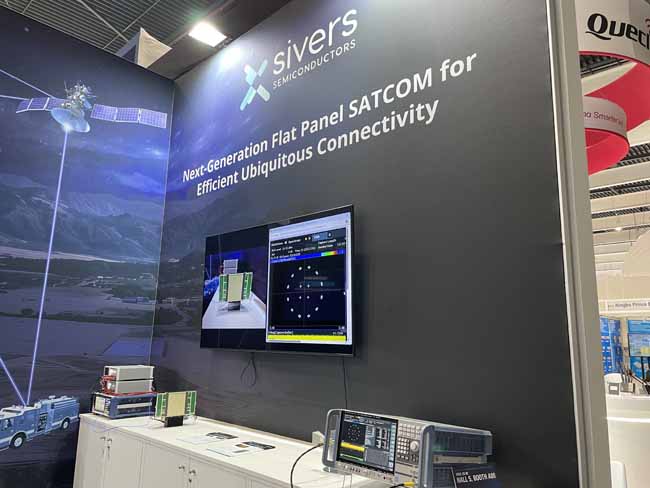 Sivers had a live demo of Maverick, its latest high-performance Ka-band 576 element transmit antenna array. Maverick integrates the company’s recently announced Cloudchaser chipset into a compact flat-panel design for electronically steered SATCOM systems. Both Maverick (BFM02701 – transmit, BFM02702 – receive) and Cloudchaser chipset (BLUEWAY1721, STAMPEDE2731, and STAMPEDE2731LP) are currently available for customer sampling.
Skyworks Solutions showcased an early 6G new FR3 frequency range RF front-end (RFFE) power amplifier. Presented in collaboration with MediaTek, the live demonstration highlights the companies’ continued efforts to advance next-generation wireless platforms and accelerate access to future 6G technologies. MediaTek demonstrated a reference design that uses the SKYR60002 advanced 6G FR3 LNA and power amplifier module with integrated filters designed to support the new 6.425 to > 7 GHz spectrum supported in the latest 3GPP standard. The SKYR60002 6G FR3 LNA power amplifier module with integrated filters supports the high linearity, wide bandwidth support and robust thermal performance needed to comply with stringent 3GPP standard requirements.
Soitec revealed that the foundational substrate for the Qualcomm QTM565 in the iPhone 17 is FD-SOI technology that enables fully integrated 5G mmWave SoCs. For manufacturers like Apple and Qualcomm, this technology unlocks several critical advantages:
- Miniaturization and Footprint Optimization: FD-SOI offers significant logic scaling advantages over competing technologies. It allows designers to integrate baseband, control logic, and the RF front-end onto a single die, reducing the Bill of Materials (BOM), minimizing board area, and drastically cutting interconnect loss.
- Best-in-Class Power Efficiency: Operating at low voltages, the platform extends battery life in mobile devices. The inherent low-noise analog devices and excellent device matching deliver peak performance without sacrificing power consumption.
- Unmatched RF Performance: As proven by the silicon mmWave demonstrators mentioned in the TechInsights report, FD-SOI provides the precise engineering required for the high-frequency demands of sub-6 GHz and mmWave 5G networks.
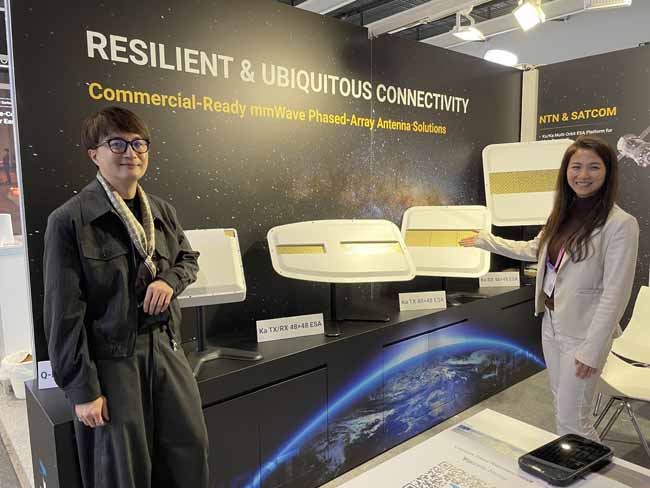 TMYTEK showcased mmWave phased array solutions for advanced 5G networks, supporting FR2 gNB, CPE, and mmWave FWA deployments with scalable, software-defined beamforming designed for real-world trials and commercial readiness. They also presented multi-orbit SATCOM mmWave solutions, enabling Ku-, Ka-, and Q-band user terminals and feeder links across GEO, MEO, and LEO satellite networks, addressing the growing demand for resilient non-terrestrial connectivity. Built on a common ESA-based architecture, TMYTEK’s platforms support NTN, HAPS, and ISAC-driven applications, providing the flexibility and performance required to evolve today’s 5G systems toward satellite-integrated and 6G-ready networks.