


Modern antenna development often involves balancing electrical performance, manufacturability, material constraints, cost and thermal management. Rigorous full-wave simulation of parameterized antenna geometries can be computationally intensive, given the fact that there can be up to a dozen geometrical parameters, making design exploration and antenna performance studies difficult. PhysAI has developed a workflow using COMSOL Multiphysics to generate high-fidelity surrogate models that learn the mapping between geometric design parameters and antenna S-parameters over a set frequency range. Once trained, these neural-network-based surrogate models evaluate in milliseconds, enabling real-time design iteration and interactive performance visualization.
This approach allows product managers and RF engineers to jointly explore the design space, assess tradeoffs and identify solutions that balance performance with practical constraints, rather than relying solely on global optimization. Designs that offer near-optimal performance, but improved manufacturability, become easier to identify and robustness analyses can be performed rapidly by sampling around nominal solutions. A real-world antenna test case is studied in the field of RFID tag localization, where antenna impedance matching, gain and far-field pattern are crucial to overall performance. The workflow demonstrates how surrogate modeling accelerates early-stage design and reduces the number of full numerical simulations required. The outcome is a faster, more transparent antenna development process, one where performance and product constraints can be balanced dynamically as opposed to being discovered late in the design cycle.
INTRODUCTION
Antennas are fundamental components in wireless communication systems, ranging from mobile devices and IoT sensors to satellite communications and radar systems. As wireless technologies advance, particularly with the proliferation of 5G/6G networks, RFID systems and autonomous vehicles, the demands on antenna performance have intensified. Modern antennas must deliver high gain, wide bandwidth, specific radiation patterns and efficient impedance matching while adhering to strict constraints on size, cost, materials, manufacturability and thermal dissipation.
Traditional antenna design relies heavily on full-wave electromagnetic (EM) solvers such as COMSOL Multiphysics, ANSYS HFSS or CST Microwave Studio. These tools provide high-fidelity predictions of antenna behavior through finite element method (FEM), method of moments (MoM) or finite-difference time-domain (FDTD) techniques. However, each simulation can take minutes to hours, depending on geometry complexity and frequency resolution. When optimizing or exploring designs with 10 to 15 geometric parameters, (e.g., patch dimensions, feed positions, substrate thickness, slot lengths) the computational burden becomes prohibitive. A large parametric sweep might require thousands of simulations, consuming days or weeks of compute time.
This bottleneck limits early-stage design exploration, where engineers and product stakeholders need to evaluate trade-offs collaboratively. Global optimization algorithms can identify theoretical optima, but they often yield designs that are difficult to manufacture or sensitive to tolerances. Late discovery of these practical issues leads to costly iterations.
Machine learning (ML)-based surrogate models offer a powerful solution. By training neural networks on data from a manageable number of high-fidelity simulations, surrogates can approximate EM responses in milliseconds. This enables interactive exploration, rapid sensitivity analysis and multi-objective trade-off visualization.
PhysAI has developed an end-to-end workflow leveraging COMSOL Multiphysics for training data generation and neural networks for surrogate modeling. The following sections describe the approach, workflow details and a practical case study in RFID tag localization.
CHALLENGES IN CONTEMPORARY ANTENNA DESIGN
Antenna design is inherently multi-objective. Key electrical metrics include return loss (S11) for impedance matching, bandwidth, gain and directivity and radiation pattern shape (e.g., omnidirectional versus directional). These must be balanced against practical constraints, such as size and form factor (especially for mobile/IoT), material availability and cost, manufacturing tolerances (e.g., etching precision, dielectric variability), thermal management in high-power applications and integration with other components.
In traditional workflows, RF engineers perform iterative simulations, often guided by experience or single-objective optimization. Product managers enter later, assessing feasibility only after significant design investment. This sequential process risks “perfect” designs that fail in production.
SURROGATE MODELING APPROACH
Surrogate models approximate expensive simulations using data-driven techniques. In EM design, neural networks excel at learning complex mappings from geometric parameters to frequency-dependent outputs like S-parameters.
The PhysAI workflow uses fully connected deep neural networks (DNNs) trained on S-parameter values across a frequency range. Inputs are normalized geometric parameters or material properties; outputs are vectorized S-parameter responses. This formulation captures broadband behavior accurately.
Once trained, the surrogate enables:
- Real-time prediction (milliseconds versus minutes)
- Monte Carlo sampling for thousands of designs
- Gradient-based or global optimization
- Interactive visualization tools for non-experts.
DETAILED WORKFLOW
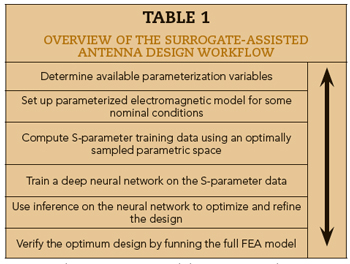
The workflow comprises six phases, as demonstrated in Table 1.
- Parameterization Determination and Sampling: Define geometric parameters and bounds based on requirements and constraints. Use Latin Hypercube Sampling (LHS) to generate 200 to 1000 designs efficiently covering the space.
- Physics Model: Set up a detailed 3D physics model of the electromagnetic wave propagation in COMSOL and test some nominal cases.
- High-Fidelity Data Generation: Run batch COMSOL simulations using the Surrogate Model Training study type. Extract S-parameters (and, if needed, far-field patterns and derived metrics such as gain or efficiency).
- Surrogate Training: Preprocess data (normalize, split train/validation). Train the deep neural network with architectures like three to four hidden layers and 32 to 64 neurons. Use mean-squared error loss.
- Deployment and Exploration: Integrate the surrogate into a dedicated app using the COMSOL Application Builder. The user has the option to explore the parameter spaces manually using sliders or optimize the design using only inference on the surrogate model.
- Validate the chosen design configuration by re-running the full FEA model at the chosen set of conditions.
This reduces full simulation time by 95 percent or more, reserving them for final verification.
CASE STUDY: RFID TAG LOCALIZATION ANTENNA
RFID tag localization systems require tag antennas with precise impedance matching, moderate gain and controlled radiation patterns for accurate positioning in warehouses or retail environments. Operating at ultra-high frequencies (902 to 928 MHz in North America), these antennas must balance read range, multipath rejection and cost-effective fabrication.