


AOC 2025's theme of "Charting a Path to 2035: Navigating the Future of EM Spectrum Operations" addresses the evolving landscape of EW amidst significant political, strategic, economic, and technological changes. The conference explored the changing strategic roadmap for achieving electromagnetic spectrum superiority, informed by international investments, evolving focus areas, and the latest advancements from industry and the Science and Technology community to achieve the 2035 vision.
Check out our photo gallery here.
In the exhibition, we found the following new and featured products:
Analog Devices featured the ADMV1455 that is a highly integrated microwave downconverter optimized for wideband radio designs operating in the 17.7 to 55 GHz RF range. It can be used as a smaller alternative to larger multichip implementations, allowing for reduced size, weight, and power at the system level. The ADMV1455 has an integrated local oscillator (LO) signal chain, that accepts LO input signals in the 8.85 to 27.5 GHz range. Within the LO signal chain are internal amplifiers, a frequency 2× multiplier, a programmable harmonic reject filter, and phase adjust circuitry, which produces the necessary 17.7GHz to 55GHz signal to drive the internal mixer. It has two, switch selectable, RF input signal chains. One chain operates within the 17.7 to 34GHz range, and the other operates in the 30 to 55 GHz range. Each chain has multiple stages of low noise amplifiers (LNAs), signal level control, and harmonic filtering. A square law power detector is provided to allow monitoring of the power levels at the mixer inputs. The ADMV1455 offers single output IF and differential in-phase/ quadrature (I/Q) modes of frequency translation. The single output IF mode provides one intermediate frequency (IF) output signal, in the 2GHz to 12GHz range, utilizing the on-chip 90° IF hybrid. The differential I/Q mode provides differential baseband I/Q output signals, from DC to 8GHz.
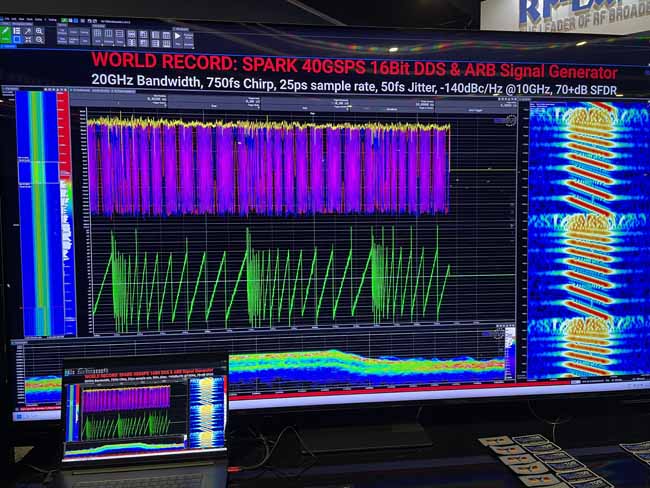 Aaronia demonstrated how flexibly and efficiently the various systems can be used for real-time direction finding, signal classification and geolocation, EW, and drone detection. Scalable USB-based real-time spectrum analyzers are indispensable for situational awareness in both civil and military applications. In aviation, emergency management, transportation, logistics, and critical infrastructure protection, they provide important information for mission control. In addition to their use in research, development, and industry, federal agencies and the military also value these intelligent signal detection and location systems for their extremely high precision, reliability, and very long range. They also showed the SPECTRAN V6 MOBILE, the first portable real-time spectrum analyzer with an RTBW of 490 MHz, enables fast and reliable measurements even in the new frequency ranges used for Wi-Fi 6 and 7. With a frequency range from 9 kHz to 140 GHz and a sweep speed of 3 THz/s, the Aaronia spectrum analyzers used are equipped for all tasks. With the SPECTRAN V6 Command Center, Aaronia displayed what is currently the fastest real-time spectrum analysis solution. The system enables extremely fast broadband frequency monitoring with simultaneous detailed analysis, including data recording. Thanks to the smart buffering solution, in which the oldest data is overwritten with new information, virtually “unlimited” recording time is available. Demodulation and decoding, as well as subsequent classification of many signal types in real time, is also possible without any problems. This makes the SPECTRAN V6 Command Center the basis for many solutions in the field of frequency regulation, signal location, or drone detection. The Aartos X9 drone detection system is universally applicable. It can detect any signal and identify it as a drone. By combining the results from multiple sensor locations, altitude and/or distance information can also be provided, allowing the object to be automatically triangulated in 3D. This allows the entire flight route to be recorded and, for example, an additional integrated camera system to be focused to visually verify the object and, if necessary, the existing payload.
dB Control featured the dB-4127-10 High Band Single Output MPM (7–18 GHz, up to 390 W CW output) and the dB-8059 Solid State Power Amplifier (2–18 GHz, up to 200 W CW output). They also featured the dB-9006 Best-in-Class Phase Noise Synthesizer and high-power RF switches from Charter Engineering, Inc., built to military standards and qualified for mission-critical performance.
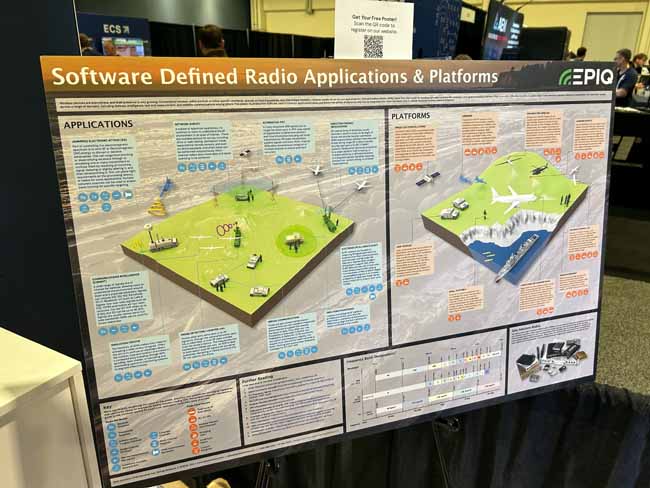 Epiq Solutions featured the Sidekiq NV800 with 8 6 GHz RF receivers and a VITA 49 standard streaming interface, it packs high channel count and high bandwidth into a power-efficient, ready-to-integrate package. It provides features such as fast hopping, phase coherency, and WhiteRabbit all into a single easy-to-use platform. With VITA 49 data format and RESTful API control, Sidekiq™ NV800 ensures seamless integration with COTS and GOTS spectrum analysis accelerating deployment. It is engineered for low power consumption and integrated into a passively cooled, compact package.
FEI-Elcom Tech featured their 3UVPX-UFS with ultra-fast switching speed of 150 ns (full band), 1 Hz resolution, low phase noise floor of -147 dBc/Hz at 18 GHz and -145 dBc/Hz at 1 MHz offset at 10 GHz, full band phase coherent switching exact frequency no offset to 1.00 Hz and exceptionally clean signal with -70 dBc spurious and harmonics. It is well suited for EW simulation, frequency agile radar, ATE systems, SIGINT and RCS.
HII announced that its Mission Technologies division has deployed and operationalized a next-generation high-performance spectrum dominance solution, now available for rapid detection and location of hostile communications, radar and other electronic threats. HII showcased its GRIMM® technology—and its field-proven capabilities in situational awareness, intelligence support and force protection. GRIMM® leverages decades of HII expertise developing electromagnetic warfare technology for national defense. Now deployed with mission success across a range of defense customers, it stands as a testament to HII’s commitment to innovation and operational excellence.
 Keysight was showing various test solutions. Their Signal Studio for Multi-Emitter Scenario Generation provides an intuitive software interface to create realistic multi-threat environments from 0 to 40 GHz. EW scenarios can be downloaded to the agile signal generator and Vector Adapter to play out the scenario for either direct inject or over the air testing. With the scalable and flexible architecture of the UXG family, additional signal generators can be included in the simulation to increase pulse density and simulate Angle of Arrival for multi-port receivers, providing a cost-effective solution to take your lab to the next level. EW system under test Development and validation of EW SUT’s require simulation of a complex RF environment. With N7660C’s suite of signal creation tools you can create EW scenarios to test the following SUT applications:
• Threat identification, prioritization and classification
• Threat de-interleaving and sorting
• Subsystem interface management
• Subsystem threat correlation
• Electronic countermeasures
 Marki Microwave’s next-generation, high-performance filters reset the bar in RF design, powered by its proprietary OmniFlow design engine. Built on a new high-Q glass substrate, they deliver MMIC-level repeatability and push Marki’s filter portfolio into the MHz range. Verified models enable true first-pass success, with measurements that tightly match simulation data. Offered in compact footprints (LP/HP: 4.25 × 4 mm; BP: 7.5 × 4.2 mm), these filters drive the next wave of RF from 100 MHz to 6 GHz.
- Replaces lumped-element and ceramic filters from VHF through C-Band
- Optimized for IF signal conditioning and anti-aliasing filter applications
- Handles up to 15W CW with robust, reliable performance
Maury Microwave has acquired several companies recently and offers complete calibration, measurement and modeling solutions including amplifiers, analyzers, cables and connectors, calibration kits, channel emulators, impedance tuners/accessories, meters/power sensors, noise generators, software and signal generators/sources.
Menlo Micro featured the MM5130-03NLX that is a high-power and wide frequency range SP3T micro-mechanical switch. Menlo Micro has developed a new Ideal Switch® fabrication process and applied it to DC and wideband RF/microwave switch applications. This technology enables highly reliable switches capable of 25 W power handling. The MM5130-03NLX provides ultra-low insertion loss and superior linearity as an SP3T from DC to 26 GHz, and greater than 3 billion switching cycles. It is configured in Super-Port mode which extends the frequency operation to 26 GHz. The MM5130 is an ideal solution for replacing large RF electromechanical relays, as well as RF/microwave solid-state switches in applications where linearity and insertion loss are critical parameters.
Mercury unveiled the latest addition to its portfolio of Direct RF digital signal processing products. Mercury’s new DRF4581L very small form factor module delivers breakthrough performance in a compact footprint—just 1 inch in height and less than 3 inches wide—to capture, process, and transmit wideband RF signals at the edge. The DRF4581L is powered by the Intel Agilex 9 SoC FPGA AGRW014 that converts between analog and digital signals at 64 Gigasamples per second simultaneously across four channels. They also featured an RF signal transmission demonstration using the DRF4580L small form factor module, which is now in production for numerous customer programs. Also on display was a range of Mercury products that ensure spectrum superiority in multi-domain operations including ARES radar environment simulators, mPOD jammer training pods, System-in-package and multi-chip modules and mini tuner modules.
Metamagnetics was discussing their Auto-tune filters or AtFs that are adaptive, dynamic and miniature RF components that sense and react to input RF energy by automatically generating highly selective rejection notches centered at signals that exceed a predetermined power threshold. Signals below this power threshold pass thru the AtF® with low loss simultaneously. The AtF’s® notching response will adjust in real time as above-threshold threats change in frequency, power, bandwidth and presence within the spectrum. The AtF® is passive and does not require power to operate, making it extremely advantageous for size, weight and power-constrained platforms. Similarly, it does not require computer-control or feedback, enabling simple system integration. AtF® technology empowers RF receivers to continuously operate in high-power and high-dynamic range EM environments while maintaining sensitivity.
Molex was featuring A&D products including fixed coaxial attenuators (0 to 40 dB) with high precision; coaxial terminations with wide frequency ranges from DC to 50 GHz; EMI filtered high-performance D-Sub Pi connectors; EMI filtered high-performance D-sub high-density connectors; EMI filter plates with wide frequency ranges from 5 MHz to 18 GHz (outperform surface mount EMI filters at frequencies above 50 MHz); circular EMI filter connectors; chip attenuators and chip terminations. They have a huge cable and connector offering so interesting to see all of these other products.
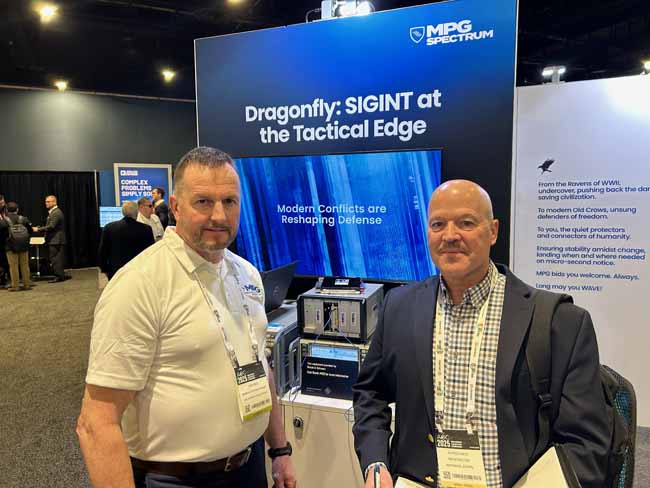 MPG Solutions featured their frequency agile preselector for direct digital receivers. The versatile tunable bandpass filter is engineered for dual-use applications, supporting both advanced military systems and high-performance commercial telecom infrastructure across the 2-18 GHz frequency range. With a wide tuning range and variable bandwidth from 200 MHz to 1 GHz, it enables agile frequency selection, adaptive interference mitigation and robust signal conditioning.
Photonis was showing the TWT power amplifiers including their model 9124 microwave power module covering 6-18 GHz with 250 W output power at mid-band. It has self-contained cooling and powered by 115 VAC 3-phase 400 Hz power. It is suitable for electronic countermeasures, airborne/UAV use, lab use and Radar/SATCOM applications.
Quantic Electronics featured cutting-edge RF and microwave technologies:
- Custom, high-reliability RF and microwave components and subsystems covering DC-70 GHz from Planar Monolithics Inc. (PMI), a trusted partner serving military, communications, commercial and consumer applications.
- Precision passive RF and microwave solutions engineered by TRM to meet the most technically demanding requirements.
- Ultra-low phase noise frequency control and timing solutions designed by Wenzel Associates, including integrated microwave assemblies to 30 GHz+, engineered for high-frequency stability and uncompromised reliability.
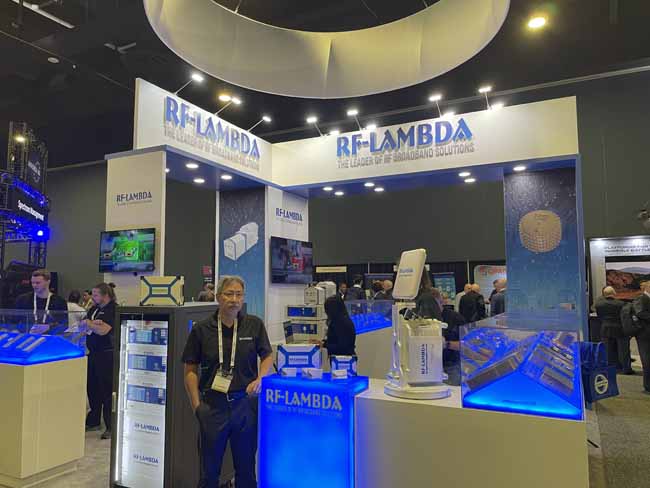 RF Lambda is a global company that continues to grow and evolve through challenging the boundaries of technology. They are the industry leader in manufacturing RF components specializing in RF broadband and high power solutions. Their highly innovative designs and extensive customization capabilities are creating new and unimaginable solutions connecting people, places and things through high powered applications beyond expectations. ISO and ITAR registered, we are empowering and revolutionizing RF components for military defense, aerospace, and commercial applications. RF Lambda has many broadband power amplifier solutions including up to 100 W for a 2-6 GHz PA, up to 63 W for 2-20 GHz or 18-40 GHz.
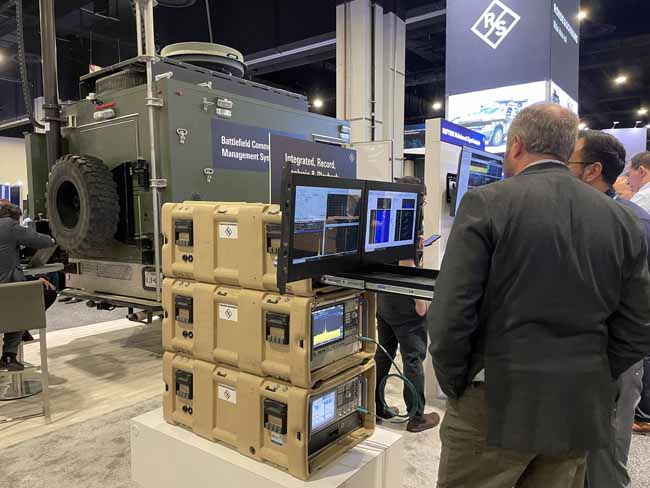 R&S had both systems and component solutions in their booth. They even had a fully loaded truck with signal sensing equipment used for military exercises to monitor the spectrum and keep score of simulated war games. R&S just published an article with MWJ on their FSWX which is a high-performance, multi-channel signal and spectrum analyzer designed for demanding applications, including DRFM testing. It provides synchronized, phase-coherent measurement capabilities, enabling engineers to simultaneously analyze the input and output of a DRFM system. FSWX has an analysis bandwidth of up to 8 GHz in single-channel mode, and 4 GHz per channel in dual-channel mode. The multi-channel architecture is crucial, facilitating timing alignment and phase coherence assessment, both critical metrics for evaluating deception effectiveness. Here is a link to the article: https://www.microwavejournal.com/articles/45121-advanced-testing-of-next-generation-drfm-jammers.
Samtec showed their Nitrowave high performance cable assemblies. The new Nitrowave Phase and Amplitude Stable RF Cable offers improved stability with flexure. The coaxial structure, with an outer jacket colored in distinctive Samtec orange, is designed to meet the demands of aerospace, defense, datacom, computer/semiconductor and instrumentation market. Performance is optimized at frequencies beyond traditional industry targets to support emerging applications. Cables are designed for frequencies of 18, 32, 43.5 71, 95 and 110 GHz. Phase versus bending is less than 0.2” x F (GHz).
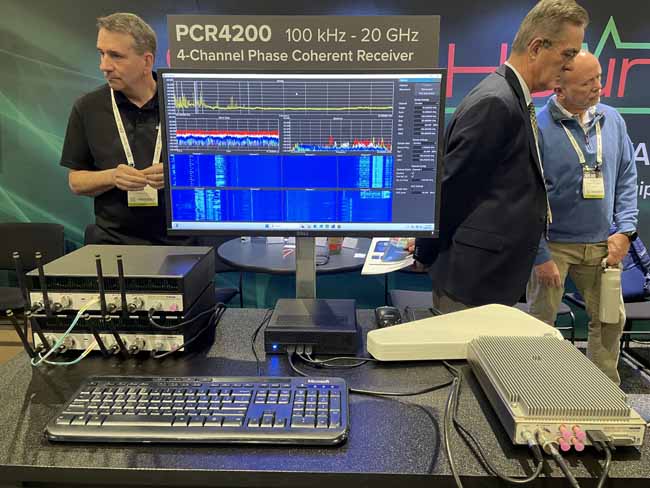 Signal Hound featured their PCR4200 4 channel, phase coherent receiver. Each channel on the PCR4200 may be configured as a phase coherent channel using the high-performance shared LO or independently tuned using that channel’s dedicated LO. Additionally, any single channel may be configured to provide swept spectrum data at up to 200 GHz/s. Other features include a built-in 30 MHz to 20 GHz vector signal generator to simplify system alignment and calibration, and an internal GPS to provide precise time, frequency, and location.
Spectrum Control was featuring their Direct RF technology. It offers high-density sampling with 8 Tx/8 Tx channels on a single 3U VPX card with 64 GSPS direct sampling rate with up to 32 GHz of instantaneous bandwidth. It has advanced FPGA processing using Intel the Agilex 9 AGRW02. It has high-speed I/O architecture with dual F-tiles, 400 GbE, PCIe Gen4 x16 and 58 Gb/s PAM4. There are 10/25 GbE control and data planes, 40/100 GbE expansion ports and dual 100 Gb optical transceivers. This seems to be the marketing leading product in the industry right now.
Stellant was showing off their power amplifiers including the M2844 mmWave microwave power module with up to 200 W CW from 26-40 GHz using a high-efficiency TWT and compact nanoMPM EPC. Its small footprint enables direct placement at the radiating element to maximize effective radiated power.
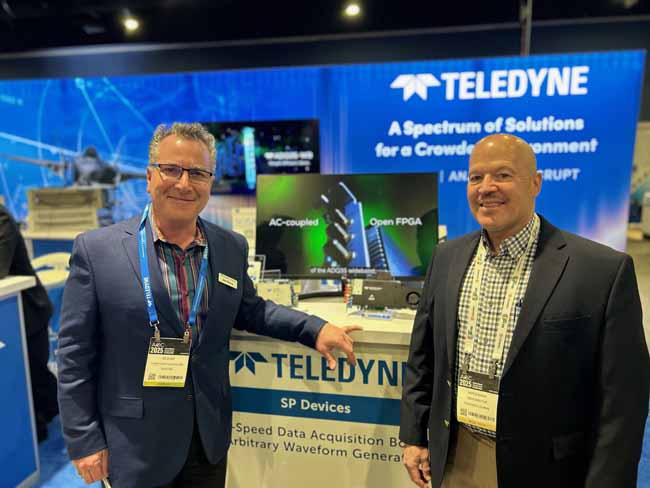 Teledyne SP Devices featured their digitizers including ADQ35-WB that has 12-bit resolution, up to 10 GSPS sampling rate and 9 GHz of usable analog bandwidth. It has open onboard FPGA, peer-to-peer streaming at up to 14 Gbyte/s and is available in PCIe and USB 3.2 form factors.
Times Microwave was showing off their upcoming Levitate series of ultra-lightweight cable assemblies with minimal loss so are well suited for avionics and UAVs. There are UAV assemblies to 8, 32 and 40 GHz. They have the lightest weight cables on the market per unit of loss. They are mostly targeting Group 3-5 DoD UAS applications. They make use of Al where possible to reduce the weight while still maintaining low loss.
Trans-Tech discussed their quiet acquisition of Lark RF Technologies. The Lark family of filters, diplexers/multiplexers and filter banks have a proven history of providing high reliability solutions to the most demanding designs. They expect this to be a good match with Trans-Tech materials and filters.
Virginia Diodes (VDI) was a first-time exhibitor showing off their terahertz capabilities for test and measurement. They were recently mentioned several times in an MWJ podcast covering the history of VNAs and other testing technologies at Keysight Technologies that lead up to development of a full vector component testing system at 330 to 500 GHz shown at IMS this year by talking with Joel Dunsmore, Research Fellow at Keysight Technologies.