

Yole Group announced the release of its Automotive Radar 2025 report alongside a new reverse engineering and costing report, Automotive Radar Chipset Comparison 2025. Together, these two reports from Yole Group provide a comprehensive view of the automotive radar industry, from system-level dynamics and market shifts to chip-level innovation and cost structures.
The Automotive Radar 2025 report delivers a comprehensive analysis of the radar ecosystem, from technologies and semiconductor platforms to market trends and regulatory drivers. It explores how evolving architectures, integration strategies and regional dynamics are shaping next-generation ADAS and autonomous driving systems. The report also evaluates the competitive landscape, highlighting key players, innovation pathways and future growth opportunities.
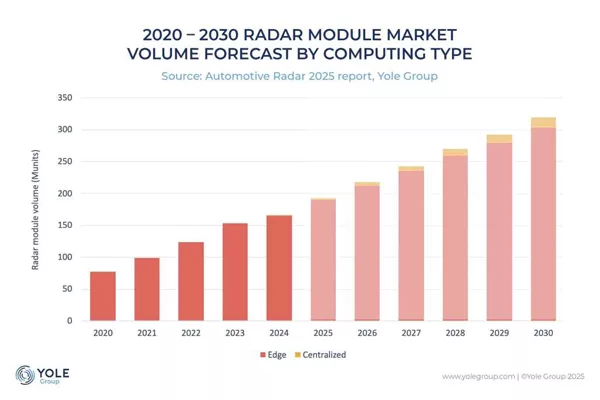
Without doubt, radar remains one of the fastest-growing sensing technologies in vehicles. In 2024, 166 million radar modules were shipped, up 8 percent year-on-year. Despite slower growth than earlier years, radar integration continues to deepen across ADAS and autonomous driving platforms.
However, ASPs remain under pressure, constraining revenue expansion despite volume gains. The industry is now centered on the 77to 81 GHz band, as older 24 GHz systems are phased out.
"The radar market is shifting from a focus on sheer volume to value optimization. As radar becomes standard, differentiation increasingly depends on sensor architecture, integration level and software-defined performance," said Hassan Saleh, Ph.D., senior technology and market analyst, Radio Frequency at Yole Group.
Technology Convergence and Market Shifts
According to Yole Group, 4D radar, capable of elevation estimation/measurement, represented about 40 percent of shipments in 2024 and is rapidly becoming the baseline for all new designs. Regulatory initiatives, including Euro NCAP, EU and NHTSA programs, are pushing OEMs toward broader radar coverage. By 2030, Yole Group’s analysts expect five radars per vehicle to become the global standard, driven by safety requirements and OEM differentiation strategies.
Meanwhile, in-cabin radar is emerging to detect the status of occupants and monitor vital signs, supported by 60 GHz and UWB technologies, though mass adoption awaits finalized safety standards.
China’s Radar Rise
China’s OEMs and suppliers are reshaping the global radar value chain. Local automakers such as BYD, Geely and Chery are driving volume growth, while Chinese Tier-1s, including Sensor Tech (WHST), Cheng-Tech, HASCO, Huawei and HiRain, are expanding rapidly.
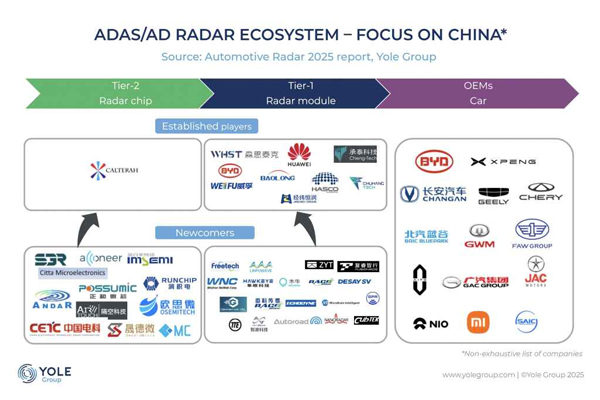
“China is no longer just a customer base,” explained Saleh. ‘’It is becoming a radar innovation hub. From module design to semiconductor development, Chinese players are redefining competitiveness through vertical integration and localization.”
At the Tier-1 level, global leaders, Aumovio (Continental), Aptiv, Bosch, Forvia-Hella, Denso and Magna still dominate. However, their market share at Chinese OEMs continues to erode. Global suppliers are adapting by localizing radar technology and supply chains for the Chinese market.
Semiconductor Leadership and Competition
- The automotive radar device market was worth US$2.5 billion in 2024.
- NXP leads in RF-CMOS radar transceivers and is ramping up single-chip SoC platforms.
- Infineon Technologies maintains strength in MCUs but faces pressure in RFICs.
- Texas Instruments (TI) is gaining share with its CMOS radar SoCs, adopted globally and in China.
- Calterah is emerging as a key Chinese SoC supplier, while Bosch is preparing the ramp-up of its in-house SoC radar chipset
- Arbe and Mobileye are developing high-end imaging radar chipsets for L2+ to L4 autonomy.
Automotive Radar Chipset Comparison
In addition to its annual market analysis, the market research and strategy consulting company has releasing the Automotive Radar Chipset Comparison 2025, a reverse engineering and costing study of two advanced radar devices from leading semiconductor players: TI’ AWR2544 and Infineon Technologies’ CTRX8191F.
This detailed comparison offers exclusive insight into the architecture, manufacturing cost and design strategy of two distinct approaches to automotive radar integration:
TI AWR2544: A radar-on-chip (RoC) for automotive ADAS, integrating 76 to 81 GHz transceivers, analog baseband, a programmable Arm® MCU with a dedicated radar accelerator and a launch-on-package antenna interface for direct antenna connection. Optimized for moderate processing and compact code size, it enables cost-effective RoC applications.
Infineon CTRX8191F: A high performance 28 nm radar MMIC for next-generation imaging radar, integrating a 76 to 81 GHz transceiver with enhanced SNR, a digital PLL (< 1 µs flyback) and cascading support for multi-chip configurations. Designed for long-range detection up to ~380 m, it targets front-facing and L2+ to L4 autonomy systems.
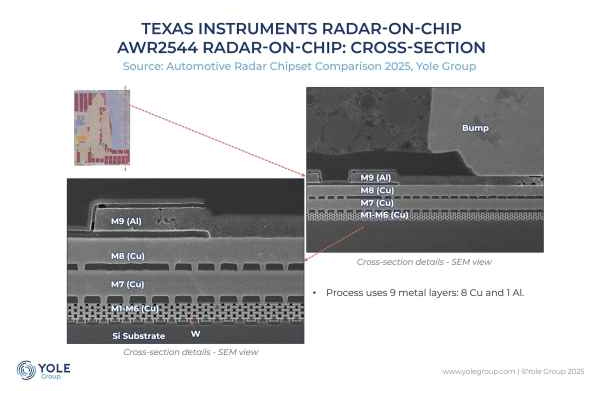
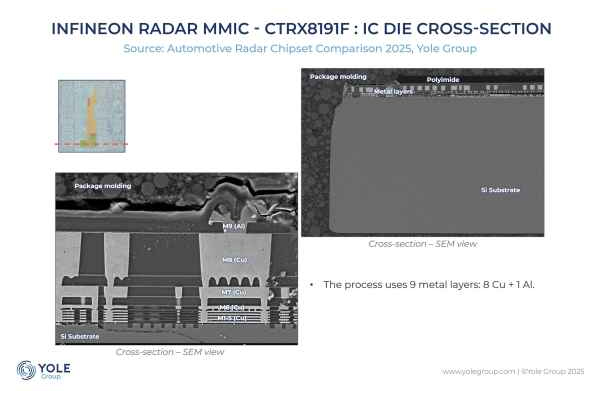
Together, these devices illustrate how differentiated semiconductor architectures are shaping the next generation of automotive radar performance, cost and scalability.
"Radar is consolidating its role as a cornerstone of automotive sensing. While the market faces cost and margin pressures, innovation at both the system and semiconductor levels is driving a new era of performance and affordability," said Ihor Pershukov, Ph.D., technology and cost analyst, Radio Frequency at Yole Group.
Through Automotive Radar 2025 and Automotive Radar Chipset Comparison, Yole Group pursues its mission of delivering comprehensive insights into technology innovation, supply chain transformation and market disruption shaping the future of mobility.