


Network congestion is a constant challenge in wireless communications, from 1G to the forthcoming 6G. As the number of connected devices skyrockets, the limited available bandwidth must be allocated judiciously to allow for higher network capacity and speed. Recently, two advancements have emerged with the most promising ways to address this challenge: integrated sensing and communication (ISAC) and reconfigurable intelligent surfaces (RIS). Individually or combined, ISAC and RIS can enhance capacity, reduce congestion and provide improved user experiences, as demonstrated in Figure 1.

Figure 1 ISAC and RIS enable wireless signal paths to connect users across the urban landscape.
UNDERSTANDING ISAC AND RIS
ISAC provides the network operator with more intelligence about users. ISAC enables efficient reuse of resources, including hardware and waveforms, to combine the sensing and communication functions. The same equipment that offers communication services can also sense the environment, providing valuable data about user locations and movements. Access to this data enhances the user experience by allowing the network to communicate optimally with users.
RIS, on the other hand, addresses the problem of signal blockage and low signal power, especially in high-density urban settings. RIS allows RF signals’ reflections to be reconfigured based on the location of the user. Once the user’s location is determined, RIS manipulates the signals’ phase, amplitude and polarization to direct them toward specific users. This capability ensures signals reach their intended audience, even in environments with obstacles, such as dense foliage, tall buildings in urban areas or indoor settings with multiple walls and partitions.
THE SYNERGY OF ISAC AND RIS
The real power of ISAC and RIS lies in their synergy. ISAC’s sensing capabilities can inform RIS on how to best direct signals. RIS uses the data ISAC provides to minimize interference and ensure each user receives the strongest possible connection. Adjusting signal paths in real-time helps alleviate network congestion and optimize available bandwidth by steering signals around obstacles and directing them toward users.
One key advantage of coupling ISAC and RIS is their economic viability. These technologies do not require new base stations, with minimal new hardware and investment needed. Instead, engineers can integrate them into existing network setups and avoid major infrastructure changes. ISAC uses existing base station setups, simply enhancing their operation with sensing capabilities. While RIS requires some investment in metasurfaces, the overall hardware investment is significantly lower than deploying new base stations or overhauling existing network infrastructure.
POTENTIAL USE CASES FOR ISAC AND RIS
The combination of ISAC and RIS is promising for addressing network congestion and enhancing connectivity in a variety of applications, including broadband wireless communications, autonomous vehicles and smart manufacturing.
Broadband Wireless Communications
In urban environments where obstacles cause signal deterioration, ISAC and RIS overcome these challenges to enable robust, high speed internet access. ISAC gathers intelligence about user locations and movements to optimize signal delivery. RIS uses building surfaces with reconfigurable elements that alter signals to overcome blockages and enhance connectivity based on the user locations ISAC provides.
Autonomous Vehicles
In autonomous vehicle operation, ISAC offers customized communication services that enable precise and reliable communication for real-time decision-making. RIS allows engineers to manipulate the environment, ensuring the signal is focused only where needed. Using ISAC and RIS in autonomous vehicle communication supports safe and efficient operations by reducing accidents and improving traffic flow.
Smart Manufacturing
Smart manufacturing relies on efficient communication and sensing to optimize production processes and improve operational efficiency. ISAC and RIS technologies facilitate these goals by enabling real-time data exchange and environmental monitoring within manufacturing facilities. ISAC’s sensing capabilities provide detailed insights into machine operations and environmental conditions, while RIS ensures reliable connectivity by dynamically adjusting signal paths to avoid interference. This combination enhances the flexibility and responsiveness of manufacturing systems, allowing for more efficient resource utilization and reduced downtime, even in highly congested industrial environments.
BEST PRACTICES IN ISAC AND RIS DEPLOYMENT
Engineers should employ various best practices, including environmental modeling, custom waveform development and advanced algorithm and hardware implementation, to effectively deploy ISAC and RIS into modern communication systems. Precise modeling and simulation of the propagation environment are crucial for successful ISAC deployment. Any errors during modeling propagate and affect the final design. Path loss, multipath and signal reflection must all be accurately modeled to optimize performance and system efficiency. Additionally, it is essential to use ray tracing to model the wireless channel by simulating the reflection, refraction and diffraction of electromagnetic waves in the environment. Ray tracing requires extreme precision as it is susceptible to atmospheric effects. Modeling and simulation are vital because the accuracy of the propagation environment directly affects waveform effectiveness.
RIS SYSTEM MODEL EXAMPLE
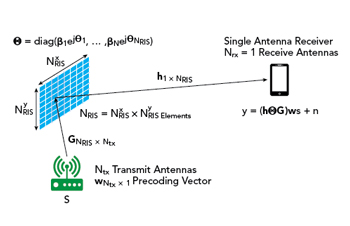
Figure 2 RIS scenario example.
Here is an example using the MATLAB 6G Exploration Library for 5G toolbox that simulates a RIS channel using two concatenated clustered delay line (CDL) channel models and provides an iterative algorithm to control the phases of each RIS element. It then sends a 6G-like signal through the RIS channel and displays the constellation of the received signal. Figure 2 models this scenario example. An Ntx-antenna transmitter sends a complex symbol s using a precoding vector w of size Ntx×1. The example assumes there is no line of sight between the transmitter and the receiver. An NRIS=NxRIS×NyRIS-element RIS reflects the transmitted signal towards a single antenna receiver. NyRIS and NxRIS are the numbers of elements per row and column, respectively, in the RIS. The signal is affected by the channel matrix G of size NRIS×Ntx, which models the channel between the transmitter and the RIS. The ith element of the RIS causes an amplitude and phase change to the impinging signal, which is modeled by the complex number βiejθi. The reflected signal then travels towards the receiver through a channel modeled by a matrix h of size 1×NRIS. The received signal y is affected by noise n.
The example models both the channel between the transmitter and the RIS and the channel between the RIS and the receiver using CDL channels. To model the RIS, the example applies a phase rotation θi to each RIS element between both CDL channels. An iterative algorithm calculates the value of the phase shifts θi assuming knowledge of channel matrices G and h. This example also models path loss and RIS scattering loss. Where appropriate, the example uses parameters as defined in the group report from ETSI on RIS.1 This example models the RIS with a stochastic channel model.
ISAC EXAMPLE USING 5G WAVEFORM
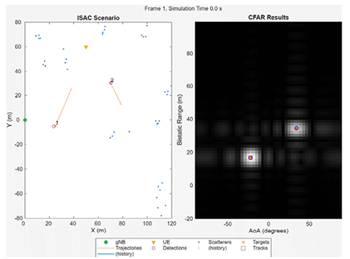
Figure 3 ISAC example results.
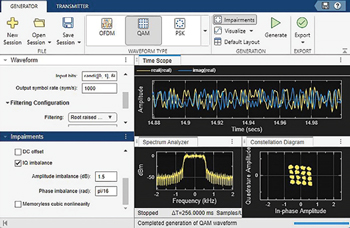
Figure 4 Generating custom waveforms using the Waveform Generator app in MATLAB.
This example, using the MATLAB 5G Toolbox and Phased Array System Toolbox, simulates data frame transmissions through the physical downlink shared channel (PDSCH) of a 5G New Radio (NR) link and shows how the channel matrix estimates obtained from the received frames can be processed to extract radar measurements of moving scatterers present in the channel. Recent research has explored various ISAC approaches, ranging from the joint design of dual-function systems to enabling sensing capabilities within existing wireless networks.
The example illustrates how sensing can be effectively accomplished using a 5G NR waveform, as defined by the 3GPP NR standard. Channel matrix estimates obtained from received PDSCH frames inherently capture information about the time delays and Doppler shifts experienced by the transmitted waveform as it travels to the receiver. By processing this information, in a manner akin to standard radar data cube techniques, these time delays and Doppler shifts can be translated into the positions and velocities of the corresponding scatterers, thereby forming radar detections.
The example begins by defining an ISAC scenario with a single transmitter and a single receiver, where the transmitter represents a base station and the receiver models user equipment. It then configures the transmitted 5G NR waveform, illustrating that the selection of demodulation reference signal parameters is directly related to the desired sensing performance. The example proceeds by simulating the propagation of PDSCH frames through a scattering MIMO channel. For each received frame, the channel matrix is estimated and then processed to detect moving scatterers present in the channel. The example demonstrates that from the sensing perspective, the modeled 5G link is a bistatic radar capable of measuring bistatic range and angle-of-arrival of the targets. Finally, these measurements are passed to a tracking algorithm to form target tracks and estimate target positions and velocities in Cartesian coordinates, with the results shown in Figure 3.
Wireless communication waveforms based on industry standards cannot be used in ISAC and RIS design. Instead, engineers must design custom waveforms to enable sensing and communication to work together seamlessly. Engineers can use the Wireless Waveform Generator app in MATLAB® to generate standards-based waveforms, as shown in Figure 4. Carefully designed waveforms enable ISAC and RIS to achieve high-resolution sensing and maintain robust communication links. When it comes time to deploy ISAC and RIS systems, their success hinges on both the waveform design and the sophisticated algorithms and hardware solutions that manage the complex computations needed for accurate sensing and communication.
Deploying ISAC and RIS technologies requires developing efficient algorithms and advanced hardware solutions to ensure reliable real-time performance. Engineers must implement the algorithms primarily on field-programmable gate arrays (FPGAs) because of their high speed processing capabilities, but this puts a burden on the real-time performance of the FPGAs. Therefore, the algorithms implementing ISAC and RIS must be optimized using FPGA-ready IP blocks.
ISAC AND RIS IN 6G AND BEYOND
As the era of 6G wireless communications draws closer, the challenge that network congestion presents grows with every passing day. The integration of ISAC and RIS has the potential to transform many industries by enabling simultaneous sensing and communication while optimizing signal propagation and coverage. Their economic viability makes them even more attractive as they offer solutions that take advantage of existing infrastructure without extensive overhauls. As engineers push the boundaries of 6G wireless communications and beyond, the synergy of ISAC and RIS will play a central role in shaping tomorrow’s wireless networks.
Reference
- “Reconfigurable Intelligent Surfaces (RIS); Communication Models, Channel Models, Channel Estimation and Evaluation Methodology,” ETSI, GR RIS 003 V1.1.1.