


Based on the previous analysis, the ratio to push the second harmonic band is about 3.367 when K1' = 0.45 and K2' = 0.18 are chosen (see Figure 6). The filter has a center frequency of 25.1 GHz with the shifted second harmonic frequency at 89.94 GHz. The electrical length of the tri-section resonator is about 110 degrees; its size is dramatically reduced compared to a uniform half-wavelength resonator. However, insertion loss is too high, so impedance matching is required to improve passband performance.
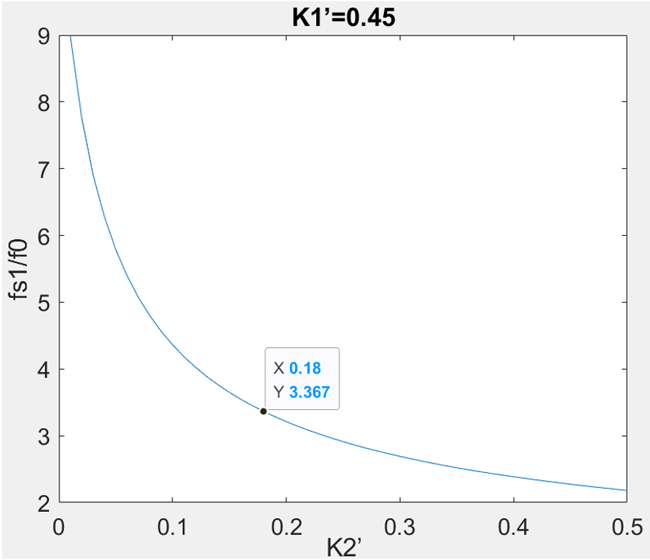
Figure 6 fs1/f0 for 24 GHz filter design.
Adding short-circuited stubs to the feed structure improves impedance matching and increases the operating bandwidth.10 Four short-circuited stubs are used. The resonant frequency is shifted from 25.2 to 25.8 GHz with a low insertion loss of 0.93 dB and wide bandwidth of 4 GHz.
To further suppress the high-frequency harmonics, a rectangular quarter-wavelength open-circuited stub is used; however, its narrowband characteristic and limited space are issues. This is addressed by using quarter-wavelength open-circuited radial stubs. The intercept angle and the inner and outer radius of the radial stub are related to the effective permittivity of the stub line and increase the bandwidth of harmonic suppression. The radial stubs parameters are R1 = R2 = 0.252 mm, θR1 = θR2 = 90 degrees and LR1 = LR2 = 0.18 mm. The second harmonic is shifted to 110 GHz without affecting the performance of the desired passband (see Figure 7).
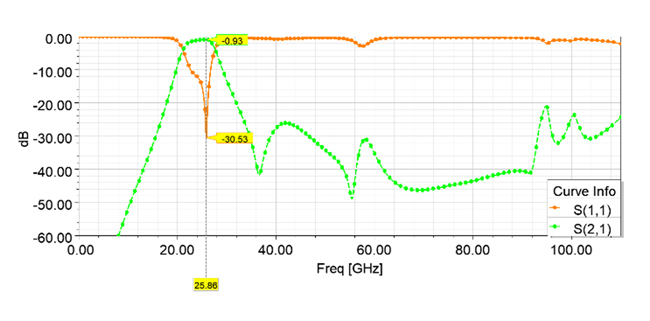
Figure 7 24 GHz bandpass filter simulated S-parameters.
Measurements
The on-wafer measurement setup comprises a Keysight N5227B PNA Microwave Network Analyzer, a probe station and microwave probes (see Figure 8). A G-S-G probe with a pitch of 150 μm is used. The final size of the LCP-based 24 GHz bandpass filter is 0.41 by 0.39 λg2.
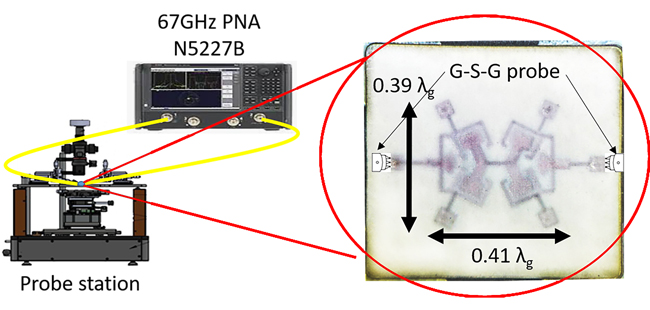
Figure 8 Prototype filter and measurement setup.
Simulation and measurement results are consistent, as demonstrated in Figures 9a and 9b. The measured 3 dB bandwidth is about 4 GHz at the center frequency of 24 GHz. Insertion loss in the passband is about 1.4 dB, and the return loss is greater than 20 dB. A wide rejection band up to 110 GHz is observed.
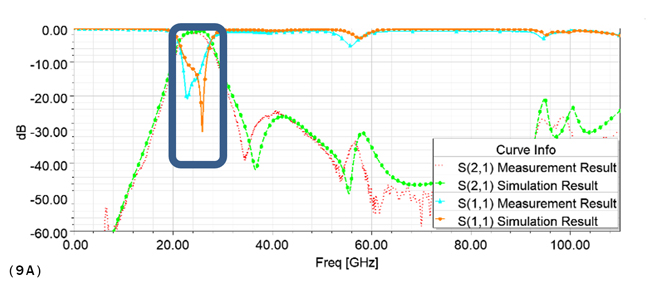
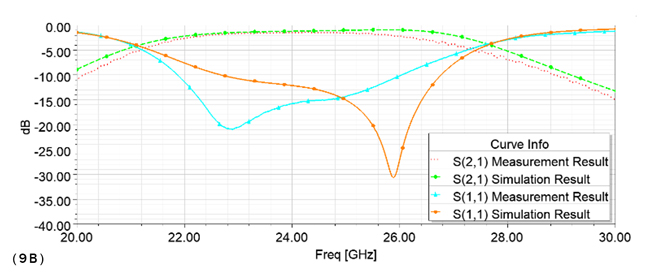
Fig. 9 Simulation and measurement: (a) full range from DC to 110 GHz and (b) operation in the passband.
Table 1 compares the performance of this filter with other similar work. The merits of this filter include its insertion loss, size and ease of fabrication. It also provides suppression greater than 20 dB up to 110 GHz to reduce interference from high-frequency signals.
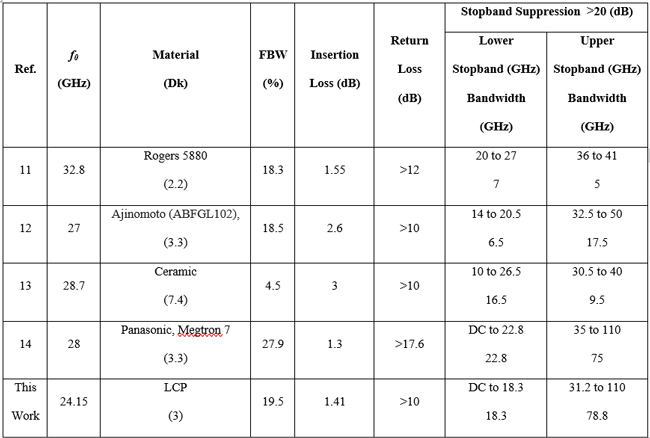
Table 1 Comparison with other related work.
Conclusion
A 24 GHz bandpass filter with a wide rejection band is fabricated on an organic LCP substrate. The LCP substrate has a stable dielectric constant, low dielectric loss, low water absorption and low deformability at mmWave frequencies. A modified tri-section resonator achieves a high ratio of the shifted second harmonic frequency to the fundamental frequency. Its total electrical length is dramatically reduced compared to a conventional uniform half-wavelength resonator. Splitting and dual-feed coupling mechanisms provide high impedance ratios for impedance matching and additional transmission zeros. The 3 dB bandwidth is about 4 GHz at a center frequency of 24 GHz. Insertion loss in the passband is about 1.4 dB, and return loss is greater than 20 dB. Out-of-band rejection up to 110 GHz is greater than 20 dB. The 24 GHz filter can be integrated into radar sensors to enhance immunity to interference.
References
- D. J. Chung, A. L. Amadjikpè and J. Papapolymerou, “Multilayer Integration of Low-Cost 60-GHz Front-End Transceiver on Organic LCP,” IEEE Antennas and Wireless Propagation Letters, Vol. 10, November 2011, pp. 1329-1332.
- Z. -C. Hao and J. -S. Hong, “Ultra-Wideband Bandpass Filter Using Multilayer Liquid-Crystal-Polymer Technology,” IEEE Transactions on Microwave Theory and Techniques, Vol. 56, No. 9, September 2008, pp. 2095-2100.
- Y. Lan, Y. Xu, C. Wang, Z. Wen, Y. Qiu, T. Mei, Y. Wu and R. Xu, “X-Band Flexible Bandpass Filter Based on Ultra-Thin Liquid Crystal Polymer Substrate,” Electronics Letters, Vol. 51, No. 4, February 2015, pp. 345-347.
- Y. Zhang, S. Shi, R. D. Martin and D. W. Prather, “Substrate Integrated Waveguide Filter on LCP Substrate AT 94 GHz,” Microwave and Optical Technology Letters, Vol. 58, No. 3, March 2016, pp. 577-580.
- M. Makimoto and S. Yamashita, “Compact Bandpass Filters Using Stepped Impedance Resonators,” Proceedings of the IEEE, Vol. 67, No. 1, January 1979, pp. 16-19.
- J. -S. Wong and M. J. Lancaster, Microstrip Filter for RF/Microwave Applications, Wiley, New York, 2001.
- I. -S. Kim, G. Kim, J. T. Park, Y. S. Jang and B. J. Park, “Tri‐Section Stepped Impedance Resonator with Adjustable Length and Improved Second Harmonic Characteristics,” Microwave and Optical Technology Letters, Vol. 62, No. 1, January 2020, pp. 82-87.
- C. -Y. Chen, C. -Y. Hsu and H. -R. Chuang, “Design of Miniature Planar Dual-Band Filter Using Dual-Feeding Structures and Embedded Resonators,” IEEE Microwave and Wireless Components Letters, Vol. 16, No. 12, December 2006, pp. 669-671.
- C. -M. Tsai, S. -Y. Lee and C. -C. Tsai, “Performance of a Planar Filter Using a Zero-Degree Feed Structure,” IEEE Transactions on Microwave Theory and Techniques, Vol. 50, No. 10, October 2002, pp. 2362-2367.
- W. -L. Chen and G. -M. Wang, “Effective Design of Novel Compact Fractal-Shaped Microstrip Coupled-Line Bandpass Filters for Suppression of the Second Harmonic,” IEEE Microwave and Wireless Components Letters, Vol. 19, No. 2, February 2009, pp. 74-76.
- X. -C. Zhu, W. Hong, K. Wu, H. -J. Tang, Z. -C. Hao, J. -X. Chen and P. Chu, “Design and Implementation of a Triple-Mode Planar Filter,” IEEE Microwave and Wireless Components Letters, Vol. 23, No. 5, May 2013, pp. 243-245.
- M. Ali, F. Liu, A. Watanabe, P. M. Raj, V. Sundaram, M. M. Tentzeris and R. R. Tummala, “First Demonstration of Compact, Ultra-Thin Low-Pass and Bandpass Filters for 5G Small-Cell Applications,” IEEE Microwave and Wireless Components Letters, Vol. 28, No. 12, December 2018, pp. 1110-1112.
- B. G. Choi, M. G. Stubbs and C. S. Park, “A Ka-Band Narrow Bandpass Filter Using LTCC Technology,” IEEE Microwave and Wireless Components Letters, Vol. 13, No. 9, September 2003, pp. 388-390.
- Y. Rao, H. J. Qian, J. Zhou, Y. Dong and X. Luo, “Miniaturized 28-GHz Packaged Bandpass Filter With High Selectivity and Wide Stopband Using Multilayer PCB Technology,” IEEE Microwave and Wireless Components Letters, Vol. 32, No. 6, June 2022, pp. 664-667.