


SDRs are now integral to many areas, both commercial and military, due to their adaptability and advanced capabilities. In the commercial sphere, SDRs support the global economy by enabling seamless communication across different standards and frequencies, which is vital for international business operations, industrial applications, medical technology, mobile communications and space. They ensure the bleeps, sweeps and creeps all stay where they should, and do so with very low latency, and, unlike Spaceballs, with no raspberry jam.
In the military domain, radio requirements have evolved significantly beyond voice and data communications, now requiring communication systems that can run multiple waveforms simultaneously to allow communication across all warfighting domains, something that currently only SDRs can accomplish.13 These technical breakthroughs allow radios to go where radios have never gone before. This has made them a focus of military communications development efforts for the last several years. They facilitate global military operations by providing versatile and secure communication solutions for command-and-control systems, tactical battlefield radios, satcom, radar systems and more. SDRs can be rapidly deployed and reconfigured to meet the demands of different mission environments. This flexibility ensures that military personnel can consistently maintain reliable communications independent of location or operating conditions.

Figure 7 The EDRS. Source: European Space Agency.
Today, SDRs are used in a wide range of applications. They play a crucial role in enabling commercial requirements across different standards and frequencies. Just as Vanu got the first one approved for a cellular base station, SDRs are now heavily used by mobile technology companies. They provide low latency, great flexibility, high interoperability and massive multiple input multiple output (MIMO) capabilities, which are useful for the 5G physical layer and the beamforming associated with 5G signal processing.14,15 Space is the next frontier for SDRs. SDRs have an advantage over traditional radios in that they can be reconfigured from the ground, enabling one unit to be adapted for multiple applications. Furthermore, a single satellite can operate in multiple frequency bands simultaneously, as with the European Data Relay System (EDRS), shown in Figure 7.
Beyond cellular technology and space purposes, SDRs have become integral to medical devices—applications that use RF, such as computed tomography (CT) scanners or magnetic resonance imaging (MRI) systems rely on SDRs. They are also used for remotely monitoring, controlling and analyzing industrial devices and processes—supervisory control and data systems, or SCADA systems. SCADA systems are used across many industries, including oil and other pipelines, utilities and water and wastewater plants.
The current military SDRs are used across all warfighting domains and have advanced encryption to ensure secure communications in contested areas. The U.S. military has moved past the JTRS system, and while it has not reached the technological level of Star Trek communicators yet, SDRs are being used across all the military departments in all the domains, from handheld radios, manpack radios for forward-deployed teams, hardened expeditionary networks, aviation radios, to space-based radios and SATCOM. The U.S. Army’s new Combat Net Radio (CNR) upgrades existing radios and provides secure battlefield voice and data communications critical for success in today’s battlefield.16
Operating a military SDR, like the Navy’s Amphibious Tactical Communications Systems (ATCS) or the CNR, outside U.S. borders is fundamentally a regulatory exercise wrapped around an RF design problem. Success hinges on three pillars: regulatory alignment, technical agility and documented assurance. All three must be addressed early in the DOD’s acquisition cycle using the SSRA process.
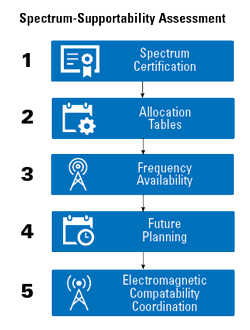
Figure 8 General SSRA process.
For military systems, building a robust SSRA is essential for design and procurement decisions throughout the acquisition process.17 They provide an early assessment for a system’s potential to cause interference to, or suffer from, other military or civilian RF systems currently in use or planned for operational environments, both domestic and foreign.2 The general process is shown in Figure 8. At a minimum, it should include:
- System overview for context (MIL-STD-469G Annex A)
- Technical data sheet for power-density calculations (ITU-R Rec. SM.329)
- Occupied-bandwidth & out-of-band plots for compliance (CISPR 16-2-3)
- Interference-hazard analysis (ITU-R Rec. M.2101)
- Footnote cross-matrix mapping RF bands to national footnotes (ITU Radio Regulations)
- EMC/EMI test reports (MIL-STD-461G)
- Signed host-nation license or MOU.
Military host-nation approvals are critical and time-consuming. National regulators process each visiting system individually, for example, requiring filing for a spectrum license for a satellite to transmit, an application, a technical annex, reviews, approvals and sometimes on-site acceptance testing. This process can take months and involve multiple rounds of questions. It is essential to know the regulatory authority, whether it’s the Ministry of Defense (MOD) frequency office in a NATO nation, or a civilian spectrum regulator like the National Communications Commission (NCC) in Nigeria.18
Commercial SDRs are increasingly sold and deployed worldwide, and like military SDRs, they must comply with local spectrum regulations in the country where they operate. However, the approval process for commercial equipment is generally faster and more standardized than for military systems.
Before a commercial SDR (like a cellular base station, Wi-Fi router or IoT device) can be sold in a new country, the manufacturer must obtain approval from the national regulatory authority. This ensures the device will only operate within permitted frequency bands, at allowed power levels, and in accordance with approved technical standards. Unlike military deployments, which often require detailed applications and case-by-case approvals, most commercial products follow a standardized process. This often includes submitting test results from accredited labs and complying with international norms such as those from the International Telecommunications Union (ITU), the European Telecommunications Standards Institute (ETSI) or the FCC.
Modern commercial SDRs are often designed with region-specific profiles or software-based geo-location. This enables a single device to automatically adapt to the frequency allocations and power limits specified by local regulators. When the device is powered up in a different country, it loads the appropriate configuration, sometimes based on SIM card location, GPS data or user selection, ensuring legal operation without any hardware changes. Firmware updates can add support for new markets or adapt to changing regulations, making SDRs highly flexible for global manufacturers.
For the end user, this means a commercial SDR can be sold and used globally with minimal changes, provided it passes the relevant compliance tests. In short, commercial SDR spectrum supportability is managed through a combination of international certification standards, reconfigurability and automated regional adaptation.
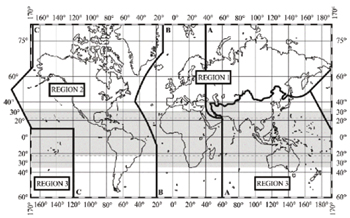
Figure 9 ITU regions and the dividing lines between them. Source: ITU.
Both commercial and military SDR manufacturers must ensure that, as they provide systems worldwide, they accurately map frequency allocations to the corresponding footnotes in the ITU regions’ frequency allocation tables, as shown in Figure 9, since this plays a significant role. For example, the 225 to 400 MHz band is allocated for aeronautical mobile use in Region 2 but has different allocations in Region 1, necessitating adjustments for commercial systems being marketed and for military systems being used during exercises. Specific national deviations also exist, such as the U.K.’s “emergency services suppression,” where frequencies 380 to 446 MHz are used only for emergency services. The U.K.’s emergency band is the U.S.’s land mobile radio. Maintaining a cross-matrix of ITU table entries, regional footnotes and country-specific differences is crucial. Spectrum convergence efforts from organizations like the European Conference of Postal and Telecommunications Administrations (CEPT) and the Inter-American Telecommunication Commission (CITEL) should also be tracked to facilitate future adjustments through firmware updates.
The military has learned many lessons both operationally and through exercises such as Bold Quest 2024 and Pacific Griffin 2023. Link-16, the tactical data network used by NATO members, had emissions that impacted aircraft positioning receivers in Norway, leading to a software patch for power reduction. The NATO Tiger Meet 2022 exercise highlighted the need for narrowband frequency-hopping to overcome intermodulation issues in crowded bands. These issues were documented, and the radio equipment was updated as a result of the exercises.
By integrating documentation, regulatory, technical and real-world information streams from the outset, commercial and military SDRs remain globally usable with only minor software tweaks, avoiding costly redesigns for the different global spectrum allocations. SDRs represent a significant advancement in radio technology, offering unparalleled flexibility and adaptability. While they come with challenges, their benefits make them invaluable in both commercial and military contexts. As we continue to innovate and improve SDR technology, we can look forward to even greater capabilities and applications. Live long and prosper.
REFERENCES
- B. Farmer and M. Klein, “Spectrum Supportability Risk Assessments: An Overview,” Defense Systems Information Analysis Center, 2 November 2019. [Online]. Available: https://dsiac.dtic.mil/articles/spectrum-supportability-risk-assessments-an-overview/.
- Defense Information Systems Agency and the Defense Spectrum Organization, “Joint Services Guide for Development of a Spectrum Supportability Risk Assessment (SSRA),” Defense Acquisition University, September 2011. [Online].
- L. Goeller and P. Bronson, “Promise, Reality, and Limitations of Software Defined Radios,” Institute for Defense Analysis (IDA), Arlington, 2013.
- Air Force Research Laboratory (AFRL), “Software Defined Radio: Connecting At Machine Speeds,” AFRL, [Online]. Available: https://afresearchlab.com/technology/information-technology/successstories/software-defined-radio/.
- R. Akeela and B. Dezfouli, “Software-defined Radios: Architecture, State-Of-The-Art, and Challenges,” Computer Communications, Vol. 128, pp. 106–125, September 2018.
- A. Guzman, “Why COMSEC is More Critical Than Ever: A Closer Look at the Hidden Battlefield of Communications Security,” U.S. Army, 8 October 2024. [Online]. Available: https://www.army.mil/article/279799/why_comsec_is_more_critical_than_ever_a_closer_look_at_the_hidden_battlefield_of_communications_security#:~:text=The%20risks%20associated%20with%20poor,the%20margin%20for%20error%20smaller.
- Global Foxcom, “The Risks of Unsecured RF Communications,” Global Foxcom, 19 May 2025. [Online]. Available: https://foxcom.com/blog/the-importance-of-secure-rf-communications-in-modern-warfare/#:~:text=Unsecured%20RF%20channels%20are%20vulnerable,need%20for%20fortified%20communication%20infrastructure.
- TVTechnology, “Vanu Receives FCC’s First Authorization for Software-Defined Radio (SDR),” TVTechnology.com.com, 33 November 2004. [Online]. Available: https://www.tvtechnology.com/news/vanu-receives-fccs-first-authorization-for-softwaredefined-radio-sdr.
- W. Bonser, “SPEAKeasy Military Software Defined Radio,” in 1998 International Symposium on Advanced Radio Technologies.
- V. Bose, “A Software Driven Approach to SDR Design,” COTS Journal, January 2004. [Online]. Available: http://www.cotsjournalonline.com/articles/view/100056.
- J. Wilson, “Military Communications Technology Makes The Switch,” Military & Aerospace Electronics, 1 April 2002.
- S. Gallagher, “How to Blow $6 Billion on a Tech Project,” ars Technica, 18 June 2012.
- D. Parsons, “Software-Defined Radios: Critical for the Military’s Future Secure Communications Needs,” Avionics International, January/February 2023.
- R. Mohammadi, “The Future of 5G with SDR,” Microwaves and RF, 26 February 2021.
- A. Sayed, “Effectiveness of Beamforming Techniques on 5G,” International Journal for Multidisclipinary Research (IJFMR), Vol. 4, No. 6, 2022.
- PEO C3N, “Combat Net Radio,” US Army, [Online]. Available: https://peoc3n.army.mil/Organizations/PM-Tactical-Radios/Combat-Net-Radio/.
- Defense Acquisition University, “J8 - Spectrum Supportability Risk Assessment SSRA,” Defense Acquisition University (DAU), [Online]. Available: https://www.dau.edu/cop/e3/resources/j8-spectrum-supportability-risk-assessment-ssra.
- Elix-IRR Partners LLP, “Spectrum Management in Africa,” Elix-IRR Partners LLP, London, 2015.