


The IEEE International Symposium on Antennas and Propagation and North American Radio Science Meeting took place in Ottawa, Canada July 13 to 18, at the Rogers Centre. The event encompasses subjects from antenna design and analysis to electromagnetic theory, wireless communication systems to remote sensing, and beyond. The symposium is co-sponsored by the IEEE Antennas and Propagation Society (IEEE AP-S), the Canadian National Committee (CNC), and the US National Committee (USNC) of the International Union of Radio Science (URSI). The Symposium featured a diverse range of keynote speeches, technical sessions, and interactive workshops covering various topics related to antennas and propagation plus a small exhibition. Check out our photo gallery here.
We visited the companies in the exhibition and summarized what they were featuring here:
Altair did a tutorial to teach the physics behind many simulation methods for RF propagation, from empirical models, via ray-tracing and shooting and bouncing rays, to the Parabolic Equation Method. The tutorial provided insight into the trade-offs of the many simulation methods that exist and teach which to choose depending on the application at hand. Many practical examples were presented and demonstrated. They also had a nice technical note about reducing phased array antenna design time by 25% by using Altair FEKO.
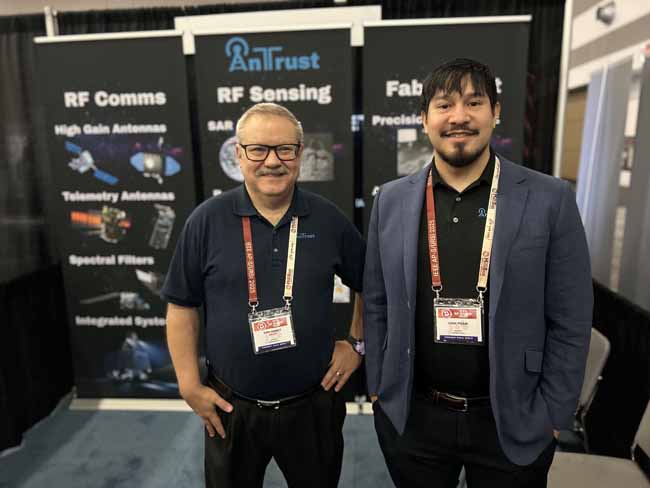 The AnTrust Anechoic Chamber (ATAC) received strong interest from industry professionals, educators and students alike at the IEEE AP-S/URSI 2025. Covering 1 to 40 GHz in just two calibrations, the ATAC delivers efficient and fully polarimetric measurements of wideband antennas and subsystems. Attendees appreciated and experienced our cleanroom-compatible absorber — “no more egregious carbon dust!” — and were intrigued by the ATAC’s unique 3-axis co-incident phase-centering positioner, which aids phase interpretation. Measurement data is provided in a clear text format and comes with a free Python-based reader to simplify analysis and publication preparation. Testing is available at AnTrust’s Columbia, Maryland site, or by shipping your test articles to us.
ANSYS officially became part of Synopsis the last day of the event. They were discussing proper meshing so that you avoid pixelization in your results. A "pixelated" appearance suggests that the mesh elements are too large to adequately resolve the gradients or details in the EM fields, leading to a blocky, stepped representation rather than a smooth and continuous one. Ansys HFSS uses an adaptive meshing process to automatically refine the mesh where needed. This process iteratively solves the fields, identifies areas with errors, and refines the mesh until the solution converges based on a user-defined threshold.
Fabric8labs uses electrochemical additive manufacturing (ECAM) that enables additive manufacturing in high volume, high growth markets such as electronics, wireless communications and medical devices. End-users select ECAM based on its unique combination of features and the benefits they provide. High-precision, 33 micron voxels enable complex features that maximize performance. Room-temperature processing allows for direct-print on a wide range of materials, such as printed circuit boards, lead-frames, ceramics, metals, and silicon. ECAM copper is 99.95% pure for optimal thermal and electrical performance. The booth had some very complicated antenna geometries made with ECAM that could not be produced by conventional methods.
IMST and R&S are collaborating to develop innovative solutions for designing and validating antennas using digital twin technology. This approach enables highly realistic simulations of antenna performance in a virtual environment, reducing development time and making testing more efficient. The workflow begins with precise antenna module measurements in a Rohde & Schwarz test chamber, followed by the conversion into a digital twin model using Rohde & Schwarz AMS32. The digital twin is then imported into EM Twin, IMST’s advanced simulation environment, for further analysis and optimization. The software tool EM Twin, developed by IMST, is designed specifically for Antenna Digital Twin EM simulation. Powered by IMST’s advanced FDTD solver and innovative XPU technology, it delivers highly accurate simulations through proprietary algorithms based on equivalent currents. To simplify the process, the tool features specialized wizards tailored for various applications, such as automotive and exposure simulations.
 MathWorks featured RF System design from antenna-to-bits: The demo enabled modeling and simulation of wireless communications and radar systems from antenna to bits, including large antenna arrays, RF transceivers, PCB boards, data converters, digital signal processing algorithms and control logic. Visitors could learn how to build a digital twin of their system to evaluate different propagation scenarios and explore implementation tradeoffs. Integrate measurements, data sheet specifications and circuit-level simulation results for antennas and RF components in your system-level model for rapid analysis and simulation.
Millibox was featuring their MBX02K, an entry level package that offers a complete OTA test solution to budget conscious users. This bundle is ideal for startups, education and industry alike. It consists of a complete MBX02 4ft chamber and a GIM06 antenna positioner along with its full software controller in Python. If a larger far-field distance or chamber cross-section is needed, they have a line of modular anechoic chambers MBX0x and MBX3x. For larger DUT size or weight, upgrade to our line of 2-axis (GIM04) and 3-axis (GIM04X) antenna positioners.
NSI-MI was featuring their CRS-PORT-8-0.5, a pre-configured portable compact measurement system ideal for measuring medium to high gain antennas from 8.2–110.0 GHz with antenna-under-test (AUT) payloads of up to 0.5 m (19.7 in.) in diameter and 75 kg (165 lb). The base, reflector, and positioning system come pre-assembled, aligned, and integrated with the chamber, for ultimate convenience and cost/time savings. The CRS-PORT-8-0.5 supports NSI-MI and Keysight RF receivers and is capable of measuring amplitude and phase from 8.2 GHz to 110.0 GHz. The system includes a workstation featuring state-of-the-art NSI-MI antenna test software. Measured data provides direct far-field patterns allowing for complete characterization of the antenna’s performance. A single data set provides rapid information on antenna gain, beamwidth, side lobe structure, beam pointing, and cross polarization among other parameters.
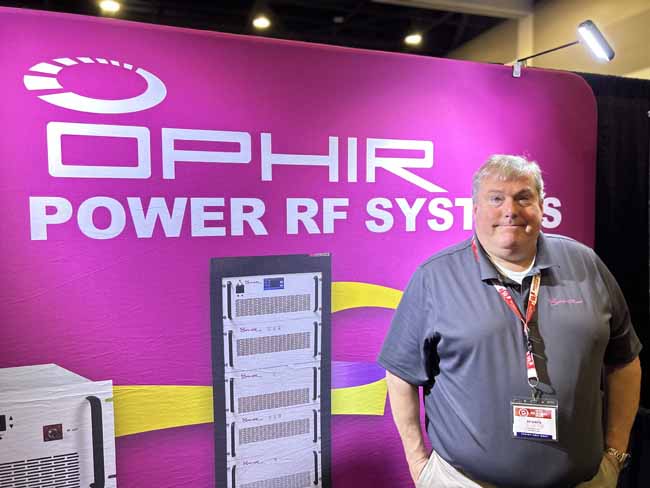 Ophir was featuring the 4159, a 1000 Watt broadband amplifier that covers the 800-1000 MHz frequency range. This small and lightweight amplifier utilizes Class A linear power devices that provide an excellent 3rd order intercept point, high gain, and a wide dynamic range. Due to robust engineering and employment of the most advanced devices and components, this amplifier achieves high efficiency operation with proven reliability. Like all OPHIRRF amplifiers, the 4159 comes with an extended multiyear warranty backed by Ophir RF’s commitment to total customer satisfaction.
Remcom recently released a new version of Wireless InSite® 3D Wireless Prediction Software with advanced capabilities including time-based mobility, lunar propagation modeling and wideband ray-tracing with S-parameter outputs. The new release (Release 4.0) expands upon Remcom’s longstanding commitment to technical precision, supporting rigorous simulation of dynamic and complex RF environments, including on-body propagation and NASA Artemis missions. Wireless InSite 4.0 introduces a robust mobility framework that accurately models the movement of transceivers and objects within a user-defined scene. Mobile platforms now enable precise evaluation of dynamic scenarios where mounted antennas on scatterers like vehicles and humans affect channel conditions. Time-based outputs, rendered as plots or animations, provide detailed insights into multipath and fading, received power, SINR and data throughput across time as RF systems and vehicle platforms move through a scene. A new Results Browser and Viewer provide multi-result access and time-sequenced visualization, allowing engineers to focus on dynamic behaviors with clarity.
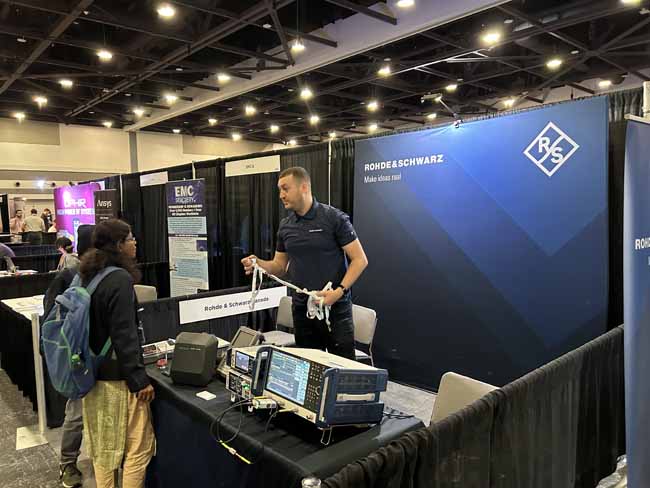 Rohde & Schwarz Canada showcased their latest test and measurement solutions on the exhibition floor. Dr. Anis Ben Arfi, a Senior Test and Measurement Engineer, engaged attendees with a comprehensive presentation of the R&S Test and Measurement catalog. Students stopped by the R&S booth to collect educational materials, including posters, RF measurement pocketbooks, and information about R&S free online courses in Test and Measurement. Over the course of the three-day exhibition, live demonstrations of the ZNB3000 Vector Network Analyzer offered exceptional speed, accuracy, and adaptability. Conference attendees posed questions related to various topics, such as antenna measurement, intelligent surfaces, time domain reflectometry, and group delay measurement.
In addition to the ZNB3000, Rohde & Schwarz Canada showcased their handheld solutions, including a demonstration of the ZPH handheld spectrum analyzer and its versatile accessories, such as the HE400 antenna for interference detection and direction-finding. These portable tools are designed to meet the demands of a wide range of applications, providing engineers with reliable performance in the field. The R&S Canada team also highlighted their essential RF and antenna lab instruments, including power sensors, power supplies, and benchtop oscilloscopes. These instruments are key for a wide array of applications, establishing the integral Rohde & Schwarz portfolio of test and measurement solutions.
Testforce is the largest RF and microwave distributor in Canada. They offer technical events and resources along with representing companies such as Maury Microwave, MPI, Lake Shore Cryotronics, Ametek, Anritsu, Luna, Quantifi Photonics, Pickering, Bird, VIAVI, R&S, ETS Lindgren, Fluke, Copper Mountain Technologies, Spirent, Pendulum, etc.
TMYTEK featured the XRifle Dynamic RIS, an advanced Reconfigurable Intelligent Surface (RIS) solution designed to optimize wireless signal propagation and boost network performance in 5G/6G deployments. With the ability to seamlessly adjust beam angles and dynamically reconfigure reflection angles, it enhances signal coverage and quality in diverse environments, both indoors and outdoors. XRifle Dynamic RIS overcomes high frequency challenges such as signal loss and obstruction, playing a crucial role in expanding non-line-of-sight coverage and improving connectivity in urban areas, industrial zones and other challenging settings. TMYTEK’s XRifle Dynamic RIS is available in two models: a 28 GHz version (26 to 30 GHz) and a 4.7 GHz version (4.2 to 5.2 GHz). These models are specifically designed to enhance signal quality in areas with weak or no coverage, providing precise control over reflective angles to extend network reach. With the ability to control up to four RIS modules using a single controller, XRifle Dynamic RIS offers a scalable solution for diverse deployment scenarios, from R&D and field trials to real-world prototyping of 5G NR FR1/FR2 networks.