

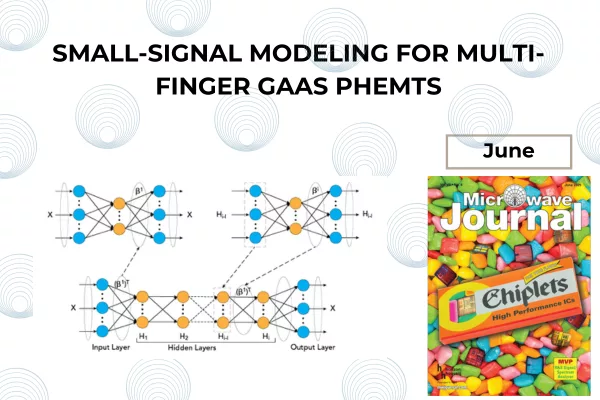
In this article, the autoencoder (AE) concept is applied to the Extreme Learning Machine (ELM) algorithm to develop a modeling method for multi-finger gallium arsenide (GaAs) pseudomorphic high electron mobility transistor (pHEMT) layouts. To avoid local optimum solutions, the Sparrow Search Algorithm (SSA) optimizes the weights and thresholds generated by the Deep ELM (DELM) algorithm, creating the SSA-DELM algorithm. To validate the accuracy and effectiveness of the SSA-DELM algorithm in small-signal modeling, its performance is compared with the Back Propagation (BP) and Support Vector Regression (SVR) algorithms. The proposed SSA-DELM algorithm achieves greater than 99.7 percent accuracy in the small-signal modeling of GaAs pHEMTs up to 50 GHz for various total gate widths.
Pseudomorphic GaAs HEMTs outperform GaAs HEMTs in current conduction and cut-off frequency.1 Due to their high electron mobility, high gain and low noise performance, GaAs pHEMTs have become crucial components in low noise amplifiers, voltage-controlled oscillators and other nonlinear RF circuit applications.2 Developing relevant pHEMT models to meet application-specific requirements is essential during the design of high frequency circuits. Meeting these needs requires effective and general modeling techniques.
The study of device modeling techniques has become fundamental in microwave circuit design. Accurate small-signal equivalent circuit models are essential for developing reliable large-signal and noise models.3 Artificial neural networks (ANNs) are a key method for characterizing and modeling microwave devices. They enable device behavior to be modeled without understanding the internal mechanisms, thus reducing computation time and speeding up design optimization.4,5 Various neural network techniques have been widely used in recent publications. However, ANN techniques require tedious parameter descriptions, while SVR can suffer from underfitting and overfitting due to data set and hyperparameter choices. Moreover, existing models often lack good generalization performance for modeling the relationship between GaAs pHEMT RF characteristics and gate width.
To address these issues, the work described in this article adopts the SSA to optimize the DELM for modeling GaAs pHEMTs under small-signal conditions. The SSA converges to the global optimal solution faster than genetic and particle swarm optimization algorithms. Thus, the SSA optimizes the DELM’s weights and thresholds, ensuring the fitness function remains minimal in a multi-finger layout.
GaAs pHEMT SMALL-SIGNAL EQUIVALENT CIRCUIT MODEL

Figure 1 GaAs pHEMT small-signal model.
The small-signal equivalent circuit model of a GaAs pHEMT is shown in Figure 1. The parasitic part of the circuit comprises nine bias-independent elements (Cpg, Cpgd, Cpd, Lg, Ld, Ls, Rg, Rd and Rs), where the intrinsic elements are within the dashed box. Rds is the drain-source interchannel resistance and Ri is the input gate-source resistance. Cgs, Cgd and Cds are the gate-source, gate-drain and drain-source capacitance, respectively.
SPARROW SEARCH OPTIMIZED DELM ALGORITHM
DELM Algorithm
The ELM is a single hidden layer feedforward neural network6 that does not require fine-tuning parameters. This results in faster learning and more effective fitting. However, adjusting parameters for optimal results can make the process complex when modeling devices with different characteristics.
AE is an unsupervised neural network model that extracts valuable information from input data while reconstructing it, learning beneficial data characteristics. Combining AE with ELM creates a DELM, allowing multilayer network structures to capture more intricate data characteristics. An ELM with only a single hidden layer cannot capture the data’s effective characteristics when confronted with input and output variables with differing grid widths. Creating the DELM solves this problem.
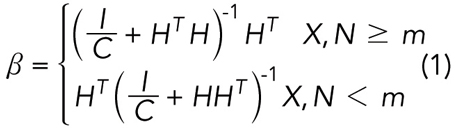
With its superior nonlinear fitting capability, deep learning is widely used for modeling complex systems like microwave modules. DELM comprises multiple ELM-AEs, with input data X and output data Y. The ELM-AE equalizes the input and output of the ELM by setting Y = X. This transforms the hidden layer feature, H, into an encoding of the input training sample, generating its output weight matrix, β. The output features of each layer are mapped from the hidden layer features and samples by determining β from Equation 1:
Where:
C is a user-specific parameter to pursue good generalization performance
N is the number of training samples
m is the number of hidden layer neurons
I is the unit matrix
The output weights expressed in equal dimensions can be described by Equation 2:

Multiple ELM-AEs are stacked to create a multilayer network feature extraction model. The output feature of each layer maps the implied layer features to samples using the output weight matrix and vice versa. The output feature of each layer is expressed in Equation 3:

Figure 2 shows a DELM with h hidden layers. During training, input data is used as the first ELM-AE’s output to determine the output weight β1. Then, the output matrix H1 of the first hidden layer is used as the input data of the second ELM-AE. After layer-by-layer unsupervised training, ELM-based supervised training is used for the final layer to solve output weights.

Figure 2 DELM structure model.
SSA
The SSA is inspired by the behavior of sparrows during their foraging process, particularly their social activities when searching for food and avoiding predators. This algorithm is especially suitable for solving complex optimization problems. The search algorithm’s core idea is to simulate a sparrow population’s dynamic interactions to discover optimal solutions within a specific search space.
In the SSA, individual sparrows are divided into three roles: discoverers, followers and sentinels. Discoverers play a pioneering role in the group, actively seeking food sources in the environment. They are not just foragers; they also communicate the food information they find to other individuals, guiding the group’s foraging behavior and ensuring the success and survival of the entire group.
Followers are those individuals who learn from the discoverers and closely follow their actions. Their main task is observing the discoverers’ behavior and competing for food resources to maximize their benefits. This emphasis on cooperative behavior not only helps improve foraging efficiency but also strengthens the transmission of information and resource sharing among individuals.
The role of sentinels within the community is equally crucial. Positioned at the edges of the group, they are responsible for monitoring potential threats, such as predators. Once danger is detected, sentinels quickly sound the alarm, guiding other sparrows to urgently move to safe areas, thereby enhancing the group’s chances of survival. The presence of sentinels reflects the sensitivity to environmental feedback during the optimization process.
Sparrow Optimized DELM Algorithm
SSA-DELM, a DELM optimized by the SSA, is proposed for GaAs pHEMT small-signal modeling. DELM offers faster training speed and better generalization than other neural network methods. However, during the unsupervised pre-training phase of ELM-AE, the output layer’s weight parameters are updated using least squares and the input layer’s weights and biases are randomly generated orthogonal matrices. This randomness affects DELM’s stability and precision across each ELM-AE.
To overcome this limitation and accurately model pHEMT device characteristics, especially with varying gate widths, the SSA is employed to optimize DELM’s input weights and biases. Figure 3 shows the proposed architecture for modeling device behavior. VGS, VDS and the frequencies of GaAs pHEMTs with different gate widths are the input variables for the ELM-AE stacking learning. The fingers and lengths correspond to the hidden layer elements of ELM-AE and the SSA optimizes the weights and thresholds. After unsupervised layer-by-layer training, the extracted high-level features are input into the final supervised ELM layer to fit the model. The final outputs are the real and imaginary parts of the modeled S-parameters.
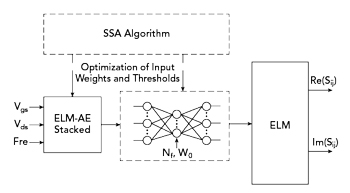
Figure 3 SSA-optimized architecture of the ELM applied to small-signal modeling.

Figure 4 Flow chart of the SSA-DELM model.
Figure 4 shows the flowchart of the SSA-DELM algorithm. Equation 4 is the fitness function, with Tsim representing simulated data and Ttest representing measured data. The positions of finder, follower and alerter in the SSA are updated first. Then, the optimal position and fitness values are updated to determine if the minimum fitness value has been reached after a specified number of iterations. The DELM model receives the optimal weights and thresholds if the end condition is satisfied. Otherwise, the SSA continues to seek the global optimal solution.