


EXPERIMENTAL RESULTS
A 0.15 μm GaAs pHEMT transistor from WIN Semiconductors is used to verify the accuracy of the established small-signal model. S-parameters are measured from 2 to 50 GHz using an Agilent network analyzer. The model’s robustness is evaluated with a 7:3 ratio of training to testing samples. The algorithm is run on an R5-5600 processor with 32 GB RAM.

Figure 5 Modeled results of different neural networks for the device with a 4 × 25 μm gate width.
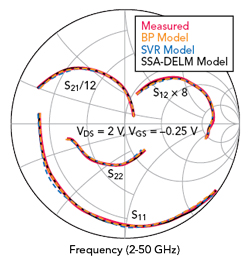
Figure 6 Modeled results of different neural networks for the device with a 4 × 75 μm gate width.
To evaluate the SSA-DELM model’s small-signal modeling, the modeling data of three neural networks with varying gate widths are compared. Figure 5 through Figure 8 show the results for four multi-finger GaAs pHEMTs with 0.15 μm gate lengths and different gate widths, comparing the neural networks’ modeled S-parameters. For the 4 × 25 μm gate width, BP and SVR models show significant errors in the S11 low frequency and S12 high frequency ranges. At 4 × 75 μm, all three neural network models perform well. However, for the 8 × 25 μm and 8 × 75 μm gate widths, BP and SVR models perform poorly for low frequency S11.
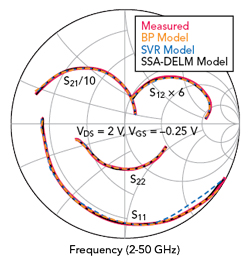
Figure 7 Modeled results of different neural networks for the device with an 8 × 25 μm gate width.
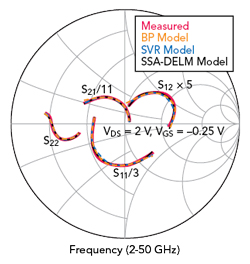
Figure 8 Modeled results of different neural networks for devices with an 8 × 75 μm gate width.
Figure 9 and Figure 10 compare the 2 to 50 GHz S-parameter magnitude and phase modeling effects of the different methods with VGS = -0.25 V and VDS = 2 V. The proposed model shows some advantages, particularly in Figure 9a, where it models |S11| more accurately.
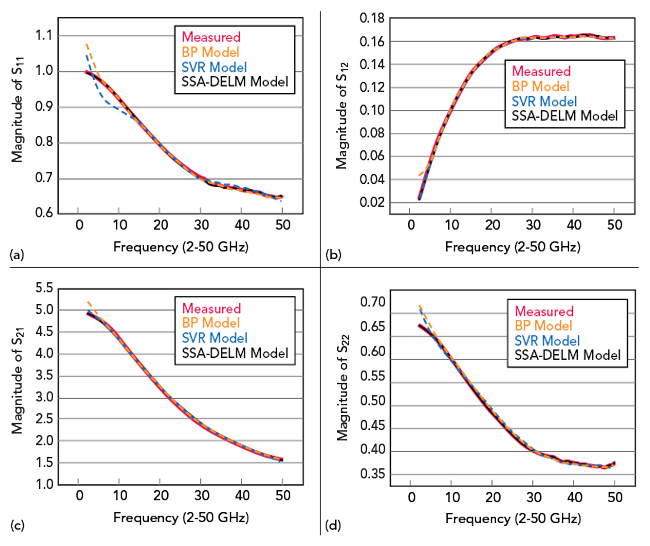
Figure 9 (a) |S11| results, (b) |S12| results, (c) |S21| results and (d) |S22| results.

Figure 10 (a) S11 phase results, (b) S12 phase results, (c) S21 phase results and (d) S22 phase results.
The small-signal modeling of GaAs pHEMTs with different gate widths is investigated to establish an accurate and fast modeling approach for microwave semiconductor devices with multi-finger layouts. A deep learning-based modeling method optimized by the SSA is proposed to refine the random weights and thresholds. Experimental results show that the model achieves an accuracy of 99.7 percent, validating its effectiveness. This technique significantly improves accuracy compared to traditional BP and SVR modeling algorithms. This accuracy improvement is realized by eliminating the need to fine-tune neural network modeling parameters for cases with varying gate widths.
ACKNOWLEDGMENTS
This work was supported in part by the National Natural Science Foundation of China under Grant 61804046 and the Foundation of Department of Science and Technology of Henan Province under Grants 222102210172 and 21210221028.
References
- A. Caddemi, E. Cardillo, S. Patanè and C. Triolo, “An Accurate Experimental Investigation of an Optical Sensing Microwave Amplifier,” IEEE Sensors Journal, Vol. 18, No. 22, November 2018, pp. 9214-9221.
- L. Y. Lee, Y. Wang and H. Wang, “A 25-31 GHz LNA in GaAs 0.15-μm pHEMT,” IEEE International Symposium on Radio-Frequency Integration Technology, August 2021.
- Z. Lv, Z. Xu and C. Song, “A Compact Model for Dual-Gate GaAs PHEMT and Application for Power Amplifier Design,” IEICE Electronics Express, Vol. 18, No. 20, 2021.
- F. Feng, W. Na, J. Jin, W. Zhang and Q. -J. Zhang, “ANNs for Fast Parameterized EM Modeling: The State of the Art in Machine Learning for Design Automation of Passive Microwave Structures,” IEEE Microwave Magazine, Vol. 22, No. 10, October 2021, pp. 37–50.
- J. Jin, F. Feng, J. Zhang, S. Yan, W. Na and Q. Zhang, “A Novel Deep Neural Network Topology for Parametric Modeling of Passive Microwave Components,” IEEE Access, Vol. 8, May 2020, pp. 82273–82285.
- G. B. Huang, Q. Y. Zhu and C. K. Siew, “Extreme Learning Machine: A New Learning Scheme of Feedforward Neural Networks,” IEEE international Joint Conference on Neural Networks, July 2004.