

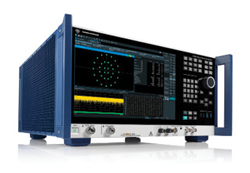
In the rapidly advancing domain of spectrum analysis, traditional methodologies often encounter significant limitations when addressing emerging technologies. These constraints were thoroughly examined in the article “Overcoming the Limitations of Modern Signal & Spectrum Analyzers” in the May 2025 issue of Microwave Journal.
At IMS2025 in San Francisco, Rohde & Schwarz introduced the new FSWX signal and spectrum analyzer with its new architecture, meticulously engineered to overcome these challenges with a strong focus on wideband signal analysis. The FSWX’s key features and innovations include:
- Multiple Input Ports: The FSWX’s ability to connect multiple signal sources simultaneously, regardless of whether they operate at the same or different frequencies, enables many new measurement scenarios. With two synchronous input ports, each boasting a 4 GHz analysis bandwidth, users can seamlessly analyze the interactions between diverse signals.
- Cross-correlation: Cross-correlation mode is a new built-in feature of the FSWX. A single signal input is internally split into two independent signal paths, each equipped with its own local oscillator and analog-to-digital converter (ADC). This design allows for the application of advanced cross-correlation algorithms in the digital backend, effectively filtering out the inherent noise of the measurement instrument and increasing measurement clarity.
- Advanced Filter Banks: The FSWX features comprehensive filter banks that span the entire operating frequency range, diverging from traditional spectrum analyzers that rely on YIG filters. YIG filters are known for having challenging frequency responses and introducing inaccuracies in wideband signal analysis. The filter banks of the FSWX complement YIGs to provide high precision and reliability, optimizing instrument settings for specific applications and reducing the risk of unwanted signal images contaminating results.
PRACTICAL APPLICATIONS
The multiple input ports of the FSWX facilitate phase-coherent measurements of antenna arrays used in beamforming for wireless communications, as well as in airborne and automotive radar sensors. In these scenarios, the phases of individual channels are compared, enabling precise analysis. Unlike traditional vector network analyzers (VNAs), the FSWX supports the analysis of wideband modulated signals that are fully compliant with standards.
Moreover, users can compare a signal against a reference signal, such as the output of a power amplifier against its input. This provides immediate visualization of distortions introduced by the amplifier, including frequency response and nonlinearities. This capability is achieved without requiring prior knowledge of the reference signal. By integrating an additional vector signal generator and an external coupler, the FSWX combines the advantages of traditional signal analyzers with those of a VNA, simplifying the characterization of frequency-converting devices.
As bandwidth requirements continue to escalate and higher-order modulation schemes emerge in mobile communications, measuring error vector magnitude (EVM) has become increasingly challenging. Traditional signal and spectrum analyzers often introduce additional wideband noise, limiting the accuracy of EVM measurements. However, with its cross-correlation feature, the FSWX overcomes this limitation, providing an unobstructed view of the device under test and enabling precise EVM analysis.
ENHANCED MEASUREMENT ACCURACY
Traditional analyzers often require bypassing microwave YIG filters for wideband measurements, which can expose the signal path to interference. In contrast, the FSWX employs broadband ADCs in conjunction with filter banks, allowing for pre-selected signal analysis. This design filters out signal components that may reside on image frequencies, preventing them from contaminating the analysis range — an advantage for measurements conducted through antennas or in multi-radio scenarios.
While traditional spectrum analyzers utilize narrowband paths for spectrum measurements like spur searches, the FSWX offers a wideband signal path with filter banks to speed up measurements by eliminating the cumbersome settling time associated with swept filters. Additionally, it enhances level accuracy by removing the inherent uncertainties of YIG filters. For users who still prefer the narrower bandwidth of a YIG filter, this option remains available as an add-on feature.
INNOVATIVE FIRMWARE APPLICATIONS
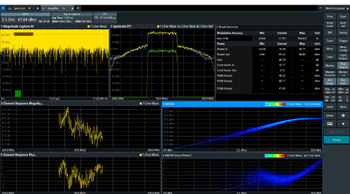
Figure 1 Amplifier characterization featuring both frequency and time domain data.
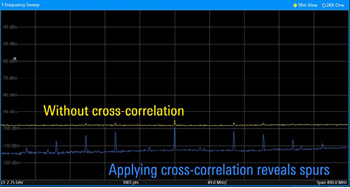
Figure 2 The built-in cross-correlation gives users a clear view of the signal.
In addition to supporting established measurement applications for analyzing communication, radar signals, noise figures and phase noise measurements, the FSWX also introduces user interface features enabled by its dual signal path design.
The CrossAct (cross application control and triggering) firmware feature synchronizes various measurements across different input channels, allowing for simultaneous analysis with multiple tools. This capability simplifies comparisons, such as determining whether the higher harmonics of a radar signal directly impact the EVM performance of a 5G signal.
The IQ-based spectrum analyzer visualizes the spectrum using wideband captured data, directly displaying input signals across different ports and offering comprehensive measurement results. Users can view both frequency and time domain data in parallel, enhancing their analytical capabilities. Figure 1 shows the FSWX characterizing an amplifier, demonstrating simultaneous measurement of input and output signals, spectral regrowth due to nonlinearities and AM to AM conversion near the 1 dB compression point.
The internal dual-path architecture of the FSWX, featuring an internal splitter, enables cross-correlation and offers advanced triggering options. Users can apply an IF or RF power trigger at distinct frequencies, as the two-path design allows for independent frequency settings for each receive path behind the splitter. This flexibility, which includes the ability to reduce inherent noise and reveal spurs not easily seen without cross-correlation, is illustrated in Figure 2. Figure 2 highlights the instrument’s dual-path architecture with built-in cross-correlation and the configurable local oscillators that can operate at different frequencies or be switched to phase-coherent mode.
ROBUST OPERATING SYSTEM
In addition to its extensive measurement capabilities, the FSWX platform operates on a Linux-based system, providing a high level of key features for users in high-security environments, such as security and long-term support. This robust operating system ensures reliability and stability, making the FSWX a new choice for demanding applications.
CONCLUSION
The FSWX represents a significant leap forward in signal and spectrum analysis technology, effectively addressing the limitations of traditional methods while introducing features that enhance measurement accuracy, flexibility and efficiency. With its contemporary design — featuring broadband ADCs, multiple input ports, cross-correlation capabilities and advanced filter banks — the FSWX empowers users to tackle complex measurement scenarios that were previously unattainable. As the landscape of wireless communication and radar technology continues to evolve, the FSWX stands ready to meet the challenges of tomorrow, providing excellent performance and insight in spectrum analysis.
Rohde & Schwarz
Munich, Germany
www.rohde-schwarz.com