


RF-over-Fiber (RFoF) technology is transforming the landscape of signal transmission systems by offering a wideband transport capability for RF signals between antennas and control locations. This article highlights the key advantages of RFoF technology, which include signal integrity, immunity to electromagnetic interference (EMI), high bandwidth capacity, reduced size and weight, environmental resistance and enhanced security. These features position RFoF as an attractive solution across a diverse set of applications in both defense and civilian markets.
In defense applications, RFoF technology plays a critical role in comprehensive remote sensing, secure communications and surveillance systems. Such systems can be hardened against external interference, preventing damage to sensitive equipment from electromagnetic pulse scenarios. Applications extend to remote antenna ground stations for drone controllers and “virtual air” radio interconnect, which securely connects large numbers of radios in physically separated trainers, such as flight simulators, avoiding emitting interference and unwanted surveillance. Phase-matched multichannel RFoF technology enables the remote operation of direction-finding antenna arrays. Combining RFoF with optical delay fiber segments creates optical delay lines (ODLs). Radar and altimeter calibration and testing using ODLs enhance radar detection accuracy by providing accurate distance simulation through stable, selectable time delays of the radar RF signal. Target simulators validate the full scale of radar detection abilities by combining many spatially separated emitters with ODL RFoF technology.
In the civilian market, RFoF technology is crucial for 5G cellular network performance and interoperability tests, providing solutions to meet the frequency and bandwidth demands of emerging technologies such as 6G. It also extends Global Navigation Satellite System (GNSS) applications to sheltered areas, ensures reliable communication in the mining industry and enables range extension of distributed antenna systems (DAS). The technology supports astronomy research in radio telescope observatories with long-distance, wideband and phase-stable RF signal transmissions linking the Very Long Baseline Array and interferometric antenna arrays.
ADVANTAGES OF RF-OVER-FIBER TECHNOLOGY
RFoF technology is a new approach in transmitting RF signals between antennas and control locations. It is a small-signal, wideband transmission technology that handles signal levels typically under +20 dBm. The key advantages include:
Signal Integrity: RFoF systems deliver signal transmission over extended distances that are greater than those that coax cables can sustain. This is crucial for applications such as radar, communication and surveillance where signal fidelity is vital.
Immunity to EMI: Fiber optics are not affected by EMI, making them ideal for environments rich in electronic noise, such as military installations and urban areas. Single-mode optical fibers are essentially glass conduits that carry the signal in a cross section that is 9 μm in diameter. It is difficult to disrupt this optical transmission by induced EM radiation. Running fiber into sheltered areas is safer than using coaxial cables, as EM radiation can be induced on a coax cable and conducted into the sheltered compound.
Bandwidth Capacity: RFoF can accommodate large volumes of data at high frequencies, enabling the simultaneous operation of wideband or multiple frequency-division channels with minimal degradation. Each RFoF link can deliver flat signals with bandwidths exceeding 40 GHz over distances ranging from a few meters to many miles. For comparison, a good 50-meter RF cable develops an insertion loss slope of approximately 5 dB over a bandwidth of 1 MHz to 1 GHz. Figure 1 illustrates the typical insertion loss and flatness of an 18 GHz RFoF link without amplifiers.
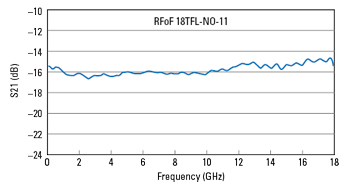
Figure 1 Insertion loss of an RFoF link without amplifiers.
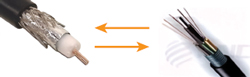
Figure 2 Fiber cable construction versus coaxial cable construction.
Size and Weight: Fiber-optic cables are lighter and less bulky than traditional coaxial cables. Single and multiple fiber strands can transport nearly unlimited amounts of RF signals and data at a minimal cost. This enhances deployment flexibility in defense scenarios, particularly for surveillance sensors, electronic warfare (EW) transponders and drones that use expendable interconnect fibers. Figure 2 shows a view of a fiber cable containing multiple fiber strands versus the construction of a coaxial cable.
Power Consumption: RFoF links consume a couple of watts per pair and compare favorably with coaxial transmission, which requires booster power amplifiers between short cable intervals. In a 60-meter application transporting an 18 GHz bandwidth RF signal, the RFoF link requires about 5 W, while a comparable coaxial transmission requires about 25 W to power the amplifiers that recondition the signal at 15-meter intervals.
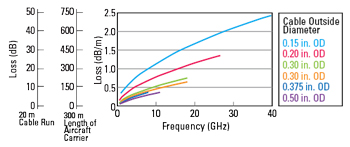
Figure 3 Coaxial cable versus frequency for various outside diameters.
Environmental Resistance: Optical fibers are resistant to moisture, chemicals and extreme temperatures, reducing the need for shielding compared to RF coaxial cables.
Enhanced Security: Fiber optics offer a higher level of security against eavesdropping and signal interception because of their confined transmission properties. In addition, splicing into existing fiber networks can be easily detected.
These advantages position RF-over-Fiber technology as a solution for various defense and civilian applications. For example, a 1000-meter section of a single-mode fiber transmits a 20 GHz RF signal with an insertion loss that is 7500× lower than the loss of the same length of 0.15 in. diameter coaxial cable. Figure 3 illustrates the insertion loss per meter versus frequency for various coaxial cable diameters. The scales on the left-hand side of Figure 3 also illustrate how this translates to total loss over a 20-meter cable run, as well as the loss incurred when running the length of a 300-meter aircraft carrier.