


APPLICATIONS OF RF-OVER-FIBER TECHNOLOGY
Defense Applications
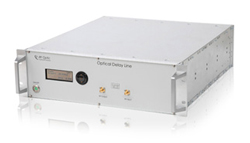
Figure 4 Progressive ODL.
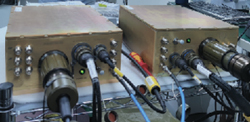
Figure 5 Six-channel miniaturized phase-matched militarized RFoF system.
RFoF technology has numerous applications in defense and homeland security. A common usage of the technology is in an ODL. ODLs combine RFoF technology with optical delay fiber segments. Progressive ODLs can introduce a range of delays by incorporating optically-switched fiber segments, typically arranged in an increasing order of delay. These instruments play an important role in testing and calibrating radar systems by introducing precise time delays to the RF signal to simulate target distances for surveillance and fire control radars. ODLs with fast delay switching can simulate range closing for proximity fuses or homing radars. Altimeter radars are calibrated and verified using ODLs that simulate heights above ground. ODL solutions are customized based on application requirements, supporting delays ranging from a nanosecond to milliseconds or from 0.5 to more than 100,000 ft. at virtually any desired step resolution. Additional features, such as high speed delay state switching, the number of delays, precision, accuracy, Doppler modulation, RF gain, bidirectional RF transmission and many more RF and optical features, may be added to meet specific application requirements. Both local and remote ODL control options are available. Figure 4 shows an example of an RFOptic progressive ODL.
Phase-matched RFoF multichannel technology is essential for remoting direction-finding (DF) antenna arrays in defense applications. These arrays are used in radar and EW systems, which employ interferometry to determine the direction of targets. Phase-matched RFoF multilinks, stable over time and temperature, simplify DF algorithms and reduce the phase calibration overhead. Such systems can employ a four-antenna array for azimuthal location or an eight-antenna array, which adds elevation discrimination. A wider bandwidth of DF RF transmission corresponds to a higher spatial resolution of the target location. Furthermore, a wide DF RF bandwidth allows the use of frequency-dependent target reflections to identify a target. A militarized high frequency phase-matched RFoF system is shown in Figure 5. It supports a DF link bandwidth of 1 MHz to 6 GHz and uses coarse wavelength division multiplexing optical multiplexing technology. It is designed for a four-antenna DF array system and includes additional omnidirectional and calibration RFoF links. These additional links bring the total number of phase-matched channels to six. This RFoF DF solution features built-in step attenuators, which match the RFoF link gains across the four channels, thereby improving the system’s performance. The RFoF links feature gain stability over a wide range of operating temperatures. Phase-matched RFoF technology achieves bandwidths up to 18 GHz with phase matching accuracy of ±10 degrees for a 1 km optical fiber cable length. Additionally, a 40 GHz phase-matched link with similar performance was demonstrated. These microwave and mmWave direct frequency solutions use wavelength division multiplexing technologies to ensure phase-matched performance. Both remote and local management capabilities are provided through an Ethernet-enabled management and control system or local USB connections.
The RFoF technology may also be used in remote antenna ground stations for drones. With this technology, it is possible to use the concept of distance radiating. This concept enables the drone control trailers to be located separately from the drone control and telemetry antennas, which may be potential targets. This separation increases the survival rate of the control trailer and personnel while also enhancing communication reliability during drone operations. The system transmits flight control signals and receives real-time video and reconnaissance data across all compatible frequency bands. Optical switching can be applied to enable seamless handover between antenna locations, providing improved resiliency and redundancy.
RFoF technology can also create realistic product calibration, training and test conditions for evaluating radar systems. These target simulators use multiple emitters, either fixed or moving, along with sophisticated RFoF signal distribution and ODL segments to form a set of simulated maneuvering targets. The radar signal can be distorted or modulated to replicate real signals, radar cross section variations and EW jamming and spoofing techniques.
RFoF technology enables physical separation between expendable sensors or antennas and the sophisticated signal processing and aggregation equipment typically placed in a safe and shielded central location in remote sensing and surveillance applications. RFoF technology can provide coherent detection by distributing a common local oscillator to multiple sensor locations through optical means. Such surveillance systems are typically lightweight enough to be mounted in unmanned aerial vehicles and larger dedicated platforms, addressing airborne reconnaissance applications.
CIVIL APPLICATIONS
In the civilian sector, RFoF technology supports various critical applications. RFoF technology is gradually replacing traditional RF switches and coaxial cables with optical switches and RFoF links in 5G testing and interoperability applications. This technology transition is driven by the demands of 5G and emerging 6G cellular and data communication technologies. The increasingly higher frequency communication bands, such as 5.8 GHz, cannot be effectively transmitted using coax cables and RF infrastructure. One area that has seen a fast adoption of RFoF technology is the 5G test environment, which focuses on validating the interoperability of base stations and mobile devices produced by different vendors. An array of base stations is connected to an optical switch using RFoF bidirectional terminals. From here, fibers lead to RFoF bidirectional terminals that service mobile devices and test equipment. The optical network is configured as needed for the test scenarios in a programmed sequence. The operational expenditure (OPEX) reduction of this reconfigurable test environment has a high utilization rate due to sharing test equipment. Additionally, the resources required to reconfigure the test setup between different tests drop to nearly zero. The entire test environment becomes programmatically reconfigurable using the RFoF subsystem’s HTML/REST web server-based remote management system, which enables monitoring, verification and control of individual channel performance. A block diagram of this scenario is shown in Figure 6. Figure 7 illustrates an example of a bidirectional RFoF terminal capable of accommodating 40 transmitters and receivers.
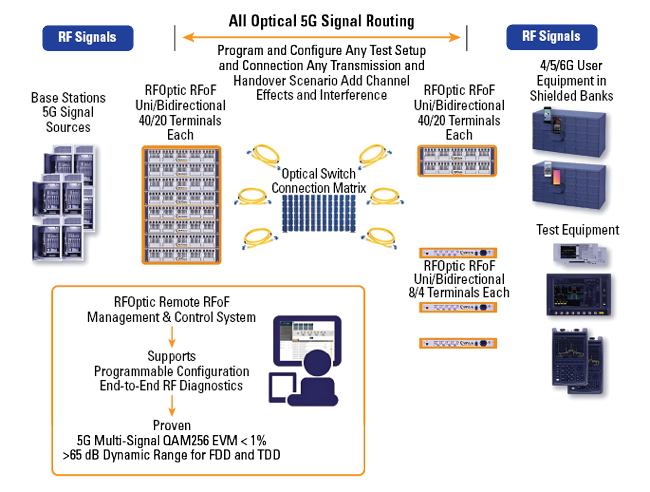
Figure 6 Block diagram indicating RFoF applications in 5G testing.
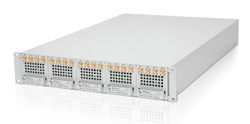
Figure 7 High-density 2U enclosure.
RFoF solutions provide reliable coverage extension in GNSS and Global Positioning System (GPS) applications. In these applications, GPS-over-fiber RFoF technology provides signals to shielded locations where direct satellite reception is blocked. These locations include parking garages, office buildings, tunnels, data centers and more. The RFoF GPS solution enables signal distribution and extension over long distances with minimal degradation, which is crucial for navigation and timing applications.
The technology also enables the extension of broadband communication capabilities into sheltered or shielded areas, utilizing DAS that can be employed in mines and buildings. Typically, in these cases, an area without reception is covered by antennas that carry a signal transported downstream by RFoF from a nearby location or rooftop with good reception. This location is referred to as the donor. In most cases, the DAS communication is bidirectional, requiring the aggregation of the upstream signals from all the antennas and their transport back to the donor. DAS solutions enhance the reliability and safety of mining operations by extending communication coverage throughout the mine or in similar sheltered areas, such as parking garages, office buildings and tunnels.
RFoF technology is crucial in radio telescope operations at observatories and other astronomy research endeavors. These systems facilitate the efficient transmission of wideband, high frequency RF signals over long distances, which is a critical requirement for applications such as very long baseline interferometry. Typical solutions provided to radio telescope centers include outdoor units with multiple RFoF transmitters that cover different frequency bands and are installed near the observatory dish antenna(s). These RFoF transmitters transport signals on bundles of optical fibers, ranging from 100 ft. to several thousand feet, to a corresponding set of receivers placed at the observatory control building. The RFoF links are designed for superior phase stability, allowing the processing of received signals into a high-resolution radio astronomical image of the observed target. RFoF enables seamless transport of wideband high frequency signals, which are essential for high-precision astronomical research.
PRACTICAL IMPLEMENTATION
Phase Matching for Radar Systems
RFOptic provided a phase-matched system comprising 10 channels in an outdoor enclosure, which included channels for communications. The system underwent approximately six months of rigorous testing with parameters such as stability, signal quality and repeatability being meticulously measured. The RFoF system was qualified and deployed to transport signals in a DF application for border protection.
5G Network Rollout
RFOptic partnered with leading base station manufacturers to replace coaxial infrastructure with an optical fiber-based test system. The program’s goal was to reduce the amount of test equipment, increase its utilization rate and decrease the setup and reconfiguration overhead. The implementation was successful, enabling the telecom company to enhance its capabilities for 5G interoperability testing, switch test plans from one test to the next in minutes instead of days and dramatically increase the test equipment use rate. The telecom company specifically required a solution that could address the limitations of existing RF switches and coaxial infrastructure, while also exceeding the error vector magnitude (EVM) and adjacent channel leakage ratio requirements of the 3GPP specifications for 5G cellular communication. The pilot deployment took place in the company’s European laboratories to test base station equipment and validate interoperability. A bidirectional demonstrator RFoF system was provided for extensive testing and validation of the required performance. This RFOptic system, which was selected, accommodates up to 20 bidirectional links in five modular drawers and meets the company’s performance, mechanical management and monitoring system requirements. This supports reduced OPEX and integration needs.
CONCLUSION
RFoF technology represents a substantial advancement in communication systems across both defense and civilian markets. Its myriad benefits include superior signal integrity, high bandwidth capacity, immunity to EMI and enhanced security. These and other benefits position the technology as an indispensable asset for contemporary wideband signal transport applications. From facilitating precise phase matching in defense systems to supporting the deployment of 5G networks, RFoF has demonstrated its utility in various critical scenarios.
As organizations increasingly adopt RFoF solutions, they will address current communication challenges and prepare for future advancements. As they enhance operational capabilities, these companies and this technology are paving the way for a more connected and efficient future with new and diverse applications. The defense sector is expecting increased demand for a wide range of applications, including ODL, along with multichannel phase-matched and phase-corrected transport and target simulators. Current applications that take advantage of the benefits of RFoF include remote antennas, remote ground stations, fiber-controlled drones, delayed signal processing, delayed repeaters, wideband DF and interferometry and true-time delay wideband phased arrays. New and previously unknown applications will undoubtedly emerge to leverage the RFoF technology and contribute to the growing list of existing applications already utilizing this technology.