


Figure 1 (a) 1U PhoneSat spacecraft. (b) 12U CAPSTONE spacecraft. (c) 3U CLICK spacecraft. (d) 6U PTD-3 spacecraft. Source: NASA and Terrain Orbital.2
The past 15 years have seen an upheaval in space technology trends. Now, there is a mix of legacy or “Old Space” applications from organizations such as NASA and ESA with incredibly stringent requirements and low volume expectations and “New Space” applications with a more commercial and mass market approach from emerging space technology companies.1 There is a multitude of small research, science and more recently founded national space organizations undertaking a diverse range of missions at an incredible pace.2 What is true for all these applications is that RF, microwave and mmWave technologies are still essential for communications and sensing missions. These technologies enable important features for spacecraft systems and payloads. Higher frequency and higher-density applications mean more RF systems with even smaller footprints and more interconnections. Coaxial cables, connectors and assemblies are necessary for connecting space systems and payload components. However, they may also introduce a host of failure modes to some of the most sensitive space equipment. This makes ensuring that coaxial interconnections meet space standards for performance and reliability a high priority for designers and systems. These satellite platforms and payloads have many different form factors, which create distinct challenges for each application. Figure 1a shows the 1U PhoneSat spacecraft. Figure 1b is the 12U CAPSTONE spacecraft. Figure 1c is the 3U CLICK spacecraft and Figure 1d is the 6U PTD-3 spacecraft. These spacecrafts have all flown in orbit and are classified as CubeSats, but the size and footprint mean that interconnection considerations and requirements can differ substantially.
WHAT IS SPACE-GRADE?
There are many different types of space applications and platforms. Some of the more common types are:
- Deep space exploration
- Space stations
- Satellites in various orbits
- Launch vehicles
- Rover vehicles, along with other sampling and experimental mobile platforms
- Lunar base and exploration vehicles and habitats
- Mars missions and habitats.
For legacy applications, classifying components as space-grade has historically meant that these components meet extremely rigorous materials, sourcing, processing, quality control, verification and manufacturing requirements. These requirements are typically determined by the space agencies or governments of countries that actively operate space programs. These efforts have created a large body of knowledge addressing how various materials, material combinations and fabrication methods operate in space environments and microgravity. While many of the newer space programs and applications do not include the same highly exacting standards and requirements as legacy space programs, the knowledge gained from these programs is still instrumental in determining what works best in space.
New Space programs generally do not operate with the same expectations as legacy space applications. Missions are shorter and the purpose of the mission may not be as critical. This may relax quality standards and widen the viable material selection and fabrication approaches for these missions. This approach will generally reduce the cost of most components since the rigorous standards of critical space programs lead to higher costs, even at volume. With New Space programs able to relax some quality requirements and standards and increase volumes, systems can use traditional space-grade components like coaxial assemblies and connectors. The advantage of this approach is that higher volumes and relaxed quality control requirements translate to lower costs.
Regardless of the mission, there are intrinsic hazards in space and steps that must be taken to ensure a component fulfills the mission requirements. The first consideration is whether the component survives the shock, vibration and acceleration stresses associated with launch. Next, the materials and construction must handle space’s vacuum and microgravity conditions. Almost all materials release gases when in low-pressure environments. The rate of gas release and the composition of these released gases significantly impact the viability of a material in space. An important consideration is how long before material outgassing begins to affect the component or the operation of other components.
Although the ambient temperature in a vacuum is extremely low, there are several ways that an RF component may be heated. These include solar radiation or waste heat from other space platform or payload components. As a result, space-grade components must operate reliably and survive over wide temperature variations and repeated cycling over these temperature ranges. Temperature fluctuations are one of the significant causes of failure for many components since thermal cycling causes dimensional changes in the component materials and structure. For space-based systems, radiational cooling may be the only method of removing heat. This cooling method is slower and less effective than conduction or convection at removing heat, raising concerns about how long a component experiences extreme temperatures.
One of the most significant concerns for space survivability is the ability of a component or system to withstand cosmic radiation and solar weather, often referred to as “space weather.” This space weather can consist of storms of high-energy particles, wideband electromagnetic (EM) radiation and intense electric/magnetic field phenomena. One of the main concerns with EM radiation is high-energy X-ray and gamma-ray radiation penetrating shielding and reacting with internal system components. Generally, this is a more significant concern for active electronic components that use semiconductors and integrated circuits. This radiation, at high enough levels, can trigger internal faults and may destroy active devices if these devices are not adequately radiation hardened. This concern extends beyond active devices as high-energy EM radiation can degrade and damage passive RF component materials and structures.
The orbit’s distance from the Earth’s surface heavily influences the actual space environment. Most legacy space missions are in outer, lunar, highly elliptical orbit (HEO) or geosynchronous orbit (GEO). These orbits are relatively far away from the Earth’s surface. Space platforms and payloads in these orbits are farther outside the protection of Earth’s magnetosphere, making these missions more susceptible to space weather.
Many of the newer space missions are in medium Earth orbit (MEO) and low Earth orbit (LEO), which are much closer to the Earth than outer orbit or GEO missions. This closer proximity to Earth results in greater protection from some space weather. However, these vehicles must travel much faster and need greater positioning precision to maintain orbit. The most cluttered orbit is LEO, which has a high concentration of active satellites and space debris. This means a higher likelihood of a collision that could damage a LEO mission than GEO and outer orbit missions. Figure 2 shows the range of distances for some of the orbit designations.
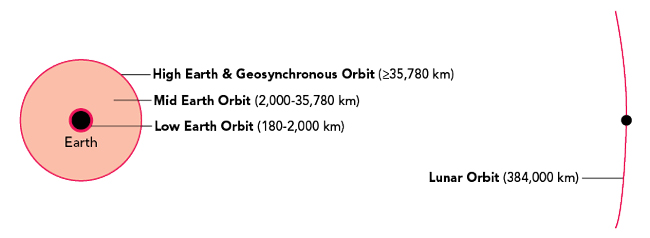
Figure 2 Orbit designations. Source: NASA illustration by Robert Simmon.3
WHAT IT TAKES TO SUCCEED IN SPACE
The orbital slot, expected mission lifetime, performance, mission control standards and regional regulatory agencies largely determine mission requirements. The performance and organizational standards are generally demanding with NASA, ESA and other national space agencies. There are many small and short-lived educational, scientific exploration and government-sponsored missions. These include CubeSats and small-satellite (SmallSat) projects. These missions often involve collaborations among many institutions with various requirements and usually limited budgets. New Space companies frequently provide another wrinkle. These companies are often commercial enterprises focusing on introducing new services previously unavailable to consumer, non-government and government users. These New Space companies typically have internal requirements and quality control programs that may not be transparent to the public. Their procurement models tend toward screening many commercial products to determine what will support their missions. This paradigm differs from the traditional legacy approach of ordering custom-designed parts from approved vendors.
Some of the essential requirements to consider for products going into space:
- Footprint and weight
- Physical ruggedness
- Temperature range
- Cosmic radiation and space weather
- Flashover
- Outgassing
- Residual magnetism
- Materials and traceability
- Manufacturing environment
- Quality (IPC Standards Class 3)
- Electrical characteristics.
A satellite platform or payload may have size restrictions that can influence the choice of technology and architecture. The miniaturization resulting from higher microwave and mmWave frequencies is advantageous for footprint- and weight-constrained applications. These size and regulated-spectrum considerations explain why microwave and mmWave frequencies are attractive for terrestrial-to-space and space-to-space communications. However, with smaller electrical components and elements, care must be taken in the design and manufacturing process to ensure each element can withstand the shock, vibration and acceleration forces associated with launch and survivability.
Operating and storage temperature ranges also factor into part suitability for space applications. Depending on the orbit and exposure of the electrical parts, even the -550°C to 125°C military temperature range may not be adequate. A more acceptable temperature range for space-grade components is -65°C to 150°C and some applications exceed even this range. The materials and construction methods must be carefully selected to operate reliably over such a wide range. Moreover, burn-in or other methods of operating temperature stabilization may need to be considered. These considerations may include matching the coefficient of thermal expansion of various materials and construction stack-ups to ensure operating requirements can be met.
Silver and gold plating over copper/beryllium copper is common for space-grade components due to the superior electrical conductivity of silver and the reduced reactivity of gold. These metallic platings must conform to stringent quality requirements to ensure reliability and effectiveness, often with industry standard methods, quality testing and contact plating thickness expectations. Stainless steel parts must frequently be passivated for corrosion resistance and made from non-magnetic compositions.
A flashover is an unintended electrical discharge that occurs across an insulator. This phenomenon can occur in enclosed spaces in electronic components, such as coaxial cable assemblies with air-gaps and minimal dielectrics. The most common cause of flashover is low-pressure arcing. Avoiding this condition requires careful part selection and system design to prevent the conditions that cause arcing or combustion to occur. Materials and construction methods for space are often governed by outgassing standards such as ASTM E-595. This standard outlines test methods for measuring total mass loss (TML) and collected volatile condensable materials (CVCM) percentages. A low TML and CVCM percentage is often desirable for space applications because it means the build-up of particles and debris, along with outgassing, is low. If these factors are not adequately considered, the result could be performance changes or destructive events such as flashover. To minimize this possibility, many space applications require facility and production process quality control methods to limit component exposure to particles in the manufacturing environment.
IPC-A-620 is an important standard, particularly for coaxial and other cable and wire harness assemblies. This standard addresses practices and requirements for manufacturing these electrical components. IPC-A-620 is generally considered the gold standard for workmanship for such components. Class 3 of the specification is the highest level and most likely to coincide with space criteria. Other factors this standard considers are the materials used and the traceability of the component material composition. Some space applications require approved vendor lists and materials, while others require only selected traceability and compatibility levels. Manufacturers often consider Ethylene tetrafluoroethylene (ETFE) a suitable jacket material for space-grade coaxial cable. This material exhibits a high melting temperature, good chemical resistance, superior electrical performance and resistance to high-energy radiation. High-energy radiation resistance is a key consideration for coaxial assemblies as some materials will degrade in the presence of high-energy radiation, which can lead to interconnect failure.
ELECTRICAL CHARACTERISTICS
Like most electrical components, coaxial cable assemblies, connectors and cables are specified for performance under nominal and operational conditions. With coaxial components for space applications, the operational conditions are usually more rigorous than those of military or industrial applications. This is why space-grade or components intended for space applications will often have more detailed datasheets with more complete tables and plots depicting the behavior of the components over broader operating parameters than typical components.
Some key electrical characteristics to consider for space applications:
- Phase stability
- Phase velocity
- Shielding effectiveness
- Insertion loss.
Phase stability over physical and environmental conditions is especially critical for coaxial assemblies in space. While this parameter is typically only a consideration for test and measurement applications, the wide operating temperature range and other factors make phase stability a critical requirement for many space applications. The phase velocity through a cable or an assembly can directly influence signal delay and timing in a system and these characteristics are critical for space networks. Because of the radiation environment in space, the potential for high-energy particles and external electrical interference, the need for electrical shielding is much greater than in terrestrial applications. RF shielding measures the amount of external signal energy penetrating a component over the operating frequency range. RF shielding effectiveness for space applications must often be 100 dB or more.
Launch costs are related to mass, so the restrictions on RF and DC power budgets are strict in space applications. This places a premium on low loss, high-efficiency components to minimize the power source’s size, weight, DC power consumption and RF transmit power. Low loss space-grade coaxial interconnections help minimize the transmit power for the mission, along with component heating issues.
WORKMANSHIP
While the performance of the coaxial cables, connectors and other devices is critically important for space applications, manufacturing techniques and workmanship cannot be overlooked. If devices are not properly manufactured, they may affect the performance and longevity of the mission. NASA has released workmanship standards for space-based components with examples of unacceptable manufacturing processes for coaxial cables and connectors in space applications.4
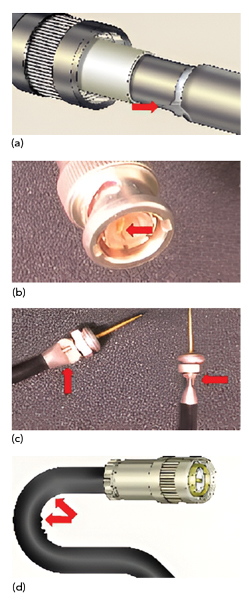
Figure 3 (a) Unacceptable solder joint. (b) Improper center contact assembly. (c) Improper connector assembly. (d) Improper cable bend radius.
Figure 3a shows an unacceptable solder joint as indicated by the arrow. In this case, the solder termination between the connector and the rigid/semi-rigid cable sheath does not exhibit a thoroughly wetted, concave, smooth and continuous fillet extending entirely around the termination periphery. Figure 3b shows an unacceptable center contact assembly as defined in NASA-STD-8739.4 [19.6.2.f.3]. As can be seen from the diagram, the center contact location/orientation does not meet the requirements for proper mating.
Figure 3c shows a cable assembly assembled incorrectly per the manufacturing or engineering documentation. As the red arrows indicate, the connector body has been excessively crimped in manufacturing by the center pin crimp tool, crushing the dielectric material. Figure 3d shows a cable with an unacceptable bend radius. In this case, the cable has been bent below the minimum recommended radius, resulting in ripples and stretching the cable sheath. This may cause a cold-flow of the dielectric, resulting in increased loss and/or shorting of the cable assembly.
SPACE-GRADE COAXIAL INTERCONNECT IS MORE ACCESSIBLE THAN EVER
In the recent past, procuring space-grade coaxial cable assemblies and connectors required contract negotiations with a coaxial cable assembly and connector manufacturer. This process could be time-consuming, with procurement lead time and qualification often taking years. While long, this timescale was acceptable for legacy space applications. However, this is no longer sufficient for New Space or agile space programs. Many New Space applications depend on very large LEO constellations. Multiple satellites are included in each launch vehicle, and the period between launches has become very short. The performance of these orbiting satellites will drive upgrades and changes for subsequent satellites and launches. This process of experimentation and qualification on the fly puts enormous pressure on development and qualification timescales. The results from this process also contribute to the relaxation of the more stringent requirements that characterize legacy space applications.
The result is a growing demand for coaxial interconnects and other space-grade components that can be ordered at the pace of e-commerce. Having more standardized coaxial interconnects that meet space-grade standards means that the prices of these coaxial cable assemblies and connectors have the economy of scale benefit and the high cost of dedicated contracts does not burden them. These coaxial interconnect components can also be purchased as needed and with very short shipping times, even same-day in some cases. This accessibility enables engineers and scientists developing space platforms and technologies to iterate rapidly without the extended lead times associated with typical contract manufacturing for space-grade components.
CONCLUSION
Advances and increased investment in space technology are enabling the rapid development of the space segment. More commercial enterprises, newly-formed space agencies and scientific organizations are joining the legacy large space agencies. This provides a valuable piece of the connectivity puzzle to consumers and businesses and enables the stars, nearby asteroids, the moon and Earth phenomenon to be studied. Coaxial interconnects, such as coaxial cable assemblies and connectors, are critical for many modern space communications and sensing systems for both space platforms and payloads. Fortunately, as space applications increase in popularity, the accessibility of space-grade coaxial interconnects also grows to meet the needs of a new era in space exploration and services.
RESOURCES
- “Payload Test Requirements,” NASA, Web: standards.nasa.gov/standard/NASA/NASA-STD-7002.
- “2.0 Complete Spacecraft Platforms,” NASA, March 3, 2024, Web: nasa.gov/smallsat-institute/sst-soa/platforms/.
- H. Riebeek, “Catalog of Earth Satellite Orbits,“ NASA Earth Observatory, September 2009, Web: earthobservatory.nasa.gov/features/OrbitsCatalog.
- “NASA Workmanship Standards,” NASA, Web: workmanship.nasa.gov/lib/insp/2%20books/links/sections/404%20Coaxial.html.