


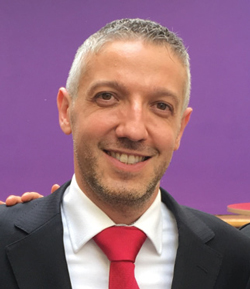
Figure 1 Professor Francesco Fornetti of the University of Bristol.
Professor Francesco Fornetti, associate professor of Radio Frequency Engineering at the University of Bristol,1 has worked tirelessly over the past 12 years to bridge the industry-academia gap. He is an internationally recognized educator known for pioneering engineering education contributions and holds a prestigious National Teaching Fellowship. This highly selective award is conferred to only 55 academics each year in the U.K. It recognizes individuals who have made an outstanding impact on student outcomes and the teaching profession. Professor Francesco Fornetti is shown in Figure 1.
There has been a longstanding collaboration between Cadence® and the University of Bristol under Professor Fornetti’s leadership. This relationship has recently gained momentum with the release of a series of novel online open courses.2 These courses on Radio Frequency Engineering3 and the Foundations of Electric Circuits4 are designed to prepare students for the real-world challenges of an increasingly connected world.
To build on his existing partnership with Cadence and further enhance the material offered in his courses, Professor Fornetti embarked on a collaboration with Rohde & Schwarz in July 2023. Drawing on Rohde & Schwarz’s hardware design expertise, the primary goal of the partnership is to modernize the teaching methods for RF engineering, both at university and in continuing professional development (CPD) courses. The vision is simple yet ambitious: make RF education more practical, engaging and relevant to the industry, equipping learners with the real-world skills essential for the workforce.
RF engineering is notoriously challenging for students. Courses are often taught in a highly theoretical, mathematical and abstract way. This is one of the reasons behind the shortage of RF engineers in the electronics industry. To address this, Professor Fornetti had previously developed virtual laboratories (VLs) using the Cadence AWR® simulation software. These VLs allowed him to create instructional material, like video tutorials and demonstrations, which were both conceptual and practical, making complex subjects more intuitive and accessible. VLs enable students to design and experiment with virtual circuits and instruments that closely resemble their physical counterparts, empowering them to take a more empirical, self-directed and exploratory approach to learning.
While this was a significant advancement, Professor Fornetti realized that hands-on physical laboratory experience was still essential. However, traditional RF labs require expensive equipment and without the insights of industrial designers, it becomes difficult to fully bridge the gap between theory and real-world practice. This is where Rohde & Schwarz has become an invaluable partner.

Figure 2 Designing a homemade VNA calibration kit.
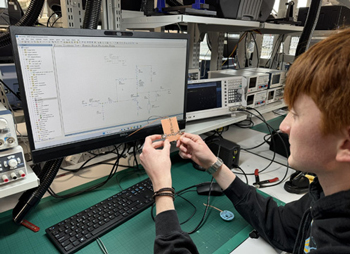
Figure 3 Amplifier design.

Figure 4 Transmission line design.

Figure 5 Matching network design.
When Rohde & Schwarz released the FPC1500, a versatile, cost-effective instrument that functions as a VNA and a spectrum analyzer, it solved the significant hurdle of equipment affordability. Collaborating with Markus Lang and his team at Rohde & Schwarz has allowed Professor Fornetti to merge the practical design expertise at Rohde & Schwarz with his academic background to create innovative and affordable RF lab exercises. The partnership successfully blends diverse perspectives from academia and industry, consistently finding creative solutions to drive the project forward. The two teams have demystified some of the “black magic” of RF design, using scientific methods to address problems that even seasoned engineers have accepted without question for years.
A key success of this collaboration is the seamless integration of practical lab work with the VLs. The techniques and design processes taught in lectures and supported by the VLs are directly applied to circuit designs implemented in physical labs. The agreement between simulation and practical implementation is excellent. Professor Fornetti has found that with proper understanding and by keeping the frequency of operation below 1 GHz, simulated results can closely match experimental measurements. One particularly valuable solution emerging from the collaboration with the Rohde & Schwarz engineers is the creation of homemade calibration kits using the same board-edge connectors employed in the experiments. A purely academic approach might not have considered this, but this practical solution removes the need for de-embedding experimental data and ensures that the simulation and practical results remain closely aligned. A YouTube video shows more details about this homemade calibration kit.5 A screenshot from this video is shown in Figure 2.
It was also very advantageous that the Cadence AWR software used for the VLs is one of the main tools Rohde & Schwarz employs for their RF circuit designs. This makes collaboration on the simulation aspect of the work seamless. The labs ranged from simple tasks using copper tape and FR4 substrates6 to more complex design challenges such as two- and three-element matching networks7 and amplifier design8 requiring custom PCBs. These labs were particularly engaging because many of the exercises had no single solution, mirroring real-world engineering challenges. Students were free to explore different design approaches, each with its trade-offs.
One of the main objectives in designing these courses is to move away from the traditional, passive forms of learning and create an environment where students are actively engaged in their education. Professor Fornetti aims to foster independent, self-paced learning, allowing students to take more control of their progress in a pressure-free environment catering to neurodiverse individuals. Another primary objective is to promote an exploratory, inquiry-based approach to learning that will not be constrained by the rigid boundaries of a set syllabus, thus encouraging students to tap into their creativity and imagination. These courses enable students to develop “functioning” knowledge that empowers them to tackle real-world problems. It helps them understand the roles of theory, simulation and practical implementations in achieving the desired goals during the electronic design process. Further, the courses provide relevant examples, challenges and instructions for using a powerful simulation tool like Cadence AWR as a virtual laboratory, along with guidance for practical experiments supported by simulations that align with the course content and learning objectives.
Professor Fornetti offers practical workshops on campus to complement his online RF course. These sessions are open not only to students at the University of Bristol but also to those from other universities and industry professionals, provided they pass a free online test. This novel approach to technical CPD is rooted in a blended, self-paced learning model: participants study the online RF course at their own pace and then sit for an exam. Only those who pass the exam are eligible to attend the workshop. As a result, attendees arrive well-prepared, having already designed several RF circuits using Cadence AWR. In just one and a half days, attendees can complete all three workshop activities as detailed in this blog post.9 Figure 3 shows a student working on an amplifier design. Figure 4 shows students working on a transmission line design and Figure 5 shows a student working on a matching network design in a workshop. These workshops also offer valuable, hands-on experience with RF instruments and equipment, further enhancing practical skills and improving industry readiness.
Working with Rohde & Schwarz and Cadence, Professor Fornetti has created a complete experience for students that combines theory, simulation and practical implementation consistently and cohesively. This helps students contextualize their learning and equips them with skills that will serve them well in their careers. Most importantly, this collaboration strengthens the link between industry and academia, creating a curriculum that better prepares students for the demands of modern RF design. It also has the potential to address the shortage of RF engineers in the industry, as all this work is freely accessible online through Connected Worlds,2 the novel virtual learning environment.
References
- “Dr. Francesco Fornetti,” University of Bristol, Web: bristol.ac.uk/people/person/Francesco-Fornetti-791e9015-12fd-40c6-921c-e32f773e5aaf.
- Connected Worlds Courses, Web: connectedworlds.net.
- Foundations of Radio Frequency Engineering, Web: connectedworlds.net/course/rf-engineering-fundamentals.
- Foundations of Electric Circuits, Web: connectedworlds.net/course/foundations-of-electric-circuits.
- “E1.0 Calibrating a VNA with a Cheap, ‘Home-made’ Cal-kit,” Explore RF, Web: youtube.com/watch?v=Ws1mIK-JIrg.
- Connected Worlds Course, Web: connectedworlds.net/path-player?courseid=rf-engineering-fundamentals&unit=669e73c7c98fc958300619feUnit.
- Connected Worlds Course, Web: connectedworlds.net/path-player?courseid=rf-engineering-fundamentals&unit=66cb2d29eb4018231f0336afUnit.
- Connected Worlds Course, Web: connectedworlds.net/path-player?courseid=rf-engineering-fundamentals&unit=66cb7d54f695b5c1100c01edUnit.
- “Practical Radio Frequency Workshop Welcomes Bristol Uni Students and Industry Professionals—A Great Success!,” University of Bristol, January 27, 2025, Web: connectedworlds.net/blog/rf-workshop-jan25.