

The proliferation of IoT applications throughout consumer, industrial and commercial markets has pushed the boundaries of wireless communication technology. The ability to maintain stable and efficient connectivity across various environments is paramount. As IoT devices become more complex, designers face a continuous challenge in selecting the best front-end modules (FEMs) that balance power efficiency, RF performance, cost and integration density.
Traditionally, FEMs have relied on specialized IC technologies, such as silicon germanium (SiGe) and gallium arsenide (GaAs), to enhance power amplifier (PA) efficiency. However, as cost pressures increase, the industry is shifting toward highly integrated solutions leveraging RF silicon-on-insulator (RF-SOI) and CMOS technologies. pSemi’s propriety RF-SOI technology is disrupting the traditional FEM market through innovative techniques that enable superior PA and receiver sensitivity performance. Additionally, pSemi’s RF-SOI technology enables monolithic IoT and Wi-Fi FEMs that provide noise figure and size advantages.
The Evolution of IoT Device Amplifier Technologies
Wireless performance in IoT applications depends on the selection of the right FEM technology that balances RF performance, power efficiency, package size and cost. One of the most important choices a FEM designer can make is the amplifier technology. This choice directly influences the link robustness and power consumption of the device. Traditional PA technologies include SiGe, GaAs and bulk CMOS, but pSemi’s RF-SOI technology is proving to be an attractive alternative to these traditional solutions.
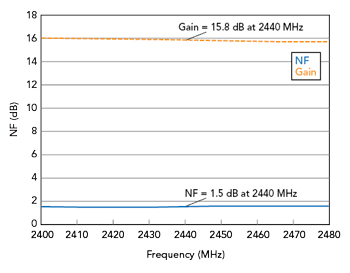
Figure 1 PE562212 LNA NF and gain.
Standard RF-SOI technology is not typically optimized to support the RF requirements needed for high performance IoT/Wi-Fi FEMs. However, pSemi has optimized its patented UltraCMOS® technology to enable performance that rivals SiGe and GaAs FEMs. UltraCMOS RF-SOI provides an alternative solution by integrating high performance RF components onto a CMOS-based platform. Traditional IoT FEM solutions use a multi-chip solution that combines a SiGe or GaAs IC for power amplification with an RF-SOI IC for low loss switching and improved receiver sensitivity. pSemi’s RF-SOI PA performance exceeds output power requirements while maintaining a competitive power-added efficiency (PAE), boasting best-in-class noise figure performance and meeting customer needs with a cost-effective CMOS-based solution. Using pSemi’s RF-SOI technology, the IoT/Wi-Fi FEM PA, LNA and switch are integrated, eliminating the need for multiple chips with different technologies. This integration capability enables pSemi to supply high performance IoT FEMs that are also the smallest on the market. Figure 1 shows the gain and noise figure for the PE562212 FEM over the 2400 to 2480 MHz frequency band.
Incumbent technologies provide solutions that have historically supported the market and are well entrenched, but they have limitations. SiGe-based PAs offer a moderate balance between performance and cost. These amplifiers provide relatively good PAE and they are widely used in low- to mid-tier IoT applications. However, their receive performance is suboptimal, impacting wireless link range and robustness. Additionally, SiGe amplifiers suffer from lower breakdown voltages, which can limit power-handling capabilities.
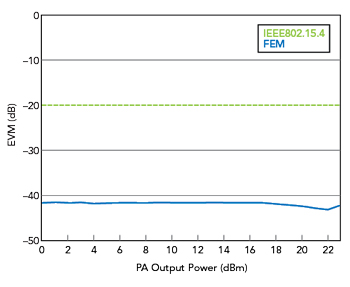
Figure 2 PE562212 EVM versus output power.
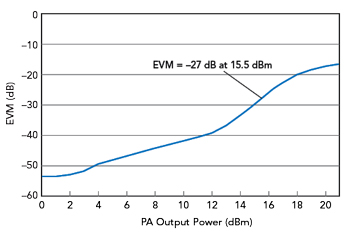
Figure 3 PE562212 EVM versus power.
GaAs PAs have long been the industry standard for high performance RF applications due to their superior linearity and efficiency. GaAs technology offers a high breakdown voltage for higher power handling, better linearity and enhanced capability in high frequency applications. Despite these advantages, GaAs is costly and it presents integration challenges that limit the adoption of this technology in cost-sensitive IoT applications.
Bulk CMOS PAs may be integrated into the system-on-chip (SoC) transceiver of the IoT device. However, these amplifiers do not provide high performance RF capability and are generally optimized for power efficiency only. The output power of these devices is often severely limited by harmonic generation that reaches the limits set by regulatory requirements and certification.
Innovations in FEM Design: pSemi’s UltraCMOS® Solution
pSemi has pioneered the development of RF-SOI-based FEMs to address the limitations of traditional amplifier technologies. The PE562212, built on pSemi’s proprietary UltraCMOS process, represents a significant advancement in IoT FEM product offerings. The PE562212 features monolithic integration incorporating a +21 dBm RF PA, an LNA with a 1.6 dB noise figure, low loss switches, a bypass path with 0.6 dB loss and harmonic/distortion filtering. It is the industry’s first multiprotocol FEM supporting Bluetooth®, Bluetooth Low Energy, Zigbee®, Thread and Wi-Fi, making it highly versatile. Transmit digital gain control ensures worldwide operability and application-specific output power requirements through 1 dB gain steps. With a form factor of 1.8 mm x 1.8 mm in a land grid array package, the PE562212 is particularly well-suited for space-constrained IoT applications. Furthermore, its superior link robustness ensures a reliable connection, minimizing excessive packet drops and improving power savings. Figure 2 shows the EVM performance of the PE562212 at different output power levels and the 802.15.4 specification for a Zigbee Thread application at 2442 MHz.
Unique to the PE562212 is its Wi-Fi capability, enabling low throughput data transfer rates of up to 54 Mbps. Low-power IoT devices benefit from extended operational life and the firmware or software can be updated to add new device features or fix bugs. The PE562212 has been carefully optimized to support protocol versatility with minimal power consumption. Figure 3 shows the EVM performance of the PE562212 over a range of output powers. The measurements in Figure 3 are in accordance with IEEE 802.11n MCS7 Wi-Fi waveform requirements at 2442 MHz.
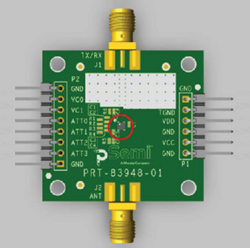
Figure 4 PE562212 mounted on EVK.
Figure 4 shows the PE562212 FEM on an evaluation kit (EVK). By leveraging their RF-SOI technology, pSemi has achieved a breakthrough in cost-performance optimization. This makes the PE562212 ideal for next-generation IoT applications.
Proven RF-SOI Leadership
pSemi’s proprietary RF-SOI technology is disrupting the existing FEM market. With over 1.5 billion FEM units shipped, pSemi has established itself as a serious contender in the IoT/Wi-Fi FEM market. For cost-effective next-generation FEM applications that require high performance, small form factor and high reliability, consider the pSemi solutions.
pSemi Corporation
San Diego, Calif.
psemi.com
For more information: psemi.com/products/front-end-modules/2-4-ghz-iot-fems/pe562212/