

Phase is a key parameter in many RF and microwave systems. Accurate phase control is essential for coaxial cables and connectors in applications ranging from radar and missile defense to satellite communication and instrumentation. Engineers can design and implement systems that achieve superior performance and reliability by understanding phase and exploring advanced cable technologies.
COAXIAL CABLE CHARACTERISTICS
Electrical length is the physical length of a cable divided by its wavelength. It varies with frequency, signal delay and physical properties like dielectric material and dimensions. While the dielectric provides stable performance, environmental factors like temperature fluctuations and physical stress can significantly impact electrical characteristics. Temperature changes primarily affect the dielectric, altering the signal propagation speed. The cable’s center conductor impacts its physical length, while the braided outer conductor has minimal influence.
Insertion loss is critical in applications requiring long-range communication or data transfer. Minimal signal loss allows the signal to travel farther before becoming unreliable.
RF coaxial cables often use PTFE dielectrics for wide operating temperatures (-50°C to 150°C) and low dielectric loss. However, PTFE exhibits a phase transition near room temperature, creating non-linear phase length variations and significant hysteresis with temperature fluctuations. These pose challenges for phase-sensitive systems in varied thermal environments. Most high-quality, high performance coaxial cables use materials with stable dielectric constants across a wide temperature range. As temperature changes, the metal conductors undergo thermal expansion/contraction. To address these issues, Times Microwave Systems has developed specialized cables using silicon dioxide and proprietary dielectrics (TF4® and TF5™) to minimize temperature-induced phase changes.
PHASE STABILITY
Phase-stable cable assemblies are crucial for increasingly sophisticated electronic systems. Phased array antennas, synthetic aperture radars and other aerospace and space applications are sensitive to phase variations. Cable assemblies form the backbone of these systems. Performance inconsistencies directly impact overall functionality and can compromise the system.
Electronically steered antennas shape the radiation pattern by manipulating phase relationships between radiating elements. Beam accuracy depends on maintaining precise phase relationships. Slight phase deviations change the pattern, hindering the antenna’s ability to track or direct signals effectively.
Accurate phase control is also critical for time-sensitive applications like GPS and radar. These systems rely on precise timing and synchronization that depend on consistent phase relationships. Components, like phase-stable cable assemblies, must be carefully managed within these complex electronic systems.
The interconnecting coaxial cables should have identical electrical lengths. In addition, ensuring consistent phase matching requires battling temperature fluctuations. Even after calibration, cables are susceptible to thermal expansion and contraction at different rates. These changes can introduce phase mismatches, degrading overall system performance.

Figure 1 PhaseTrack® family.
Mitigating temperature-induced phase mismatches requires careful cable design and phase tracking becomes crucial. Phase-matched cables minimize phase tracking variations over temperature and frequency. Variations are influenced by electrical length and operating temperature, further compounded by initial phase matching tolerances. Understanding these factors and utilizing advanced cable technologies to optimize system operation can mitigate phase instability concerns. Some members of the Times Microwave PhaseTrack® family are shown in Figure 1.
PHASE-STABLE COAXIAL CABLES
Specific cable designs can prioritize phase stability. These cables often use materials with consistent electrical properties across temperatures. Factors affecting phase stability in coaxial cables include:
- Cable Length: Physical length influences electrical length and phase shift. Longer cables introduce a larger phase shift.
- Bending: Cable bends can introduce phase variations. Tight bends or kinks can disrupt signal propagation, leading to phase inconsistencies.
- Temperature: Dielectric core material can be temperature sensitive. The dielectric’s electrical properties can change with these fluctuations, causing phase changes.
- Dielectric Material: Dielectric materials have different electrical properties. Some, like PTFE, exhibit a significant phase shift around room temperature, creating instability. Other materials, like TF4 or TF5 foam fluoropolymers, offer superior phase stability with minimal variation across a wider temperature range.
- Connectors: Design and quality impact phase stability. Loose connections or poorly designed interfaces can introduce unwanted reflections and phase changes.
- Frequency: Higher frequencies are typically more sensitive to phase variations.
Phase stability over temperature necessitates accurate phase tracking. Higher frequencies improve resolution and accuracy and amplify the importance of minimal phase change and consistent phase tracking. Phase-stable cables extend calibration intervals and reduce performance drift. The demanding nature of some applications requires robust outer jackets for abrasion resistance and double shielding to minimize signal interference in harsh environments.
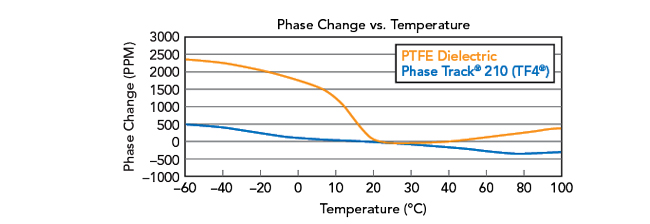
Figure 2 Phase change versus temperature.
TIMES MICROWAVE SYSTEMS ASSEMBLIES
PhaseTrack cable assemblies excel at controlling phase. These cable assemblies provide minimal phase change over temperature. The proprietary TF4 and TF5 dielectrics improve phase stability over temperature by eliminating the drastic phase change between 15 and 25°C caused by PTFE dielectrics. This performance is shown in Figure 2.
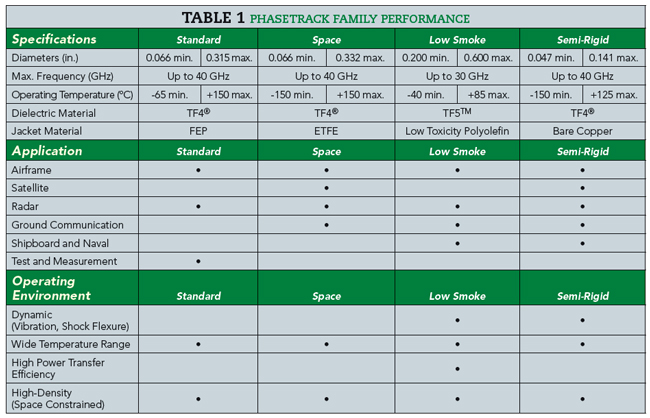
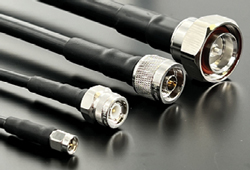
Figure 3 PTLS cables.
PhaseTrack cable assemblies have diameters from 0.047 to 0.318 in., covering a broad frequency range. PhaseTrack’s 150°C operating temperature range exceeds polyethylene (85°C), making them ideal for demanding environments. Compatibility with standard SMA, TNC, N-type, 2.92 mm and 2.4 mm connector designs enhances versatility and compatibility with a wide range of equipment. PhaseTrack caters to diverse needs with standard FEP, space-grade ETFE, low smoke zero halogen and a semi-rigid version with either copper or tin-lead plated copper tubing jacket material options. The PhaseTrack family performance is shown in Table 1. PhaseTrack low smoke cables are shown in Figure 3.
CONCLUSION
As technology advances and system requirements become increasingly stringent, the demand for phase-stable components grows. From radar and missile defense to satellite communication and instrumentation, maintaining accurate phase relationships in systems is essential. By mastering the complexities of phase management, engineers can mitigate phase instability and enhance overall system reliability by carefully selecting cable materials and minimizing environmental influences. With advanced technologies like Times Microwave’s PhaseTrack® assemblies, systems that push the boundaries of performance and innovation become possible.
Times Microwave Systems
Wallingford, Conn.
timesmicrowave.com