

The company SSB-Electronic GmbH from Lippstadt, Germany, specialized in high frequency solutions, is working with the University of Florida and supporting the team at the Precision Space Systems Laboratory (PSSL) on a new space project, the development of a special charge management device for the ESA and NASA Laser Interferometer Space Antenna (LISA) space mission. SSB-Electronic’s coaxial cables are used to evaluate conformity with the strict timing requirements of the LISA project.
LISA is the first gravitational wave observatory in space1 and one of three large-class missions in ESA’s “Cosmic Vision 2015-2025” program. The LISA mission, led by ESA, is a collaboration between ESA, NASA and an international consortium of scientists from 20 ESA member states, including the Max Planck Institute for Gravitational Physics in Hanover, DLR Institute of Space Systems in Bremen as well as numerous universities and institutes worldwide such as the University of Florida in Gainesville.2
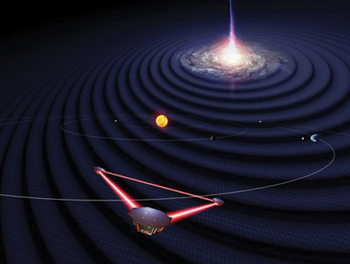
Figure 1 Artist’s rendition of LISA once deployed in orbit. Source: University of Florida
LISA will consist of three identical spacecraft, separated by 2.5 million km, which will trail the Earth on their orbit around the sun in a triangular formation (see Figure 1).3 These three spacecraft will be connected by laser beams forming a high-precision laser interferometer with millions of kilometer-long laser arms. Compared to the already existing ground-based gravitational waves observatories like Geo 600, LIGO or VIRGO,4 LISA will address the much richer frequency range between 0.1 mHz and 1 Hz, which is inaccessible on Earth due to arm-length limitations and terrestrial gravity gradient noise arising from terrestrial gravity fluctuations. These fluctuations are caused by seismic activity, atmospheric disturbances (e.g. wind, rain, cloud movement) and anthropogenic activities (industry, busy roads or train routes).4,5 From space, LISA can avoid the noise from Earth and access regions of the gravitational wave spectrum that are inaccessible from Earth due to its extremely long arms.1
The aim of the LISA mission is to complement terrestrial detectors in investigating new areas of the gravitational wave spectrum.1 Like ground-based detectors, LISA is based on heterodyne laser interferometry. The three LISA spacecraft relay laser beams back and forth between them and the signals are combined to search for gravitational wave signatures that come from distortions of spacetime. The gravitational wave sources that LISA would discover include supermassive black hole mergers, neutron star mergers and other major astrophysical events such as the Big Bang.3 Gravitational wave detection with LISA will complement our knowledge about the beginning, evolution and structure of our universe.3
The LISA mission is scheduled to be launched in 2034. From there, the LISA spacecraft will take approximately a year to reach and enter orbit around the sun and will then collect scientific data over a period of at least eight to 12 years.
The LISA mission needs many new key technologies to work including high-end optics and micro-thrusters.2 Various systems and components are being developed for the mission in numerous projects around the world. For example, the scientists of the Cluster of Excellence Quantum Universe at the University of Hamburg are working on an electronic phase measurement system, a phase meter for ultra-precise laser-based length measurements at low frequencies, as well as optical components for the ground equipment.3
Development of the Charge Management Device at the University of Florida

Figure 2 LISA charge management device prototype. Source: University of Florida.