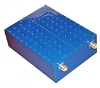
 Reactel part number 2DP-PCS-75 is a diplexer with passbands of 1850 to 1910 & 1930 to 1990 MHz. Passband insertion loss comes in at less than 1.0 dB, with a passband Return Loss of less than 16 dB, minimum channel to channel isolation of 75 dB, and is rated for input power of up to 250 W.



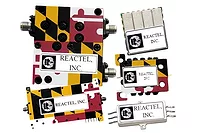


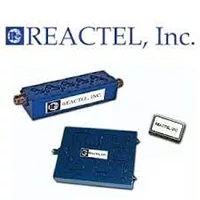

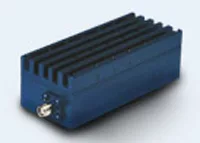
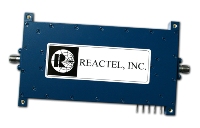 Reactel has a broad line of multifunction assemblies ranging from amplified filters and multiplexers to switched filter banks with up to 16 channels. You can place your trust in Reactel's over 35 years of experience in the design and manufacture of multifunction assemblies with Reactel to create an application specific assembly which will be the best combination of specifications, pricing and delivery.
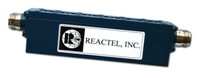 This filter has a pass band of 1217 to 1606 MHz passing GPS L1 and L2 frequencies while rejecting extremely close-in Iridium and TACAN 123X signals. Utilizing a unique approach to achieve these specs, this filter exhibits low pass band loss and a high level of unwanted signal attenuation all while offering a DC thru path via the center conductor of the RF connector pins.
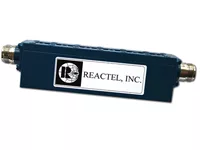
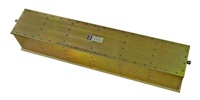 This extremely narrow band IF band pass filter is centered at 70 MHz with a 3 dB bandwidth of only 450 kHz. This unit offers 40 dB of unwanted signal attenuation only 1.2 MHz away from the center frequency and can be fitted with most any RF connector required. Reactel manufactures a wide variety of filters, multiplexers and multifunction assemblies.
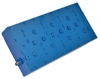 Reactel part number 22R7-1580.5-X80S11 is a highly selective cavity notch filter which eliminates GPS, GLONASS, COMPASS and BeiDou signals simultaneously while allowing a passband up to 3000 MHz.
  Reactel part number 8CX-5550-X800Q is a high frequency surface mount ceramic filter which passes 5150 to 5950 MHz with low loss and high out of band attenuation.
  Reactel part number 8CX9-2436.5-X60N11 is a bandpass filter suitable for IEEE 802.1 applications. This unit will suppress interference which is inherent in outdoor environment applications.
 Reactel manufactures filters specifically designed for MoCA 2.0 testing. Utilizing specially designed highpass and lowpass filters, these units are the perfect fit for MoCA Certification.
 With a profile of 0.12”, part number 9AM-1315-X1710M is the perfect choice for densely populated boards or portable applications. Featuring low loss, high rejection and compact size, this unit it the right combination of size and performance.
 This unit is specifically designed for use in systems utilizing the Tactical Common Data Link, Reactel part number 2DP3-14.65G/15.25G-X500/X200S11 is the right choice for harsh environments.
  Reactel manufactures filters specifically designed for PTC Systems. Utilizing specially designed bandpass filters, these units are the perfect fit for PTC systems. We have designed a number of variants of these units with differing attenuation specifications, sizes and connectors.
 Reactel part number 16CX11-752-X108N11 is another member of the growing family of 700 MHz LTE units. This particular unit is suitable for the entire 700 MHz band and is centered at 752 MHz and features low loss and high out of band attenuation.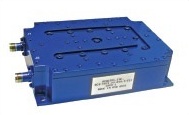
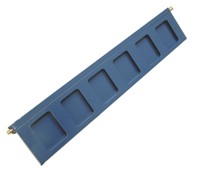 Reactel part number 4R9-2000-X4S11 is an ultra-narrowband notch filter which utilizes a unique design to achieve a bandwidth of less than 0.8 percent. Attenuation at the center of the notch approaches 90 dB while insertion loss in the passband is less than 0.75 dB.
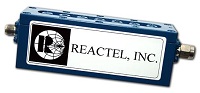 Reactel part number 5LM-X1582-T11 filter passes 1164 to 1582 MHz while holding attenuation of greater than 20 dB in the Iridium band of 1616 to 1626.5 MHz. This unit can be fitted with most any RF connector of your choosing.
 Reactel offers their flat pack combline and interdigital filters in a bandpass configuration operating in a frequency range of 2000 to 15000 MHz. These extremely small, surface mount packages are perfect for mobile or man-pack systems, and are rugged enough to withstand the harshest of environments.
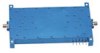 This customized four-channel switched filter bank covers the frequency range of 7 to 18 GHz. Utilizing pin diode switching techniques, it offers high channel to channel isolation while maintaining low insertion loss and fast switching speed.
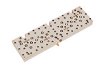 This diplexer provides 60 dB of Isolation between TX band of 5250 to 5290 MHz, and RX band of 5310 to 5350 MHz. Typical Insertion Loss is 1.5 dB with better than 17 dB of Return Loss. These units can be furnished with built in detectors.
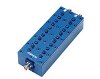 This Compact diplexer provides 60 dB of isolation between transmit and receive frequency of 1950 and 2140 MHz.
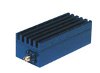 Reactel model number 7R6-269-X17S11 is a narrowband high power notch filter. The center of the notch is 269 MHz with a nominal 3 dB bandwidth of 16 MHz. Passband Insertion loss is less than 0.3 dB, notch depth is 85 dB while power handling capability is 1.
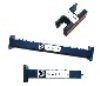 The model 4W8-9.375G-X9FS1 is a narrowband waveguide filter centered at 9.375 GHz with a minimum 1 dB passband of 9 MHz. This 0.1 percent bandwidth filter only has 1.75 dB of insertion loss and exhibits a VSWR of 1.5 or better. The unit takes up only 0.75" × 1.25" × 5.4" of space.
 Reactel part number 16R7-1270.86-X73.5S11 is a highly selective cavity notch filter. This unit is centered at 1270.86 MHz and has a nominal 3 dB bandwidth of 73.5 MHz. The notch depth is greater than 45 dB across the frequency band of CF +/- 25 MHz.
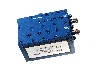 Reactel part number 2DP-925/1575-S11 is an L band diplexer. This unit has passbands of 905-925 and 1450-1700 while maintaining loss of less than 0.3 dB. This unit can withstand power of 60 W CW, has channel to channel isolation of at least 30 dB and maintains a VSWR of 1.5:1 or better.
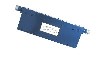 Reactel part number 6R7-1575.42-X15N11 is a highly selective cavity notch filter. This unit is centered at the GPS frequency of 1575.42 MHz and has nominal a 3 dB bandwidth of 15 MHz. The notch depth is greater than 70 dB at CF +/- 1 MHz, and has a insertion loss measuring less than 1.25 dB.
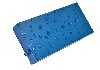 Reactel part number 7C9-2656.39-5.11S11 is a narrow band, highly selective cavity filter. This unit is centered at 2656.39 MHz and has a 3 dB bandwidth of 5.11 MHz. This filter has a rejection of greater than 45 dB at CF +/- 6 MHz Insertion loss measures less than 4 dB, and VSWR is less than 1.25:1.
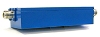 Reactel part number 10CX9-854.5-X61N11 is a CDMA Transmit band filter. This unit sized at only 2.75" high x 4.55" wide x 11.1" long has Type N Connectors, but can be fitted with most any RF connector.
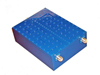 Reactel part number 2DP-AMPS-75 is a diplexer with passbands of 824 - 849 & 869 - 894 MHz. Passband insertion loss comes in at less than 1.0 dB, a passband Return Loss of less than 16 dB, minimum channel to channel isolation of 75 dB, and is rated for input power of up to 500 W.
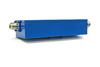 Reactel part number 8C9-836-X25N11 is an AMPS Receive band filter. This unit is centered at 836 MHz with a flat passband of 824 - 849 MHz. Passband Insertion Loss comes in at less than 1.0 dB, a passband Return Loss of greater than 16 dB and has 60 dB of attenuation at 869 - 894 MHz.
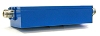 Reactel part number 8C9-1880-X60N11 is a PCS Receive band filter. This unit is centered at 1880 MHz with a flat passband of 60 MHz. Passband Insertion Loss comes in at less than 0.8 dB, with a passband Return Loss of greater than 16 dB and has 60 dB of attenuation at 1930 to 1990 MHz.
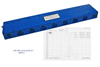 Reactel part number 9R7-1575.42-50S11 is a highly selective cavity notch filter. This unit is centered at the GPS frequency of 1575.42 MHz and has nominal a 1 dB bandwidth of 50 MHz. The notch depth is greater than 70 dB at CF +/- 25 MHz, and has a insertion loss measuring less than 0.5 dB.
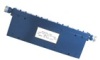 Reactel’s 6R7-1575.42-X15N11 is a highly selective notch filter. This unit is centered at the GPS frequency of 1575.42 MHz and has a nominal 3 dB bandwidth of 15 MHz. The notch depth is greater than 75 dB at CF ±1 MHz.
 Reactel part number 2DF-1227/1575-M is a moderately narrowband dual filter which passes both the L1 and L2 GPS frequencies. It is the perfect unit for applications that are utilizing both of these GPS bands simultaneously, yet can only tolerate a two port device.
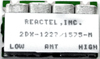 Reactel part number 2DX-1227/1575-M is a ceramic diplexer which passes both the L1 and the L2 GPS frequencies. It is the perfect unit for applications requiring small size and high performance. This ultra low profile unit features loss of less than 1 dB and isolation in excess of 40 dB.
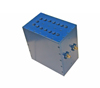 Reactel part number 8C9-438-X41S11 is a UHF band cavity bandpass filter centered at 438 MHz with a passband of 41 MHz. This unit features loss of less than 0.65 dB and rejection in excess of 40 dB at 470 MHz.
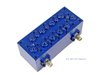 Reactel part number DF-1227/1575-S11 is a narrowband dual filter which passes both the L1 and L2 GPS frequencies. It is the perfect unit for applications that are utilizing both of these GPS bands simultaneously, yet can only tolerate a two port device.
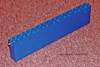 This narrowband dual notch filter attenuates both L1 and L2 GPS frequencies. It is the perfect unit for applications which need to eliminate both of these GPS bands simultaneously, yet can only tolerate a two port device.
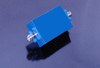 This wideband bandpass filter has a passband of 2 to 6.16 GHz. Featuring loss of 1 dB and rejection in excess of 60 dB, this tiny unit is perfect for portable or “hi-rel” applications.
 This wideband bandpass filter has a passband of 6 to 18.16 GHz. Featuring loss of 1 dB and rejection in excess of 60 dB, this tiny unit is perfect for portable or “hi-rel” applications.
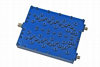 Reactel part number 2DP-EGSM-900 is a diplexer for the E-GSM Band. This unit features Passbands of 880 – 915 & 925 – 960 MHz with an in-band insertion loss of less than 1.2 dB. With 40 dB of isolation and minimum handling capability of 20 W, this unit is a great fit for your application.
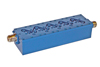 Reactel part number 8CX9-2436.5-X60N11 is a bandpass filter suitable for IEEE 802.1 applications. This unit is centered at 2436.5 MHz and has a minimum Passband of 60 MHz and insertion loss of less than 0.75 dB.
 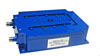 Reactel part number 6C9-1621.25-X10.5T11 is a bandpass filter for the Iridium band. This unit is specifically designed with a narrow bandwidth and high rejection to isolate Iridium frequencies from outside interference due to Inmarsat systems. This unit can be outfitted with any RF connector you may desire.
 Reactel part number 3TP-90/150-11 is a VHF LC triplexer. This unit exhibits low loss and high isolation as it splits the VHF band into three individual bands. This unit has a high power option and can be outfitted with most any RF connector you desire.
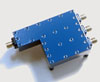 This unit exhibits low loss and high isolation as it splits the VHF band into 30-88, 100-172 & 225-400 MHz channels. This unit has a high power option and can be outfitted with most any RF connector you desire.
 This unit exhibits superior VSWR performance in both the passband (120 to 1000 MHz) and reject band (20 to 100 MHz). This high power unit offers 0.7 dB of insertion loss and greater than 70 dB of rejection.
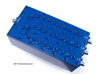 Reactel model 3TP-1176.45/1575.42-S11 is a cavity triplexer designed for all 3 GPS frequencies: L1 (New Civilian), L2 (Civilian), and L5 (Safety of Life). This unit has an insertion loss of less than 1 dB mid-band, and a high degree of band to band isolation.
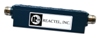 Reactel Inc.'s low frequency, high power notch filter is perfect for co-site interference applications. While this unit is centered at 434 MHz, there are many other center frequency and passband configurations available.