

 RSS
RSS
In real-world devices, signal interference can directly degrade user experience. Wireless earbuds may experience audio dropouts when Wi-Fi traffic spikes. Sending a file over Bluetooth can slow down Wi-Fi throughput. When interference increases, data packets are lost, and devices must retransmit them. These extra retransmissions use more power and drain the battery faster. Latency-sensitive applications such as online gaming may also suffer from noticeable lag and jitter. If Wi-Fi and Bluetooth coexistence is not properly managed, users may encounter reduced data rates, higher battery drain, and unpredictable latency. These issues are not isolated edge cases; they arise from the way wireless devices operate.
Today’s wireless products rarely depend on a single radio technology. Smartphones, headsets, IoT gateways, and laptops commonly operate both Wi-Fi (WLAN) and Bluetooth at the same time, typically within the 2.4 GHz band. Since these technologies share the same spectrum, coexistence challenges can arise that impact throughput, latency, reliability, and power efficiency. In addition to 2.4 GHz operation, Bluetooth is also expanding into the 6 GHz band, where it will coexist with Wi-Fi 6E and Wi-Fi 7 deployments. As more devices begin operating in this extended spectrum, new coexistence scenarios and regulatory requirements must also be considered. For system designers and algorithm developers, understanding and accurately simulating coexistence behavior across bands is therefore crucial.
Modern network simulators address this challenge by integrating detailed Wi-Fi and Bluetooth node models with realistic traffic patterns, mobility scenarios, and channel effects. Using standards-aligned path loss, fading, and interference models, simulations can provide practical and actionable insights before real-world deployment. The following sections examine common Wi-Fi and Bluetooth coexistence scenarios, evaluate their use cases, and discuss strategies to mitigate interference in shared spectrum environments.
WLAN/Bluetooth Transmitters as Interferers
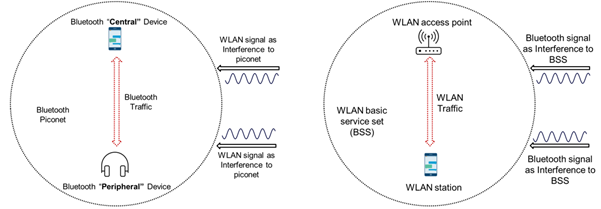
Figure 1: Bluetooth network with WLAN interference and WLAN network with Bluetooth interference. ©2026 The MathWorks, Inc.
Figure 1 illustrates a typical WLAN and Bluetooth coexistence scenario in a simulation environment. A WLAN transmitter generating periodic or random traffic can be introduced into a Bluetooth network to evaluate its impact on performance. Similarly, a Bluetooth transmitter can be added to a WLAN network to analyze interference effects and assess throughput, latency, and reliability degradation.
Study how continuous Bluetooth traffic, such as file transfer or IoT sensor data streaming, influences Wi-Fi network performance. This use case helps measure Wi-Fi throughput reduction, increased contention, and delay caused by Bluetooth interference in shared spectrum.
WLAN/Bluetooth Non-Collaborative Coexistence
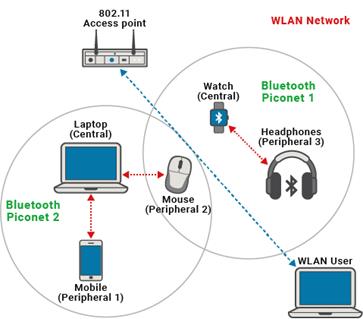
Figure 2: Bluetooth and WLAN coexistence with overlapping piconets and Wi-Fi users operating simultaneously in the same spectrum. ©2026 The MathWorks, Inc.
Figure 2 depicts Bluetooth and WLAN networks in which each node implements the complete protocol stack, representing a non-collaborative coexistence scenario where the systems operate independently. Devices such as laptops, smartphones, smartwatches, and headphones operate within overlapping coverage areas. Both networks generate their own traffic, potentially interfere with each other, and respond autonomously without coordination or cross-technology signaling.
Use Case 1: Protecting Wi-Fi Traffic from Bluetooth Interference
A laptop is connected to a Wi-Fi network for a high-definition video conference while simultaneously using a Bluetooth headset and mouse. Continuous Bluetooth transmissions can introduce interference in the shared 2.4 GHz band, increasing Wi-Fi retransmissions and causing video freezes or reduced throughput. This scenario evaluates mitigation strategies such as moving Wi-Fi traffic to 5 GHz or 6 GHz, enabling QoS prioritization for video traffic, and optimizing Bluetooth hopping behavior.
Bluetooth devices monitor channel quality, identify good and bad channels, and adapt the hopping sequence to use only good channels, updating the channel set as interference conditions change.
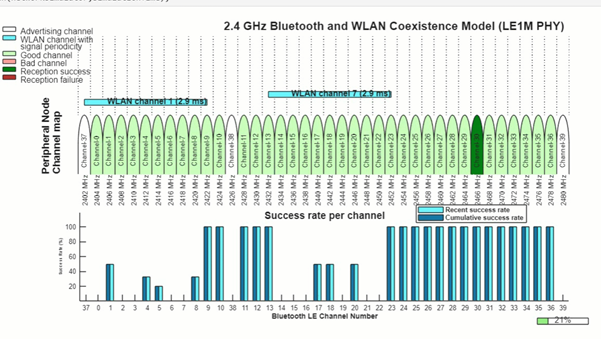
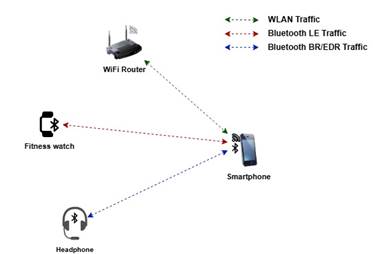
Figure 4: Bluetooth and WLAN coexistence with integrated controllers in a single chipset. ©2026 The MathWorks, Inc.
Figure 4 shows a scenario that examines coexistence when both Bluetooth and WLAN controllers are implemented within the same chipset. In such designs, the radios share hardware resources, antennas, and spectrum, enabling tighter coordination but also introducing internal contention. Simulation helps evaluate how shared scheduling, time-division multiplexing, and cross-technology signaling within the chipset can optimize throughput, reduce latency, and improve overall spectrum efficiency.
Use Case 1: Coordinated Scheduling for Stable Bluetooth Audio
A smartphone with integrated Bluetooth and WLAN controllers streams video over Wi-Fi while connected to Bluetooth earbuds. Since both radios share the same chipset, internal coordination mechanisms such as time-division multiplexing or packet traffic arbitration can be used to prioritize latency-sensitive Bluetooth audio. This use case evaluates how coordinated scheduling reduces audio dropouts, minimizes jitter, and maintains Wi-Fi throughput under simultaneous operation.
Use Case 2: Optimized Spectrum Sharing for High Data Throughput
A laptop with a single-chip Wi-Fi and Bluetooth solution performs a large Wi-Fi file download while synchronizing data with a Bluetooth peripheral such as a smartwatch. The shared chipset enables cross-technology signaling and dynamic resource allocation. This scenario analyses how intelligent coexistence algorithms balance throughput, reduce retransmissions, and improve power efficiency compared to non-coordinated operation.
In the 2.4 GHz band, Bluetooth relies on Frequency-Hopping Spread Spectrum (FHSS) to mitigate interference. However, the 6 GHz band features wider channels and stricter regulatory requirements, necessitating new coexistence strategies alongside Wi-Fi. As a result, traditional FHSS-based access is complemented or replaced by sensing-based mechanisms designed for fair and efficient spectrum sharing. Evaluating these techniques through simulation is essential to understand their impact on latency, throughput, spectrum efficiency, and reliability in dense, next-generation wireless environments.
Coexistence challenges don’t end in simulation. They scale into every next-generation wireless environment. At IMS 2026 (June 7-12, Boston, MA), MathWorks will be at Booth #18090 demonstrating exactly how the modelling and simulation workflows explored in this article come to life – from classifying coexisting wireless signals in real-time using software-defined radios and deep learning, to building RF digital twins that span antenna to bits. Workshops with industry partners will push further into 6G waveform design, AI-assisted component modelling, and phased array verification: the emerging terrain where coexistence challenges will only grow more complex. If the 2.4 GHz band keeps engineers busy today, the 6GHz band and beyond will demand even sharper tools tomorrow. Come see them in action by stopping by the MathWorks booth at IMS.
Can’t make it to IMS? To learn more about the topics covered in this Code & Waves blog and explore such designs, see the examples below or email vijayenk@mathworks.com for more information.
- Noncollaborative Coexistence of WLAN and Bluetooth (Example code): Simulate noncollaborative coexistence of Wireless Local Area Network (WLAN), Bluetooth Low Energy (LE), and Bluetooth Basic Rate / Enhanced Data Rate (BR/EDR) networks operating independently in shared spectrum.
- Collaborative Coexistence of WLAN and Bluetooth (Example code): Simulate collaborative coexistence of WLAN, Bluetooth® low energy (LE), and Bluetooth basic rate/enhanced data rate (BR/EDR) networks with physical layer (PHY) packet traffic arbitration (PTA).
- Explore Bluetooth LE and WLAN Coexistence in 6 GHz (Example Code) Simulate the noncollaborative coexistence of Bluetooth® low energy (LE) and WLAN in 6 GHz
- Coexistence Modeling (Website page): Model and simulate coexistence network scenarios that share spectrum between W-Fi and Bluetooth.