

 RSS
RSS
As cellular networks grow in scale and complexity, network simulation has become a critical step in designing, validating, and optimizing deployments before any physical hardware is installed. By modeling realistic network behavior in software, engineers can explore design choices in a cost-effective and risk-free environment, rapidly experiment with protocols, mobility, and traffic patterns, and evaluate key performance metrics such as coverage, capacity, throughput, and latency under a wide range of conditions.
For these results to be meaningful, simulations must accurately reflect real-world network behaviour. A 5G network digital twin enables scalable evaluation of complex, multi-node scenarios that are impractical to build in the real world, while also helping teams reduce time to market by identifying performance bottlenecks and design trade-offs early in the development cycle.
Modern 5G network simulators bring together detailed models of network nodes, protocols, traffic, mobility, and wireless channel effects. By incorporating 3GPP-compliant path loss, fading, and interference models, these simulators deliver realistic and actionable insights. Let’s explore how to create a 5G network digital twin that corresponds to various 3GPP-defined 5G deployment scenarios, some of which are summarized in the table below.
Scenario | Description | Inter Cell Site Distance | Deployment Focus | Key Characteristics |
Urban Macro (UMa) | Macro cells above rooftop level in dense urban areas | ~500 m | Wide-area urban coverage | High transmit power, strong inter-cell interference, high mobility |
Urban Micro (UMi) | Small cells below rooftop level (street level) | ~200 m | Urban capacity and hotspots | Dense deployment, rich multipath, street-canyon effects |
Rural Macro (RMa) | Sparse macro cells in rural environments | 1–5 km | Coverage-oriented | Large cell size, lower interference, mobility-dominated |
Indoor Hotspot (InH) | Indoor access points (offices, malls, campuses) | 20–50 m | High indoor throughput | Short range, rich multipath, low mobility |
Table 1 5G deployment scenarios by 3GPP
The 3GPP-defined 5G deployment scenarios can be modelled using single-cell, 7-cell, 19-cell, or custom layouts as shown in the figures below, to explore how a network behaves. A single-cell setup helps you understand the best-case performance without interference, a 7-cell layout shows how neighbouring cells interfere with each other, and a 19-cell layout represents a large, realistic network deployment.
Use a single-cell scenario to measure the upper bound of network performance
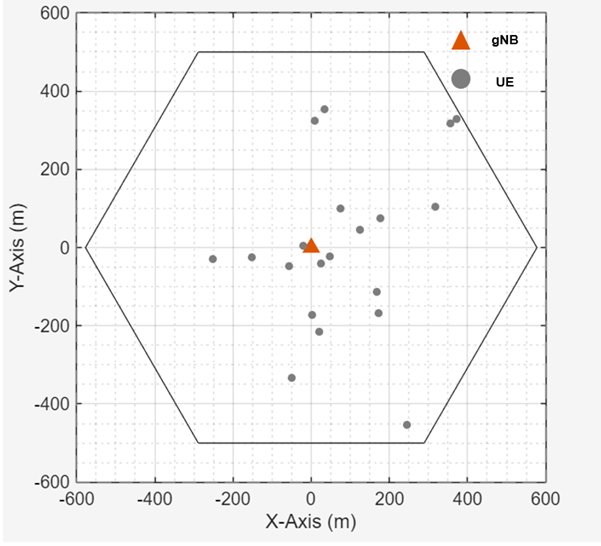
A 5G single-cell scenario is often used as a baseline to understand the upper bound of network performance without the impact of interference from neighbouring cells. It is especially useful for evaluating scheduling algorithms, link adaptation, and Modulation and Coding Scheme (MCS) selection under controlled conditions. Single-cell simulations also help study Single-User Multiple-Input Multiple-Output (SU-MIMO) and beamforming performance, as well as the impact of antenna configuration, transmit power, and channel conditions such as Line-of-Sight (LOS), Non-Line-of-Sight (NLOS), fading, and Doppler effects. Key performance indicators, including throughput, latency, and Block Error Rate (BLER), can be measured clearly. Due to their simplicity and clarity, single-cell scenarios are widely used for algorithm validation, debugging, benchmarking, and educational demonstrations before scaling to more complex multi-cell network deployments.
Use 7-cell scenarios to understand the impact of inter-cell interference on network performance

A 7-cell scenario is widely used in 5G network simulation to study the impact of inter-cell interference in a realistic yet computationally efficient way. With one central cell surrounded by six neighbouring cells, it enables clear evaluation of cell-edge performance metrics such as Signal-to-Interference-plus-Noise Ratio (SINR), throughput, and Block Error Rate (BLER). This setup is well-suited for analysing scheduler behaviour, power control, and coverage optimization, as well as for evaluating beamforming and Single-User or Multi-User Multiple-Input Multiple-Output (SU-MIMO/MU-MIMO) performance under interference. In addition, 7-cell scenarios support mobility and handover studies between adjacent cells and serve as a practical stepping stone before scaling simulations to larger multi-cell deployments, such as 19-cell layouts.
Use a 19-cell scenario to model large-scale 5G network deployments
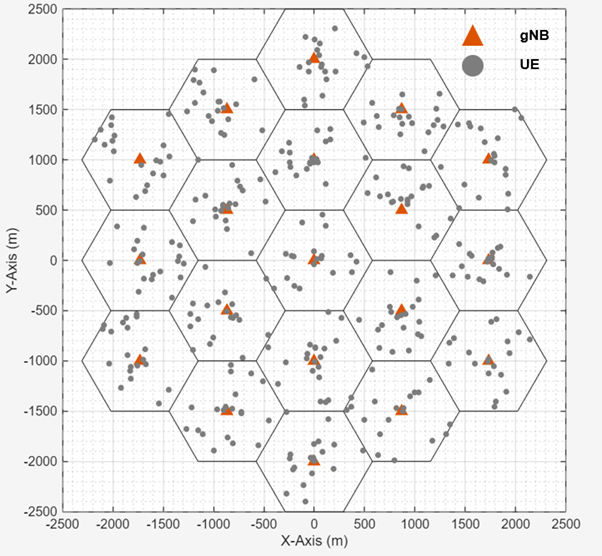
A 19-cell scenario is used when a 5G simulation needs to reflect a real, large-scale network rather than a small test setup. Surrounding each cell with multiple layers of neighbouring cells ensures interference comes from all directions, closely reflecting real-world deployments. This makes it ideal for studying cell-edge and average network performance, evaluating scheduler behaviour, power control, beamforming or Multi-User Multiple-Input Multiple-Output (MU-MIMO) performance under realistic load, and frequency planning. With techniques, such as toroidal wrap-around to remove artificial edge effects, a 19-cell layout provides a fair and consistent way to analyze mobility, handovers, and large-scale deployment trade-offs in 5G networks.
Custom deployment scenarios
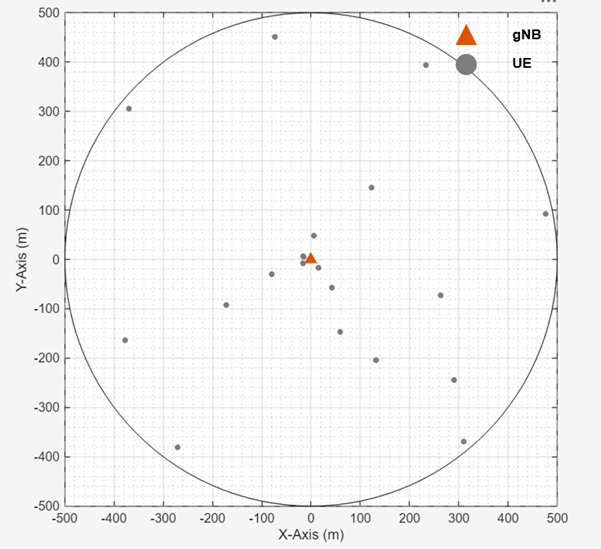
Custom 5G scenarios and custom channel models, such as ray-tracing-based propagation models, provide an intuitive way to bridge the gap between theoretical analysis and real-world network behaviour. While standardized 3GPP channel models capture average conditions, custom scenarios allow engineers to model specific environments like urban street canyons, campuses, factories, or stadiums with realistic building layouts, materials, and user mobility. Ray tracing enables precise modeling of reflections, diffractions, and blockages, making it possible to visualize how signals propagate, where coverage holes occur, and how interference is created. By combining custom deployment layouts with environment-specific channel models, engineers gain deeper intuition into site-specific performance, beamforming effectiveness, and mobility behaviour, leading to more informed design decisions and optimized 5G network deployments.
Network simulation workflow
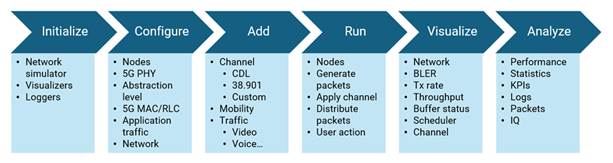
A typical network simulation workflow follows a structured sequence to ensure realistic modeling and meaningful analysis. It begins with initialization, where the simulation engine, visualizers, and loggers are launched, the engine operating as a discrete-event simulator, while visualizers and loggers provide real-time insights and data capture. Next, users configure nodes and protocol layers, defining network elements such as base stations, access points, and devices, along with parameters across the physical layer (PHY), data link, and higher layers. To reflect real-world behaviour, realistic factors like channel models, traffic patterns, and mobility are then added. The simulation is subsequently run and visualized, enabling packet generation, transmission, channel effects, and live monitoring of key performance metrics such as latency, throughput, and channel quality. Finally, users analyze results by reviewing logged statistics, packet traces, and signal samples to evaluate overall network performance. In essence, the workflow progresses through initialize, configure, add, run, visualize, and analyze, forming a complete end-to-end network simulation process.
Driving confident 5G deployment decisions with accurate simulations
Network simulation plays a foundational role in the design and evolution of modern 5G systems, enabling engineers to evaluate complex deployment scenarios long before real-world rollouts. By combining 3GPP-compliant channel models, realistic traffic and mobility patterns, and scalable multi-cell layouts, simulation provides deep insight into how networks behave under both ideal and interference-limited conditions. From single-cell baselines that establish performance upper bounds to 7-cell and 19-cell scenarios that capture inter-cell interference and large-scale dynamics, each configuration serves a distinct and complementary purpose in the network design process.
Equally important is a structured simulation workflow that includes initialize, configure, add, run, visualize, and analyze steps, ensuring repeatability, realism, and actionable results. Together, these scenarios and workflows enable the creation of accurate 5G digital twins that help identify performance bottlenecks, validate algorithms, and explore deployment trade-offs with confidence. As 5G networks continue to expand in scale and capability, simulation-driven approaches will remain essential for accelerating innovation, reducing risk, and delivering robust, high-performance wireless networks.
To learn more about the topics covered in this Code & Waves blog and explore such designs, see the examples below or email vijayenk@mathworks.com for more information.
- NR Cell Performance Evaluation with MIMO (Example code): Learn how to model a 5G New Radio (NR) cell with multiple-input multiple-output (MIMO) antenna configuration and evaluate the network performance for coverage and throughput analysis.
- NR Cell Performance with Downlink MU-MIMO (Example code): Learn how to evaluate the system performance of downlink (DL) multi-user (MU) multiple-input multiple-output (MIMO) for capacity improvement.
- NR Intercell Interference Modeling (Example code): Learn how to simulate a multicell interference scenario and measure the impact on network performance due to downlink (DL) intercell interference caused by nearby cells for frequency planning.
- System-Level Simulation (Website page): 5G NR multinode communications.