

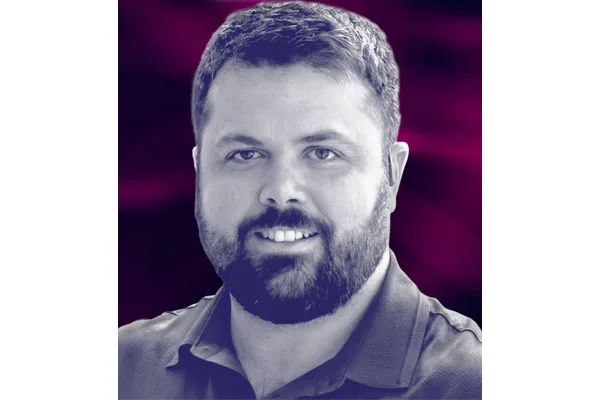
1. Cam, can you tell us about your educational and professional journey to founding LintrinsIC?
Like many founders, starting a tech company was not always the goal. In fact, I wanted to be a professional athlete. It turned out that I was a much better academic than I was an athlete, so I moved from Canada and went to Stevens Institute of Technology in Hoboken, NJ, where I played golf and studied electrical engineering. I was generally interested in semiconductors, but as I was getting ready to graduate, I was a bit disenchanted with the corporate opportunities that were available at the time. Ultimately, I was encouraged to apply to grad school and I ended up at the University of California, Santa Barbara.
At UCSB, my advisor, Jim Buckwalter, was working on a project for the DARPA signal processing at RF program (SPAR). SPAR used direct RF modulation/demodulation to achieve spread spectrum self-interference cancellation without burdening the bandwidth limitation of the conventional RF chain. To make this work, we needed modulators (essentially ring mixers with a low frequency LO) that could withstand the output power of the power amplifier. In these types of systems, the cancellation is dependent on the spreading bandwidth, so fast switching times are also highly desirable. Historically, there was a strong trade-off between switching time and power handling, especially for SOI switches, which was the technology we wanted to use given its excellent RF and digital performance. While we made good progress on improving this trade-off, we found that there was a fundamental wall that we were running into. If we were to maintain high power handling, the maximum switching (LO) frequency that we could achieve in these modulators was about half the RF frequency in our design.
While I was working on this problem, I was interested to see if we could make the LO frequency equal to or greater than the RF frequency, as we could then look at building high linearity mixers, not just modulators. Around this time, Jim introduced me to Chris Marki, who was expanding his mixer business. This made the challenge particularly interesting.
Around the time I graduated, I made a breakthrough that allowed us to build a Marki Microwave T3 mixer with integrated drivers in a silicon process. I built this mixer with GlobalFoundries 45 nm process. The fact that we were able to get this type of high linearity and broad bandwidth in a silicon process was interesting enough to catch the attention of our DARPA sponsors. They consequently recommended me to a program that they were funding, the Activate Entrepreneurship Fellowship, which funded unique ideas coming out of graduate programs in the US.
When I was accepted to the Activate program, it was clear that there was enough interest in my mixer/switch idea to start a company, so I founded LintrinsIC. For the first few years, I struggled to find the right customers. While the mixer performance was exceptional, the suitable SOI nodes are only economically viable for high volume markets. High performance mixers are typically a low volume, high margin business, which made an SOI mixer business difficult.
Eventually, we saw a few opportunities for high power switches with fast switching times. One opportunity was a topic that the Office of Naval Research put out through their SBIR program. We did some projections and found that if we were successful in achieving the program goals for this SBIR, the opportunity was larger than all the mixer opportunities that I had come across combined. Additionally, switches would be faster to develop. Armed with this information, we pivoted our focus to switches, and the rest is history.
2. What lessons have you learned as a first-time founder that you wish you had known when launching the company?
My biggest lesson learned over time is that you have no secrets if you have no customers. The risk/reward profile of telling people what you are doing, who you want to work with, and your overarching business plan is extremely favored toward reward. Sharing these details opens the door to the potential of getting highly valuable information, despite the exposure to risk of someone trying to scoop you. This is especially true for younger founders with less industry knowledge. You should only closely protect the key fundamental insight that makes your company valuable in the early days, and even those details will need to be shared, if only obfuscated, to get people to take you seriously. If your work is interesting, there are significantly more people that will try to help rather than hurt you.
3. There are a lot of switches in the market — what makes the FastSwitch™ so special, and where do you see it going?
For aerospace and defense applications, switching time, power handling, loss and size, weight, and power (SWAP) are the key metrics that everyone wants to optimize. Typically, there are strong trade-offs between these metrics, and the system designer must make compromises on at least one of the four metrics. In general, SOI has slow switching time when designed for high power, GaN has a poor Ron*Coff metric, and PIN diodes are terrible for SWAP considerations. FastSwitch™ uses a high voltage supply and unique on-chip drivers to break the conventional trade-offs in SOI design. When the switching time/power handling tradeoff is alleviated, the customer doesn’t have to compromise on any of the RF performance metrics. The only additional need is a high voltage supply — something they often have native in their systems anyway. If the switching time exceeds the speed of the customer’s needs, we can always slow it back down and trade off another variable, such as improved bandwidth or lower loss.
4. What emerging RF and microwave applications do you believe will place the greatest demands on switching technology over the next five years?
Radar and electronic warfare (EW) are the key markets, and they play off each other, always driving the demand for the highest performance system. If you make a better radar, you need to make a better EW system to counter it. This cat and mouse game will constantly drive the performance metrics of the RF front end. Additionally, the scale of the competition for spectrum dominance has rapidly increased with the advances we’ve seen with drones over the last few years. This phenomenon brings the needs for EW from a somewhat obscure field to something that everybody in aerospace and defense needs to think about.
5. Why did you sell your company to Marki Microwave, and what characteristics do you look for in strategic partners and customers as the technology gains traction?
As LintrinsIC (before the acquisition by Marki Microwave), we were able to attain a few early adopting customers and had funding from the government through our SBIR and through the Northeast Microelectronics Coalition (NEMC, part of the CHIPS act). Additionally, we had demonstrated that we could achieve the performance that we predicted, and that the business model was viable. The challenges started to shift from R&D and early pilot programs with select customers, to needing to sell our products at scale and doing extensive, and expensive, reliability testing and supply chain management.
This was going to require a new tranche of money outside of government R&D funding, and the options were to either raise money from venture capital or find a strategic parter for acquisition. While I had some success in the venture capital space, it became apparent that the strategic partner was the better choice for my style and the FastSwitch technology. More specifically, Marki was the best choice for a strategic partnership since they have existing strong supply chains and customer relationships, allowing FastSwitch to ramp production and go to market faster. Marki is also a good fit because the switch technology fills a strategic gap in its portfolio. Unlike other strategic partners we looked at, with Marki, we’re not competing internally with an existing team. With this, everyone’s incentives are aligned and I can run the business unit in a similar way to before with the benefit of a lot more resources.
6. How do you see the partnership benefiting your switch technology and business model?
Switches are complementary to a lot of components in Marki’s existing portfolio. As Marki expands product offerings beyond mixers to cover the entire transmit and receive block diagram, switches will be a key part. It also allows us to branch out beyond stand-alone switch components, to building systems with Marki’s amplifiers and filter products right away, which is very exciting from a business perspective.
7. What challenges do emerging semiconductor companies face today that weren't present even a few years ago?
The biggest thing facing new semiconductor companies right now, especially in RF, is the hype around AI. A lot of money has been diverted from important and necessary, though less exciting fields, towards blue sky AI plays. This is true in both private and public funding sources. These types of funding cycles can make it difficult if you’re trying to build a business that’s not “trendy”, but might still be a great technology or business innovation. However, I think that LintrinsIC shows that it’s still possible to run a small business on fundamentals without chasing the latest buzz.
8. What advice would you give to engineers or researchers who are considering taking their innovations from the lab to the marketplace?
I think it’s tough to give good advice without having specific context for a particular engineer or researcher and what their proposed technology is. With that said, I think it’s important to realize how much luck is involved with building a new company and having it succeed. There are always good companies and founders that fail for reasons that are external. I think that early on at LintrinsIC, we did a good job of staying grounded and setting concrete go/no go scenarios to mark progress and stay on track. When things got tough, these gates helped us stay calm and make rational decisions. We worked hard and still needed to get lucky to survive, but never leveraged ourselves in dangerous ways.
9. When you think about your legacy as a founder, what impact do you hope your work will have on the industry?
Legacy isn’t really important to me. To be honest, I don’t consider LintrinsIC a success yet, and it won’t be until we see continued success within Marki. We have been successful so far, but we still have a long way to go! Ask this question again in five years, and I might have a different answer.