

As RF systems move deeper into mmWave operating ranges, extending frequency becomes a priority. The challenge goes beyond reaching higher frequencies. It is adding that capability without increasing footprint, introducing integration risk or delaying deployment.
For many programs, the available options have been limited. Engineers can design a new board-level converter chain, which requires layout, component selection, LO distribution, power conditioning, control, monitoring, calibration, validation and obsolescence management. Another option is to use a connectorized converter box, which may simplify installation but often adds size, weight, cabling and mechanical complexity. In some cases, those modules provide only up- or down-conversion, necessitating additional hardware when both transmit and receive paths are required.
Spectrum Control’s new dual-channel up-converter and down-converter solutions offer a more compact path to mmWave frequency extension. The family supports two complete 18 to 40 GHz conversion paths within an integrated subsystem, helping engineers reduce footprint, simplify integration and shorten time to deployment.
The solutions extend Spectrum Control’s SCi Blocks™ family and address frequency conversion as a subsystem integration challenge rather than a component-level assembly exercise. Key conversion and support functions are consolidated into compact, engineered packages (see Figure 1), reducing the external circuitry, coordination and validation effort typically associated with discrete converter designs.
Dual-Channel Conversion in One Compact Package
The new dual-channel additions to the SCi Blocks frequency conversion family extend the platform’s density advantage. The dual-channel block converter family supports two complete conversion paths in a single compact package, enabling higher channel density without the footprint penalty of separate converter assemblies.
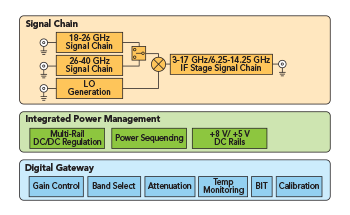
Fig. 1 Simplified block diagram showing integrated subsystem approach.
Configurations include dual Rx, dual Tx and combined Tx/Rx options. The family spans 18 to 40 GHz, including Band 1 (18 to 26 GHz) and Band 2 (26 to 40 GHz).
By integrating two conversion chains into a single miniature package, the dual-channel family helps preserve board space, simplify mechanical layouts and reduce the number of discrete RF elements required in dense VPX, VNX, airborne, shipboard, ground vehicle and payload-constrained architectures.
Two Integration Paths from One Platform
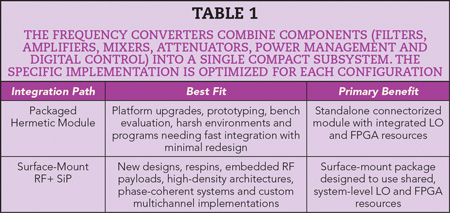
The SCi Blocks dual-channel solutions support two practical paths: a ruggedized, connectorized module for standalone deployment and a surface-mount RF+ SiP for board-level integration, design derivatives and custom assemblies (see Table 1). Both paths reflect the same design philosophy: simplify frequency extension into compact, characterized subsystems.
Path 1: Packaged Hermetic Module for Rapid Integration
For applications where PCB-based integration is not ideal, Spectrum Control offers connectorized hermetic module configurations (see Figure 2). These ruggedized modules integrate RF+ SiP technology in a hermetically sealed enclosure for use in demanding environments, prototyping, bench applications, modernization programs and platform upgrades.
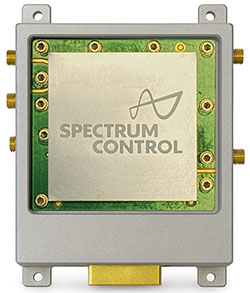
Fig. 2 The connectorized hermetic module packages RF+ SiP technology with integrated LO and FPGA resources. Note: Cover removed to show the incorporated SiP package.
The hermetic option enables drop-in integration to extend frequency coverage while minimizing changes to an existing system. RF and digital interfaces simplify integration with current cabling and subsystem layouts, while the sealed module provides environmental robustness.
Path 2: Surface-Mount RF+ SiP for Board-Level and Custom Designs
For board-level integration, Spectrum Control offers the dual-channel RF+ SiP (see Figure 3) in a compact 30 × 30 mm surface-mount BGA package. This option is intended for new designs, respins and high-density architectures, enabling direct integration of the converter onto the customer’s PCB.
The surface-mount option minimizes board area by replacing what would otherwise be a larger array of discrete mmWave converter elements. These dual-channel SiPs are especially well suited for phase-coherent, channel-dense solutions that share system-level LO and FPGA resources.
From Standard Product to Custom Integration
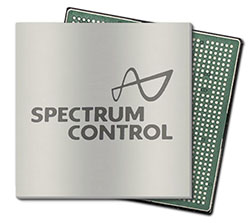
Fig. 3 Surface-mount RF+ SiP provides compact dual-channel mmWave frequency conversion with integrated power management, temperature monitoring and digital interface capability.
For many programs, a standard packaged converter offers the fastest path to deployment. It provides engineers with a compact, characterized subsystem that reduces external circuitry, simplifies integration and supports mmWave frequency extension without a ground-up RF redesign.
For broader or more specialized requirements, the same RF+ SiP-based platform can scale to design derivatives, custom integrated microwave assemblies and complete multichannel board-level solutions. Frequency plans, IF ranges, channel counts, control interfaces, power inputs and mechanical configurations can be tailored to the platform.
This gives engineers a scalable path to frequency extension: standard packaged modules for rapid deployment or custom integrated solutions built on the same miniaturization platform.
Learn More
For more details on integrated, miniaturized frequency extension solutions, including datasheets and ordering information, visit spectrumcontrol.com/freq-ext.
Spectrum Control
Fairview, Penn.
www.spectrumcontrol.com