

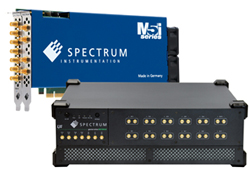
Until recently, signal generators using direct digital synthesis (DDS) technology generally fell into two groups: simple, low-cost devices suited for producing single-channel periodic signals around 10 MHz, and more expensive benchtop units capable of generating one or two signals into the GHz range.
A new offering from Spectrum Instrumentation changes this landscape. The company has added DDS capability to its entire arbitrary waveform generator (AWG) product line, which includes more than 70 different product variants. This upgrade enables multitone DDS signal generation, with multi-channel operation, reaching frequencies up to 3.9 GHz.
In DDS mode, the AWGs can generate up to 64 individual sine waves (tones) per channel. Simple commands allow each tone’s frequency, amplitude and phase to be adjusted within just a few nanoseconds. With the ability to apply frequency and amplitude slopes, along with command sequencing, it becomes easy to create waveform trains, frequency sweeps or finely tunable reference signals. These fast, straightforward waveforms enable reliable testing across a broad range of industries, including communications, medical science, lasers, quantum research, radar, LiDAR, ultrasound, sonar, automotive, aerospace, ATE, semiconductor testing, fiber optics and materials science.
Designed for automated, computer-controlled test environments, the products are offered in three popular form factors:
- PCIe cards, which plug directly into PC systems
- PXIe modules, which plug into a PXIe chassis
- LXI stand-alone instruments, which connect to any PC or network using a standard Ethernet cable.
This lineup allows users to choose the performance level they require.
At the top of the range is the 63xx series (22 models), offering 1 to 16 fully synchronized channels, output rates from 3.2 to 10 GSPS, 16-bit resolution and bandwidths up to 3.9 GHz. These units are ideal for applications in telecommunications (including 5G and radar), aerospace, quantum research and advanced test and measurement.
The 66xx series (23 models) serves the mid-range segment, with 1 to 32 channels, output rates of 625 MSPS or 1.25 GSPS, 16-bit resolution and up to 400 MHz bandwidth.
The 65xx series (32 models) is designed for general-purpose use and offers the most compact form factor. Individual cards provide one to eight channels, while complete systems support up to 128 channels. This series delivers output rates from 40 to 125 MSPS, with 16-bit resolution and up to 60 MHz bandwidth. These characteristics make them well-suited for simulating networks or automating the testing of filters and amplifiers. They are also effective when used with medical and industrial sensors, where agile frequency sources help locate resonant frequencies or compensate for system drift.
With both AWG mode (replaying waveforms from stored data) and the DDS mode (generating command-based sine waves) in one device, Spectrum Instrumentation products are versatile signal sources. The entire product family, along with the company’s extensive digitizer lineup, uses a unified software toolkit. This simplifies upgrades, model changes and system integration. All products include software support for Windows and Linux, programming examples for popular languages such as Python, MATLAB, C++ and LabVIEW and a high-level Python API. They also come with lifetime technical support directly from Spectrum’s engineers, as well as free software and firmware updates.
EXAMPLE 1: RADAR WITH BARKER CODE
This example uses the ultrafast AWGs of the 63xx series in DDS mode, with up to 64 sine waves on one output channel.
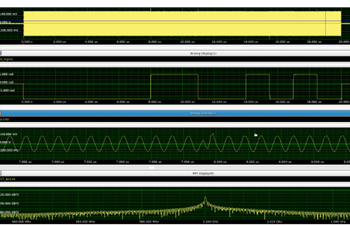
Figure 1 Radar with Barker code.
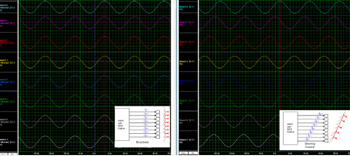
Figure 2 Focusing an antenna wavefront.
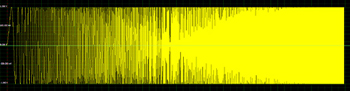
Figure 3 Vibration test.
DDS Waveform: This is a 1 GHz carrier and 20 μs radar pulse with a phase-modulated Barker code to improve the radar resolution, as shown in Figure 1. This uses a combination of both the DDS amplitude and DDS phase modulation capabilities.
Usage: Radar simulation and electronic warfare simulation, where multiple independent radar sources are required.
EXAMPLE 2: FOCUSING AN ANTENNA WAVEFRONT
Here, the AWGs of the fast 66xx series are used in DDS mode, with up to 20 sine waves on one output channel.
DDS Waveform: Multiple sine outputs are used for driving a phased array system by controlling the amplitude and phase of every individual DDS sine wave to steer or focus the wavefront of an array of antennas or transducers (see Figure 2).
Usage: Developing and testing antenna and transducer arrays, e.g., for radar or ultrasound in medical science.
EXAMPLE 3: VIBRATION TEST
For this example, the medium-speed AWGs of the 65xx series are used in DDS mode, with up to 16 sine waves on one output.
DDS Waveform: One slowly changing swept sine is generated over the range of 20 Hz to 20 kHz. Up to 16 sweeps with different frequency ranges are possible in parallel.
Usage: These sweeps are used in vibration testing for automotive and aerospace applications. An example of data from a vibration test is shown in Figure 3. A device (for example, a car) is mounted on a vibration shaker, which applies a frequency sweep to identify mechanical resonances and fatigue. In automotive testing, multitone sweeps are now standard because they significantly reduce test time. By using 10 simultaneous swept sines, each covering one-tenth of the total frequency range, the test can be completed in one-tenth of the time.
Spectrum Instrumentation’s AWGs with DDS capabilities enable multitone DDS signal generation with multi-channel operation. General DDS explanations, programming examples, details about the DDS products and product videos can be found here:
https://spectrum-instrumentation.com/support/knowledgebase/hardware_features/DDS_mode.php
Spectrum Instrumentation
Grosshansdorf, Germany
www.spectrum-instrumentation.com